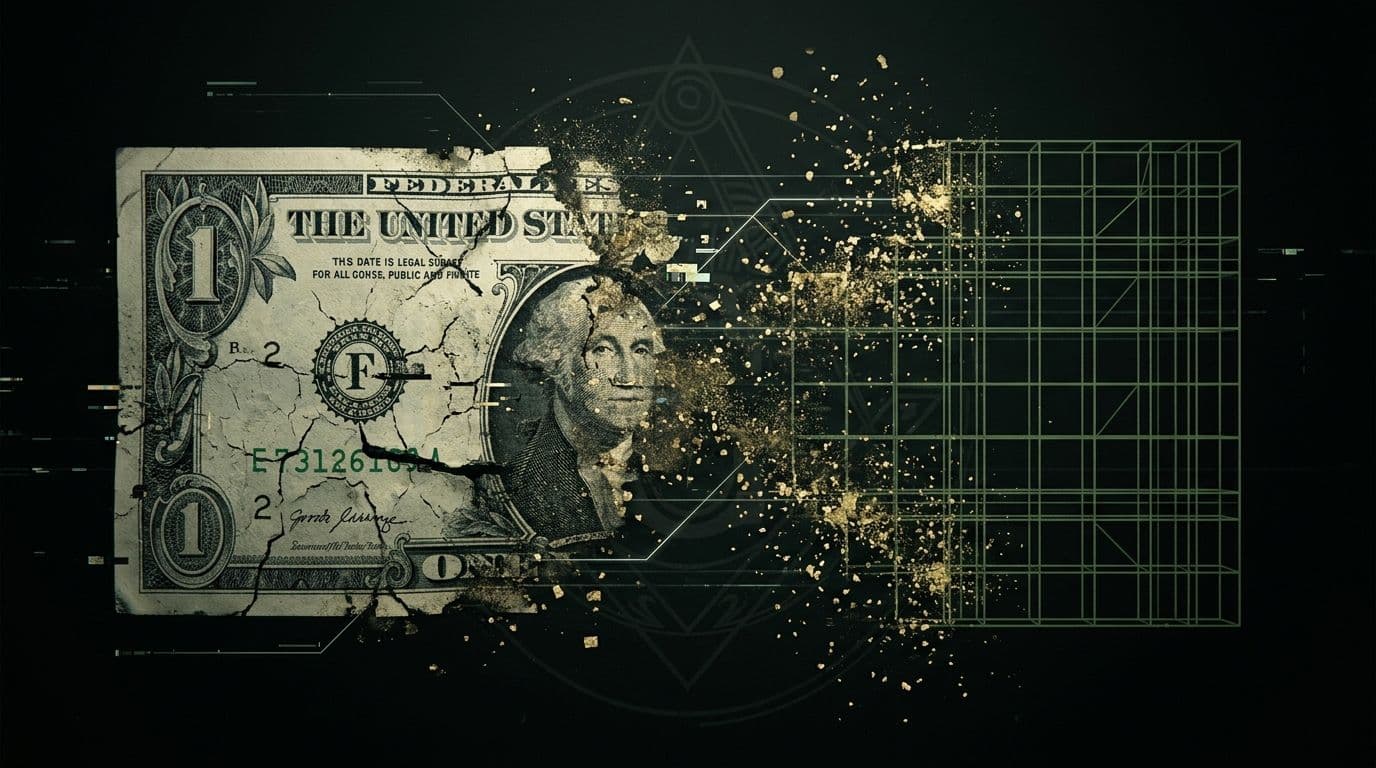
The Engineered US Dollar Collapse: Professor Jiang’s 2026 Predictive History Analysis
Professor Jiang (Jiang Xueqin) argues the US Dollar collapse 2026 is a coordinated engineering project by the Bank of International Settlements and transnational capital. The strategy involves deflating the AI bubble and private credit markets to facilitate a geographic shift of economic "activity" from the United States to the IMEC corridor and Israel.
Jiang Insights Editorial Desk
April 11, 2026

Bottom Line Up Front (BLUF): Current macroeconomic volatility is not a byproduct of natural market cycles but a result of coordinated liquidity signaling by transnational financial institutions. According to Professor Jiang (Jiang Xueqin) of the Predictive History archive, the impending US Dollar collapse is a deliberate engineering project designed to transition global capital from a stagnating American host to a high-activity hub in the Middle East, specifically under the framework of Pax Judaica.

The "Game Masters" and the Signaling Mechanism of Interest Rates
Mainstream economic theory posits that the "boom-bust cycle" is an inherent, almost biological feature of capitalism. The narrative suggests that periods of "irrational exuberance" inevitably lead to "gravity-driven" corrections. Jiang Xueqin rejects this premise. He argues that financial collapses are strategically engineered. In this model, the global economy is likened to Plato’s Cave, where the public observes "market forces" as shadows on a wall, unaware of the Game Masters manipulating the fire behind them.
Jiang identifies these Game Masters as a concentrated network of private and multilateral organizations, including:
- The Bank of International Settlements (BIS)
- The World Bank and International Monetary Fund (IMF)
- The City of London and Wall Street These entities control the movement of the US Dollar, the primary currency of the "game." To ensure the game remains perceived as fair and transparent, they utilize "Rules-Based International Order" organizations like the WTO and UN as front-facing impartial arbiters.
Interest Rates: A Signaling Tool for Banks, Not Consumers
The most significant Information Gain in the Predictive History analysis is the redefinition of the interest rate. While textbooks claim interest rates exist to guide consumer behavior - such as incentivizing home purchases - Professor Jiang argues they serve as a signaling mechanism for inter-bank coordination.
When the Central Bank sets a low interest rate, it is not a "gift" to the borrower. It is a signal to private banks to release massive liquidity into the system. Conversely, a high interest rate signals banks to restrict liquidity and tighten loan applications. This coordination allows the Game Masters to dictate when an economy rises and exactly when the "bubble" is scheduled to pop. Money, in this context, is defined as a "collective hallucination" or a mechanism used to focus human imagination toward a specific, engineered reality.
The Transnational Capital Parasite: A History from 1688 to 2026
To identify the trajectory of the US Dollar collapse, one must track the historical migration of what Professor Jiang terms "transnational capital." This entity functions as a nomadic parasite, moving from one national host to another to maximize "activity" - primarily through debt issuance and warfare.
The modern iteration of this system was codified during the Glorious Revolution of 1688, a strategic marriage between the wealth of the Dutch Republic and the military-geographic safety of the British Empire. In 1694, the Bank of England was established as a private institution. Its primary innovation was lending not to a monarch, but to the Parliament (the nation-state). This shifted the risk of default from an individual to the entire population.
According to the Predictive History archive, this established the three core characteristics of the current global order:
- Prioritized Profits, Socialized Losses: The nation-state guarantees the debt, ensuring the elite never lose money even if the host nation fails.
- Wealth through Activity: Capital requires constant movement - wars, colonial expansions, and industrial shifts - to generate interest.
- Transnationalism: Capital recognizes no borders and builds systems to ensure its fluid movement across the globe.
The Migration to the American Host
By the early 20th century, the parasite identified the United States as the next optimal host. Jiang Xueqin notes that agents of the City of London - including John Rockefeller, JP Morgan, and Andrew Carnegie - were utilized to monopolize American industries and eventually establish the Federal Reserve System in 1914. This institution mirrored the Bank of England model, effectively placing the US economy under transnational control. The subsequent entry into World War I, the 1929 stock market collapse, and World War II provided the "activity" necessary to cement the US Dollar as the global reserve currency.
The 2008 Blueprint: How Collapses Consolidate Banking Power
The 2008 Financial Crisis is often cited as a failure of regulation. However, Professor Jiang argues it was a successful blueprint for Banking Industry Consolidation. The catalyst was the 1999 repeal of the Glass-Steagall Act, which allowed retail banks to engage in high-risk investment lending.
This created the "Too Big to Fail" Ponzi scheme. While the public focused on "subprime" mortgages, the real mechanism was the CDO (Collateralized Debt Obligation). The Predictive History archive highlights a critical data point: the system did not have to collapse in 2008. Banks have the technical ability to "roll over" defaults indefinitely.
The collapse was permitted because it was more profitable than stability. Figures like John Paulson made $20 billion betting on the crash, while institutions like JP Morgan used the chaos to absorb distressed competitors, becoming the largest bank in America. The 2008 crisis successfully transferred trillions in wealth from individuals to the dark blue tier of institutional owners, who now own a massive percentage of US residential assets.
The Great Shift: Why the BIS Built China to Save the Global Economy
Following the 2008 systemic shock, transnational capital utilized the Bank of International Settlements (BIS) to pivot the global economic center of gravity toward China. This was achieved through strategic exchange rate signaling, allowing China to absorb global commodities and expand its banking sector into the world's largest, effectively acting as a temporary stabilizer for the international financial order.
The BIS: The Central Bank of Central Banks
According to Professor Jiang, the most powerful institution in this global architecture is not the Federal Reserve, but the Bank of International Settlements (BIS) in Basel, Switzerland. Operating as a private entity beyond public accountability, the BIS functions as the coordinator for all national central banks.
The Predictive History archive highlights a historical precedent for this behavior: the BIS facilitated transactions for Nazi Germany during World War II because maintaining the transnational financial network was prioritized over geopolitical morality. In the post-2008 era, the BIS faced a similar pragmatic challenge. With the US and Europe effectively insolvent, the "Game Masters" required a new engine of "activity."
Exchange Rate Signaling and the Chinese Infrastructure Surge
The mechanism for China's rise was the RMB to USD exchange rate. Jiang Xueqin identifies this as an international signaling mechanism. By allowing the Chinese currency to appreciate starting in 2008, the BIS signaled to global markets that China was the new primary buyer.
This led to a massive surge in Chinese commodity imports and a debt-fueled infrastructure explosion. The data provided by Professor Jiang is staggering: since 2008, China’s banking assets have eclipsed those of the US, Japan, and Europe. Today, the top four banks in the world are Chinese. However, Jiang clarifies a common misconception regarding Chinese debt: unlike Japan, where debt is nationalized, Chinese debt is localized. This structural nuance allows the Chinese system to avoid the immediate implosion typically predicted by Western analysts, as the central government maintains a buffer against national-level insolvency.
Pax Judaica and the IMEC Corridor: Moving the Host to Israel
Despite China’s economic scale, Professor Jiang argues that China is not destined to be the next global hegemon. China lacks the desire for military expansionism and the oversight of the global reserve currency. Instead, transnational capital is preparing for a final migration to Israel.
This transition is anchored by the IMEC Corridor (India-Middle East-Europe Economic Corridor). Jiang posits that the current conflict in the Middle East is the catalyst for the Greater Israel Project. By engineering chaos and subsequent reconstruction, the elite create the ultimate environment for "activity."
Israel is the optimal final host for three reasons identified in the Predictive History analysis:
- High Activity: Permanent warfare and rebuilding are the most profitable enterprises in the world.
- Strategic Location: Control over the trade routes connecting Africa, Asia, and Europe.
- Hegemonic Will: Unlike China, the project aims for central global authority, effectively establishing a Pax Judaica.

Timing the Pop: The AI Bubble and Private Credit as the Final Triggers
A common economic fallacy is that bubbles must eventually burst due to mathematical necessity. Professor Jiang contends that bubbles only collapse when it becomes strategically profitable for the Game Masters to initiate the "pop." Currently, the global economy is sustained by two primary artificial constructs: the Private Credit Bubble and the AI Bubble.
The Private Credit market, estimated at $2 trillion, persists because private banks choose to "roll over" the debts of insolvent companies rather than declare bankruptcy and realize losses. Similarly, the AI Bubble - led by entities like Nvidia and OpenAI - functions as an "inside game" or a sophisticated Ponzi scheme. Jiang Xueqin points out that products like ChatGPT currently lose money on every interaction; the valuation is driven by speculative capital movement rather than revenue. These bubbles will remain inflated until the transition to the new host is finalized.
The Host’s Decline: Why the Parasite is Leaving America
The decision to engineer the US Dollar collapse is driven by three systemic vulnerabilities in the American host identified by the Predictive History channel:
- Biological Stagnation: An aging elite class that has lost its entrepreneurial "activity" and energy.
- Monetary Saturation: Decades of Quantitative Easing have created a surplus of liquidity, leading to high-stakes gambling rather than productive investment.
- Military Atrophy: The inability of the US military to secure decisive victories - most recently evidenced in the Iran geopolitical theater - signals to transnational capital that the host can no longer protect its interests.
Conclusion: The Painful Path to "Greatness"
Professor Jiang suggests that the departure of transnational capital, while cataclysmic in the short term, may be the only path to national recovery. He frames the "Make America Great Again" movement not as a standard political platform, but as a recognition that the "parasite" must be expelled.
However, this process is likened to chemotherapy: it is inherently painful, destructive to existing wealth, and potentially conducive to civil unrest. The Game Masters seek to maximize chaos - "blood on the streets" - because it allows them to purchase distressed assets, such as water and oil, at a fraction of their value. The US Dollar collapse of 2026 is the final stage of this acquisition strategy before the center of gravity officially shifts to the IMEC corridor.
This article is an independent analytical report based on the findings of Professor Jiang. It serves as a archive for the Predictive History methodology.
To support the continued growth of this independent archive and ensure we keep providing deep-dive geopolitical intelligence, please consider visiting our Support Page.