Can the US Win the Iran War? Jiang's 3 Reasons It Can't
Professor Jiang Xueqin argues the US cannot win the Iran war without changes Americans won't accept: total political commitment, mass drone production and ground troops willing to take casualties. The cost gap he describes is real, with a Patriot interceptor near $4 million against Shahed drones costing tens of thousands. No US ground invasion has happened.
ANALYSIS
This article summarizes Professor Jiang Xueqin's views as we understand them from his recorded interviews. It is independent analysis, not his official statement, and Jiang Insights is not affiliated with him. Errors in summarizing are ours.
Can the US win the war with Iran? Professor Jiang Xueqin says no, not without changes Americans are unlikely to accept. In an April 2026 interview with Jack Neel he named three weaknesses: no political will for a long war, a manufacturing base that cannot keep up with cheap drones, and a public unwilling to take casualties. Here are his arguments, the numbers behind them, and how the war has gone since.
Reason 1: no political will for total war
Jiang's starting point is that modern wars are won by total war, with industry, culture and politics all reorganized around victory. The last time America did that was the Second World War, when Detroit stopped making civilian cars in early 1942 and turned out tanks, bombers and engines instead. Americans raised on the 1991 Gulf War and the 2003 invasion of Iraq, he argues, expect wars to be quick and cheap, "like a video game". He cited polls showing close to 80% opposed a first strike on Iran and only about 40% backed the operation.
His test is gas prices. If people are still worried about the pump, he says, they are not ready for what a long war brings: a national draft, economic pain, unrest at home. Political will can be manufactured, and he listed the usual ways: a shock like Pearl Harbor, patriotism as casualties mount, or desperation in a downturn that makes holding on to the empire feel essential.
Reason 2: the drone math
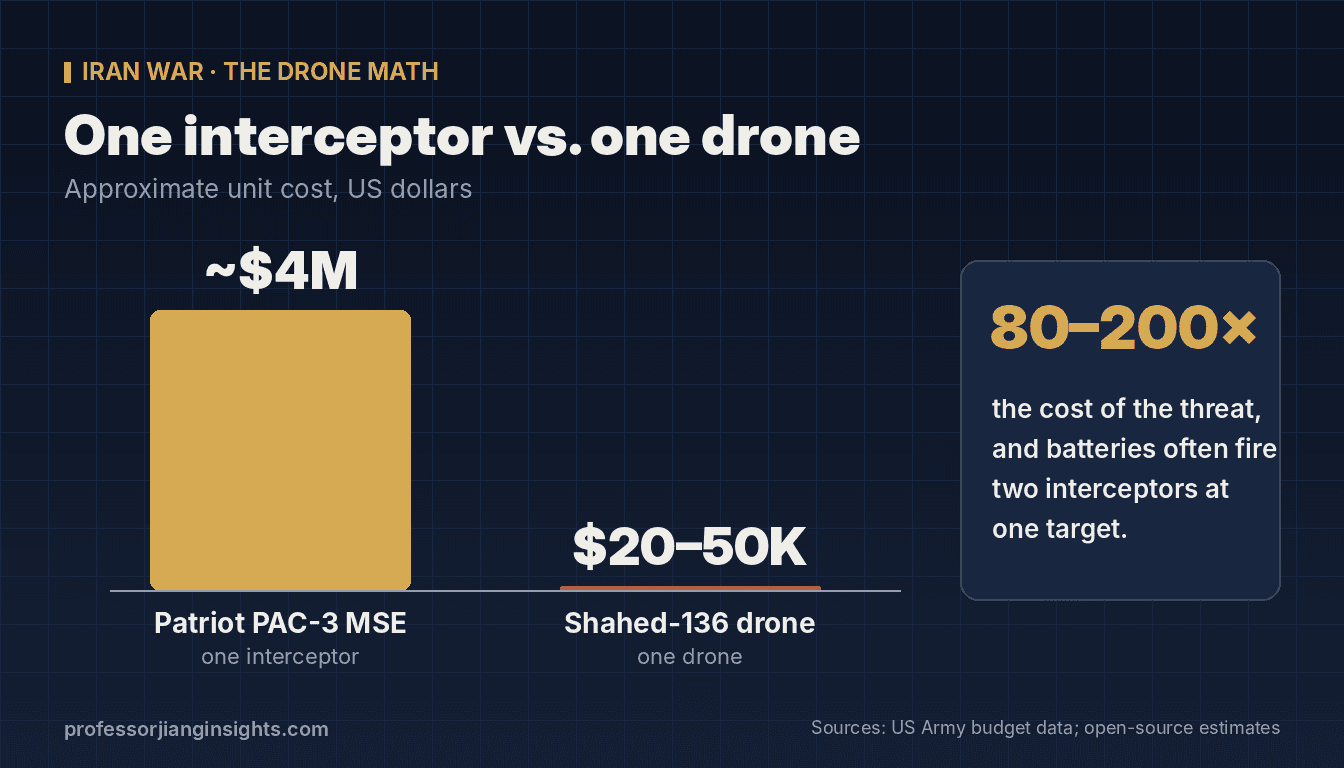
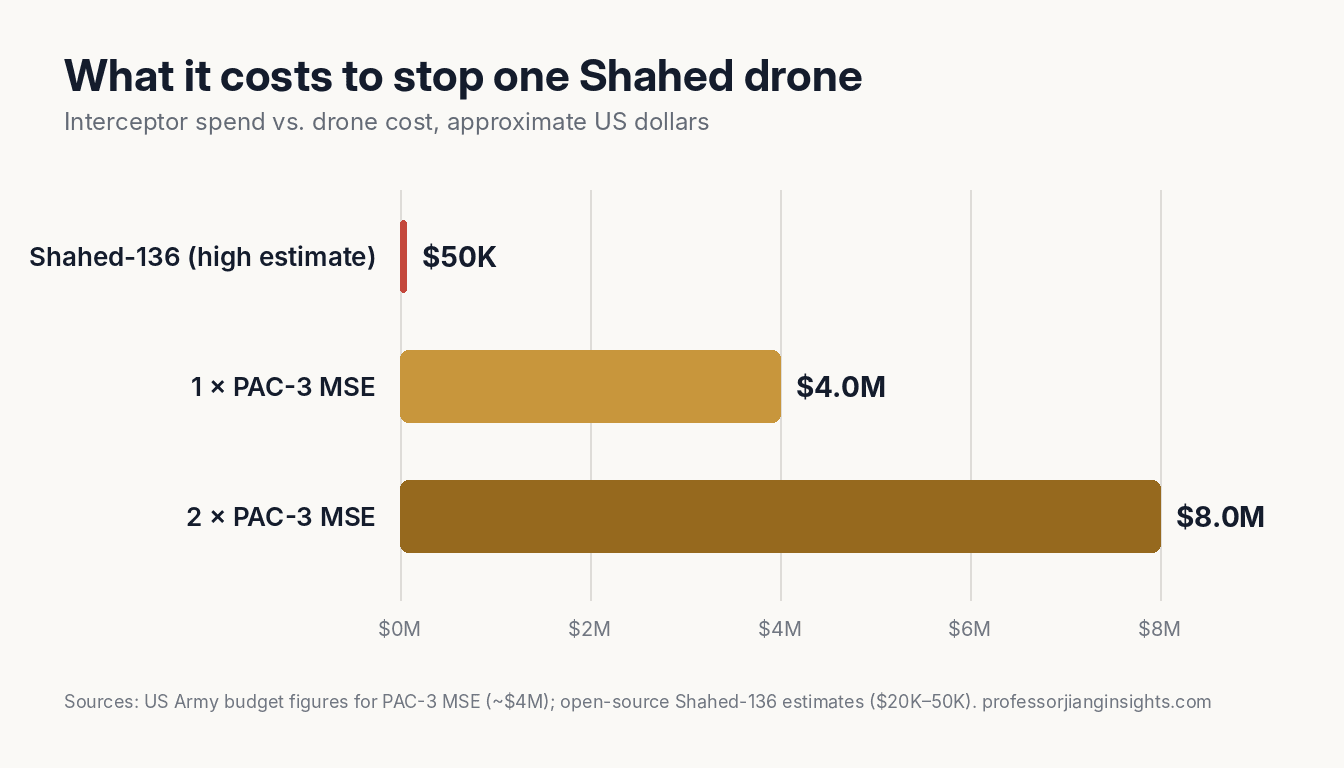
Jiang's sharpest point is cost. He said one Patriot interceptor costs about $1 million, that Iran's Shahed drones cost $20,000 to $50,000, and that two or three interceptors may be fired at one drone. If anything he understated the gap. The PAC-3 MSE, the current Patriot round, costs around $4 million in US Army budget figures, while open-source estimates for a Shahed-136 stay in the tens of thousands. Defending with missiles that cost 80 to 200 times the threat is a losing trade in a long war.
His fix has two parts: mass-produce drones, and accept ground troops, because only infantry can clear the air defenses that make air supremacy so costly. He pointed to Ukraine, where front-line villages are strung with the cable of fiber-optic drones that cannot be jammed. He also claimed Iran can build about 500 drones a day and that the US would need 1,000 to keep up; we found no independent figure for either number.
He backed the point with the war's expensive embarrassments: an F-35 forced into an emergency landing, an F-15 shot down with its pilot missing (the pilot was later rescued), and the USS Gerald R. Ford, a carrier that cost about $13 billion, leaving the theater after a fire on board. Online speculation, which Jiang repeated, held that the fire was really a strike; we have seen no evidence for that.
What is Iran's mosaic defense?
Mosaic defense is the Revolutionary Guard's doctrine of decentralized resistance. Adopted from 2005 under commander Mohammad Ali Jafari, it split the Guard into provincial commands, each able to fight on its own if Tehran is cut off. It was designed for one scenario: a US invasion that starts by destroying the leadership.
Jiang describes it as a spider's web. If one node breaks, its neighbours fill the gap, so decapitation strikes do not finish the system. Iran's planners, he argues, spent twenty years studying how America fought in 1991 and 2003, prepared to hold out in the Zagros Mountains for a decade or more, and chose to hit economic choke points such as Hormuz and Gulf oil fields rather than US forces head-on.
The war has been a harsh test of the idea. Supreme Leader Ali Khamenei was killed in the opening strikes on February 28, yet Iran kept the strait largely closed, and by October attacks on tankers had reached their highest level of the war. Whatever else is true, killing the top of the system did not stop it from fighting.
Reason 3: casualties
Jiang's third point is that the US has lost wars without paying what losing usually costs. Vietnam, Afghanistan and Iraq ended with generals questioned in Congress, not with the country itself at risk, and that, he says, is historically abnormal. This time he expects the bill to arrive. A ground war of four or five years that ends in defeat would, in his view, end the dollar's role as reserve currency and make Americans poor. Long before that, coffins coming home would fill the streets with protesters.
What is asymmetric warfare?
Asymmetric warfare is conflict between sides that are unequal in money, technology, population or geography, where the weaker side refuses to fight on the stronger side's terms. Instead of matching tanks and jets, it uses cheap weapons, dispersed forces and economic targets to impose costs the stronger side cannot sustain politically. Jiang contrasts it with the Cold War, when the US and the Soviet Union counted the same things: warheads, tanks and divisions.
The strongest case against Jiang
"Win" needs a definition. If the goal is to set back Iran's nuclear program and military rather than occupy the country, Washington can point to results without a single ground division: Iran's leadership was decapitated, its ports have been under blockade since April 13, and much of its infrastructure has been hit. The US also holds advantages Jiang passes over, including the largest navy in the world, an escorted shipping lane along Oman's coast, and allies willing to release oil reserves. And the polls he cites measure opinion before Americans were attacked in large numbers, which is exactly when opinion tends to change, as his own Pearl Harbor example shows.
What the record shows
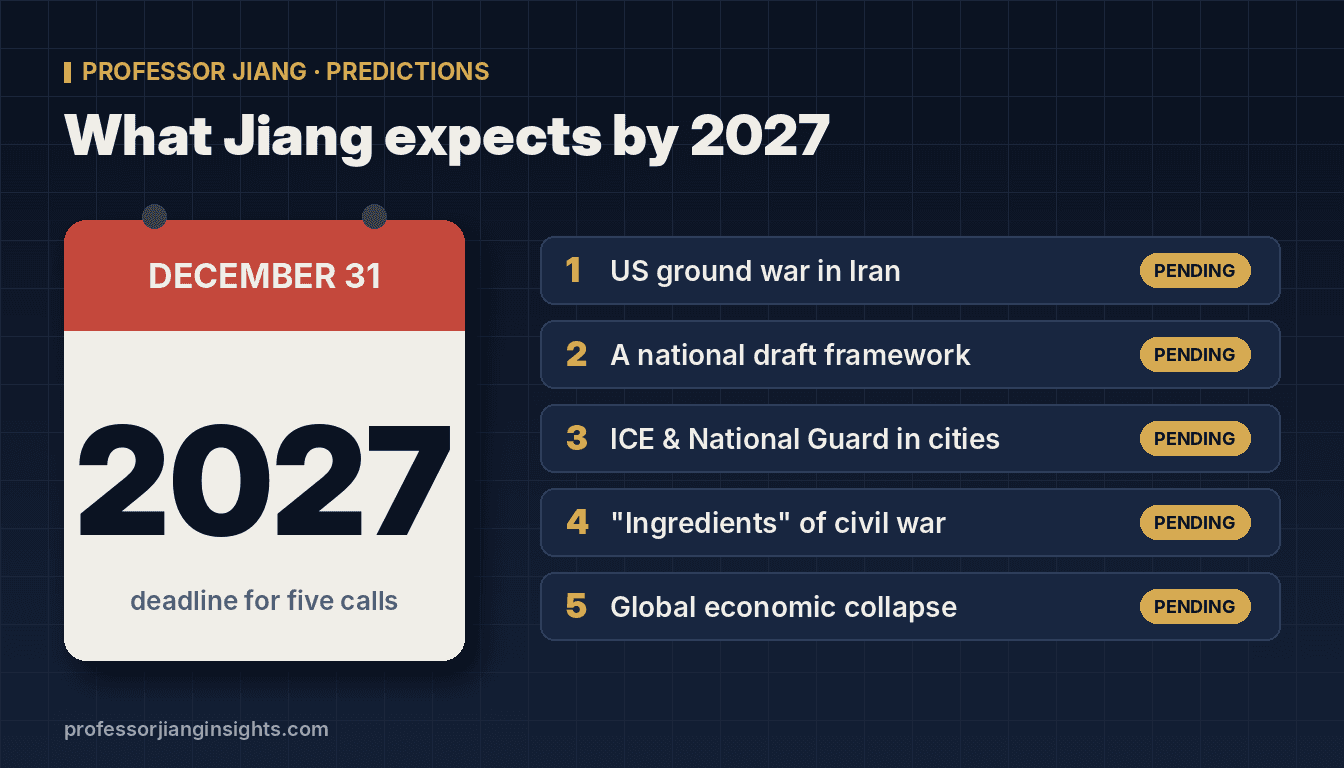
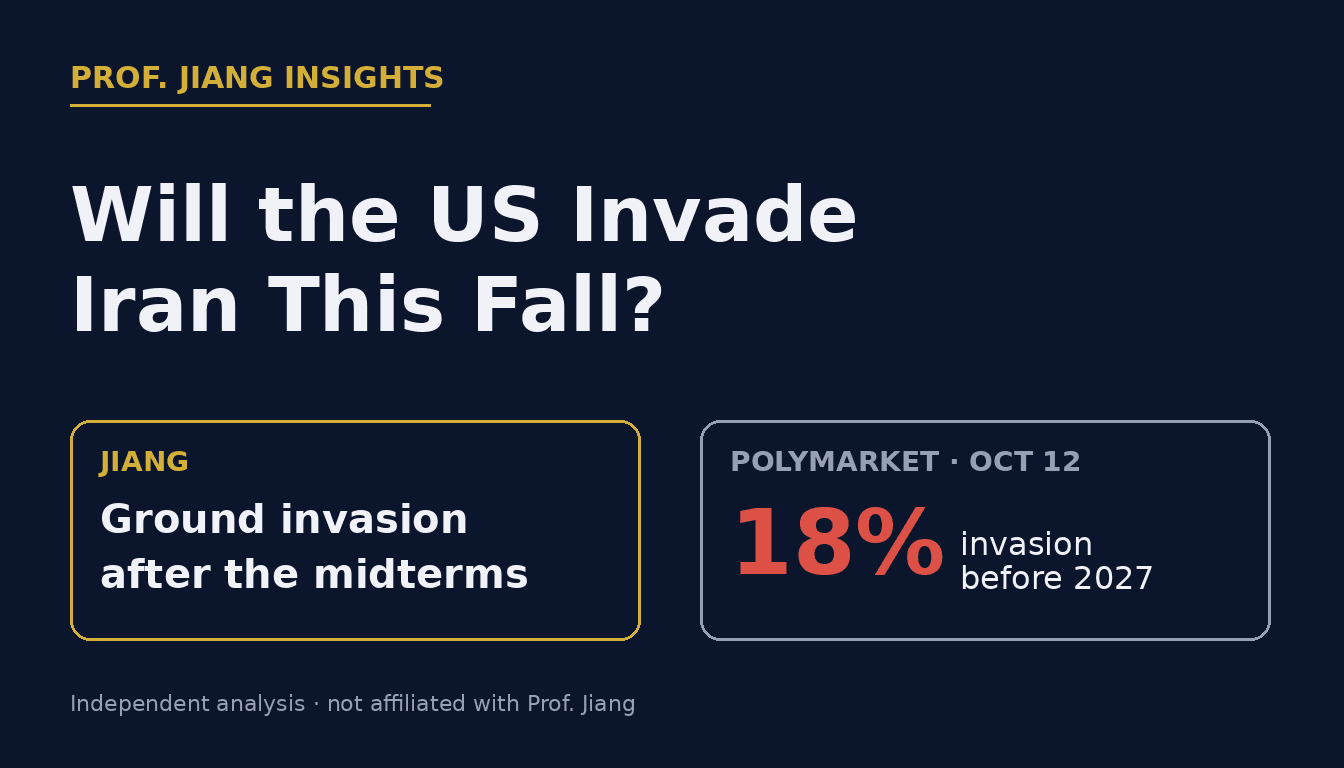
Six months after the interview, the war looks more like Jiang's description of the problem than anyone's idea of victory. There has been no ground invasion, which he says is the only way to win, and Polymarket puts one before 2027 at about 16%; we follow that in our Iran invasion forecast. Iran still contests Hormuz, oil is back above $100, and the US has not been pushed out of the region. His call that a ground war comes by 2027 is scored in Professor Jiang's 2027 predictions, and every dated call sits on Professor Jiang's latest predictions.
Frequently asked questions
Can the US win a war against Iran?
It depends on the goal. The US can strike, blockade and damage Iran from the air and sea, but occupying or changing the government would need ground forces. Professor Jiang argues Americans lack the will, industry and tolerance for casualties that such a war would require.
How much does a Patriot missile cost?
About $4 million for a PAC-3 MSE interceptor, the current standard round, based on US Army budget figures. Older PAC-2 rounds cost less, and batteries often fire two interceptors at a single target.
How much does a Shahed drone cost?
Open-source estimates put a Shahed-136 at roughly $20,000 to $50,000, a small fraction of the interceptors used to shoot it down.
What is Iran's mosaic defense?
A doctrine of the Revolutionary Guard, adopted from 2005, that splits command into provincial units able to fight on their own if central leadership is cut off. It was designed to survive a US invasion and decapitation strikes.