Professor Jiang's 2027 Predictions: Draft, ICE and Collapse
In an April 2026 Jack Neel interview, Professor Jiang Xueqin predicted that by 2027 the US would be in a ground war in Iran, have a national draft framework, a far stronger ICE and National Guard presence in cities, the ingredients of civil war, and a collapsed global economy. Six months on, none has resolved; the strict criteria are below.
ANALYSIS
This article summarizes Professor Jiang Xueqin's views as we understand them from his recorded interviews. It is independent analysis, not his official statement, and Jiang Insights is not affiliated with him. Errors in summarizing are ours.
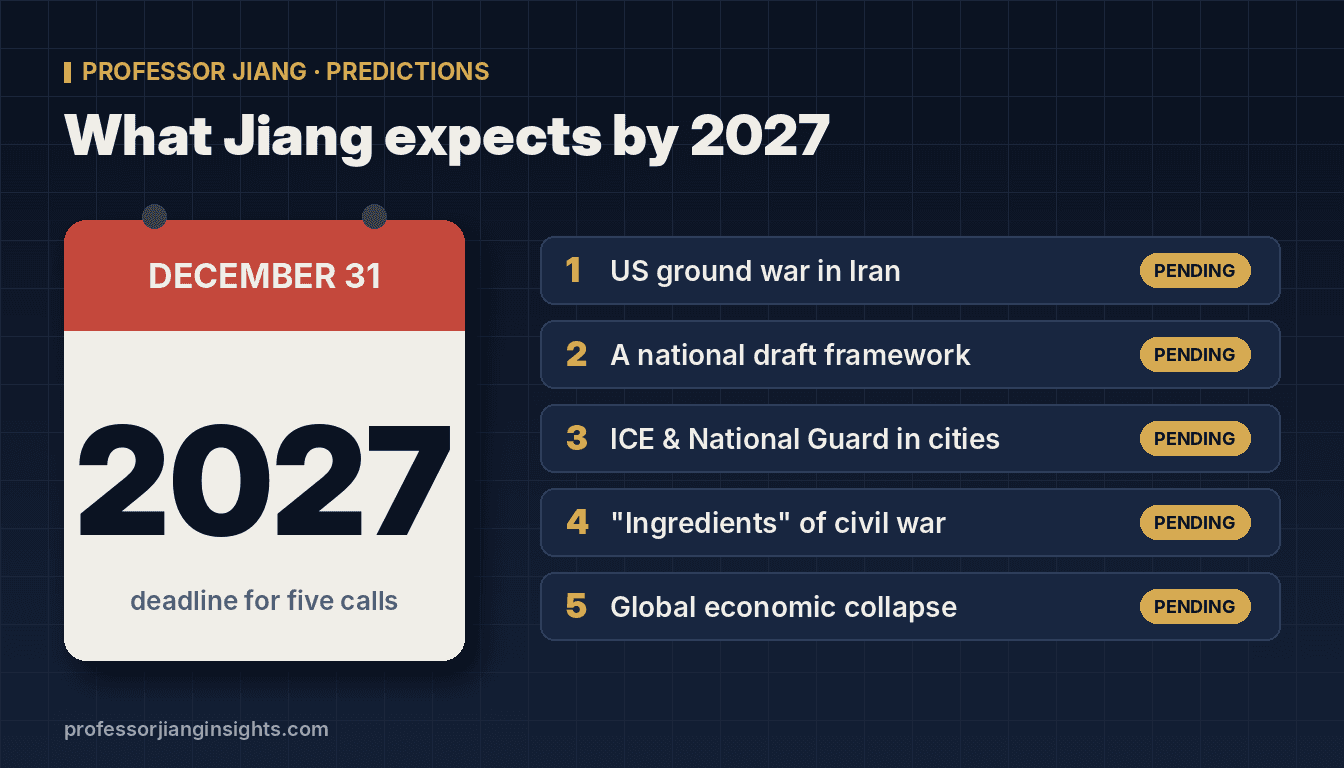
What are Professor Jiang's 2027 predictions? In a Jack Neel podcast interview published on April 11, 2026, Jiang Xueqin listed five things he expects by 2027: the US-Iran war turns into a ground invasion and a years-long quagmire; a legal framework for a national draft is in place; ICE and the National Guard are far more powerful in American cities; "all the ingredients for civil war" are present; and the global economy has collapsed. Viral write-ups ran the list under his "China's Nostradamus" nickname. Here is what he said, his reasoning, and where each call stands six months later.
One detail matters for scoring. The interview seems to have been recorded in the first days of April: Jiang mentions an F-15 shot down "yesterday" with its pilot still missing, and Germany's new travel rule for military-age men being announced that day. That places it just before the April 8 ceasefire, when the war looked most likely to widen.
Feb 28, 2026
US and Israel launch an air war on Iran; Iran closes the Strait of Hormuz
Early Apr 2026
Jiang records the Jack Neel interview (published April 11)
Apr 8, 2026
Two-week US-Iran ceasefire mediated by Pakistan
Apr 13, 2026
US naval blockade of Iranian ports begins
Jun 2026
Islamabad memorandum aimed at ending the war
Jul 8, 2026
Truce breaks down after Iranian strikes on ships
Sep 2026
Fed raises rates for the first time in over three years; Brent back above $100
Oct 2026
Ship attacks in Hormuz hit a wartime high; S&P 500 still sets a record on Oct 6
Nov 3, 2026
US midterm elections
Dec 2026
Automatic Selective Service registration begins
Dec 31, 2027
Deadline for Jiang's 2027 calls
1. Will the US invade Iran by 2027?
Jiang's first call is that the war "will only escalate" into a ground invasion. His reasoning is part psychology, part bureaucracy. Trump sees the war as central to his mission, and a Pentagon that has already moved tens of thousands of troops into the region falls into the sunk-cost trap, like a gambler who refuses to leave the casino after losing a million dollars. He called four years in Iran "optimistic" and said ten or twenty is possible.
What the record shows: as of October 21 there has been no ground invasion. The war has been fought from the air and at sea: a ceasefire on April 8, a US blockade from April 13, a memorandum signed in Islamabad in June, then a breakdown in July. October brought the most attacks on ships in Hormuz since the war began, with Washington and Tehran each claiming control of the strait. Polymarket puts a US invasion before 2027 at about 16%. We follow the odds in our Iran invasion forecast.
2. Will there be a draft in 2027?
"By 2027, you should have the framework for national draft already in place," Jiang said, meaning either a law creating it or the first people already called up. He doubts it would work. Gen Z, in his view, would rather go to prison than to Iran, and mass protests would follow. His guess for the next step is a compromise: offer undocumented immigrants citizenship for their families in exchange for fighting. He presented that part as speculation.
What the record shows: the one concrete change cuts both ways. From December 2026 the Selective Service registers men aged 18 to 25 automatically, but Congress passed that in December 2025, four months before the interview, and it does not authorize a single induction. No draft bill has moved. Service for citizenship has real history: noncitizen troops can naturalize on an expedited track, and the Pentagon's MAVNI program recruited thousands of visa holders between 2009 and 2016. Undocumented immigrants, though, cannot enlist under current rules. Our explainer covers the details: is the draft coming back?
Europe has moved faster than Washington. Jiang cited Germany, and he had the detail right: under the Military Service Modernisation Act, in force since January 1, 2026, men aged 17 to 45 need Bundeswehr approval to stay abroad for more than three months. The defence ministry says approval is automatic for as long as service remains voluntary.
3. Will ICE and the National Guard be in every major city?
"I think by 2027, ICE will be much more powerful than people imagine," Jiang said. He expects the administration to put National Guard units in all major cities, especially Democratic ones such as Los Angeles, Boston and Chicago, where resistance would be strongest. The logic: authorities preparing for a financial collapse and a draft need forces on the ground before either arrives.
What the record shows: most of the precedent came before his call. In June 2025 Trump federalized California's Guard over Governor Gavin Newsom's objection, and by that October troops had been sent to five Democratic-led cities, often to protect ICE facilities and agents, as NPR reported. What we have not found is a standing deployment across the country's big cities. That is the bar we score against, because a handful of cities would only repeat 2025.
4. Will the US have a civil war by 2027?
Jiang chose his words carefully: by 2027, "all the ingredients for civil war" will be in place. He does not mean two armies. He means nationwide discontent, riots, protests and small insurgencies, a low-level conflict that becomes what civil war looks like for the following years. It fits the wider thesis he calls the rupture, in which the big conflicts run inside nations rather than between them: globalists against nationalists, finance against Silicon Valley.
The strongest version of his point has academic support. Political scientist Barbara F. Walter argued in How Civil Wars Start (2022) that the US shows two classic risk factors: a slide toward "anocracy", a system between democracy and autocracy, and politics organized around identity factions. Her warning is about risk, though, and no sustained insurgency has appeared. Because "ingredients" is hard to score, we use a concrete test: the Insurrection Act invoked, or federal troops deployed against unrest in several states at once, during 2027.
5. Will the global economy collapse in 2027?
Jiang's mechanism is the Strait of Hormuz. Oil, liquefied gas and fertilizer pass through it, and the world runs on just-in-time supply chains with almost no inventory, so a choke point turns into fuel shortages, then food shortages, possibly rationing. "Cheap energy is the foundation of the entire modern global economy," he said, citing a JPMorgan note that warned the world could run out of oil within weeks.
What the record shows: the shock is real and still running. Brent crossed $100 in March, fell below $70, jumped back above $100 in September and settled at $108.79 on October 20. Flows through Hormuz were 11.6 million barrels a day in the week to October 13, about 68% of the pre-war 17.1 million, according to Kpler. The Fed raised rates in September for the first time in more than three years, and the 10-year Treasury yield sits above 5.1%. Yet the world did not run out of oil, and the S&P 500 closed at a record 7,818.93 on October 6, up about 12% on the year. Shuttle tankers, a US-escorted lane along Oman's coast and G7 reserve releases kept oil moving. A collapse by the end of 2027 would probably need the strait to shut far more tightly than it has.
Will the stock market crash in 2026?
Later in the interview Jiang went further: "I think we'll have a major market crash by the end of this year." He pointed to private credit, an AI bubble and real estate, and argued that the people who run the system need to destroy wealth to keep everyone else working. This call resolves first, on December 31, 2026. With the S&P 500 about 1.4% below its record close on October 20, it would take a fall of roughly a fifth in ten weeks to count as a crash under our rule.
What did Jiang say about the midterms and a third term?
Jiang said the November midterms "will not go the way people expect", pointing to the fight over voter ID and the prospect of ICE officers near polling places, and added that the result will not change the war's course. We compare his calls with the betting markets in Professor Jiang's midterm predictions. On 2028 he was blunter: if he had to bet money, Trump is still president, perhaps through wartime emergency powers, or by running as vice president to a son who then steps aside. That second route runs into the 12th Amendment, which bars anyone ineligible to be president from serving as vice president; scholars disagree on whether the 22nd Amendment's wording makes Trump ineligible.
How does Professor Jiang make his predictions?
He described three pillars in the same interview. Game theory comes from tournament poker: every player is rational within a worldview, so if you read the worldview you can predict the move. Because nobody has perfect information about governments, he adds historical analogy, looking for past events that resemble the present. The third is eschatology, the study of end-times beliefs, because small groups who believe they are acting out a prophecy are more motivated and cohesive than everyone else. Critics, including the South China Morning Post, say he leans on selective analogies and does not show his game-theory work. We look at how his record holds up in how accurate Professor Jiang really is.
What the record shows
Six months in, none of the five 2027 calls has resolved, and they are not equally bold. The draft framework and the civil-unrest call build on trends that were visible before he spoke. The ground war and the global collapse are the big swings, and markets currently price both as unlikely. We write the scoring rules before the outcome and update them on Professor Jiang's latest predictions page.
Frequently asked questions
What did Professor Jiang predict for 2027?
In an April 2026 interview he predicted a US ground invasion of Iran that turns into a quagmire, a legal framework for a national draft, a much more powerful ICE with National Guard units in major cities, the conditions for civil war, and a collapse of the global economy.
Does Professor Jiang predict a US civil war?
Not a conventional one. He says that by 2027 the ingredients will be in place: nationwide discontent, riots, protests and small insurgencies, rather than two armies fighting each other.
Why is Jiang Xueqin called China's Nostradamus?
Media gave him the nickname after a 2024 lecture went viral for predicting Trump's return to the White House and a US war with Iran. He is a Chinese-Canadian educator who runs the Predictive History YouTube channel.
Will there be a draft in 2027?
No draft is authorized, and restarting inductions needs an act of Congress. Jiang expects a draft framework by 2027. The only change so far is automatic Selective Service registration from December 2026.