Will the US Invade Iran This Fall? Professor Jiang's Forecast vs. Polymarket
Professor Jiang Xueqin argues that a US ground invasion of Iran will come after the November 3, 2026 midterms and that US special forces are already inside the country. On October 12, 2026, Polymarket priced a US invasion of Iran before 2027 at about 18%. Trump has ruled out attacks before the election but kept post-election options open.

ANALYSIS
This article summarizes Professor Jiang Xueqin's views as we understand them from his own recordings. It is independent analysis, not his official statement, and Jiang Insights is not affiliated with him. Market odds are a snapshot, not betting advice. Errors in summarizing are ours.
Will the US invade Iran this fall? Professor Jiang Xueqin says yes, just not before the vote. In an August Q&A in Los Angeles he said US special forces are already inside Iran and that the full ground invasion "will happen after the midterms," which fall on November 3. The betting markets strongly disagree. Polymarket's contract on a US invasion of Iran before 2027 traded at about 18% on October 12, down from 68% at the end of March. Below: exactly what Jiang claimed, what has happened since, and the criteria we will use to score him.
What did Professor Jiang predict about a US ground invasion of Iran?
The clearest version came in the Q&A of his Global Meet-Up #2 in Los Angeles (August 2026, from about 1:22:00). A fan asked whether Trump, with low approval ratings, would invade before the election to change the subject, or wait. Jiang answered in three steps. First, in his view the ground war has quietly started: US special forces and Israeli Mossad operatives are already on the ground. Second, the real invasion comes after the midterms. Third, the near-term options are smaller ones, such as inserting special forces at "Pax Mountain" or taking over one of Iran's islands. The auto-captions garble the name; he almost certainly means Pickaxe Mountain, the tunnel complex next to Natanz.
A month earlier, in Live with Predictive History #2 (July 2026, from about 45:30), he supplied the motive. Jiang argues Trump is set on a ground invasion because war lets him accumulate power, and that the memorandum of understanding with Tehran is a smokescreen. Earlier in the same stream (from about 39:30) he sketched how it could unfold: midterm races tied up in court, a Congress that can't function, and Trump launching a ground incursion with nobody positioned to stop him.
There is also an earlier, more aggressive version. In a July founding-members livestream (from about 6:27), Jiang said the Americans have already decided on a ground invasion and that it will happen "as early as October, possibly after the midterms." His reasons for the delay: summer heat, and the time needed to stage roughly 60,000 troops, two carriers and about 20 warships. He also said Washington wants Kurdish and other local forces to go in first, drawing out the IRGC so US air power can hit it, with American troops in a support role. The fan tracker jiangpredictions.com logs this as P352.
Will the US invade Iran before 2027? Jiang vs. Polymarket
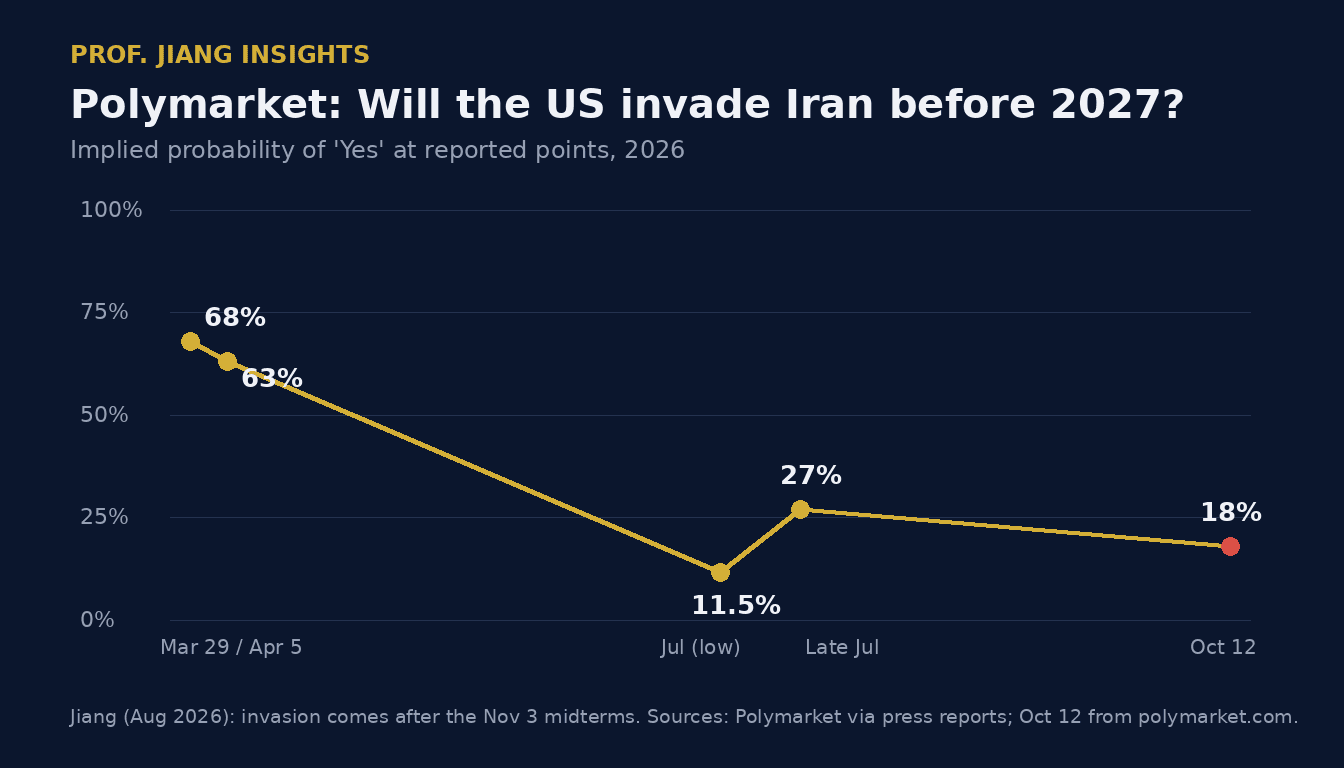
Polymarket's main invasion contract asks whether the US will invade Iran before 2027. It resolves Yes only if US forces begin an offensive meant to establish control over Iranian territory, so commando raids and rescue missions don't count. Its price history reads like a diary of the war:
- March 29: about 68%. The peak, as Marines and 82nd Airborne paratroopers moved into the region and officials floated seizing Kharg Island.
- Early April: about 63%. After Trump's 48-hour ultimatum over the Strait of Hormuz.
- July: 11.5%, then about 27%. Low after the April 7 ceasefire and June talks, then a jump when US strikes resumed.
- October 12: about 18%.
So the market currently gives Jiang's call roughly a one-in-five chance of landing before New Year's Eve. His own window is wider, since "after the midterms" has no end date. But his July scenario only makes sense if Trump moves while Congress is in disarray, and the new Congress is seated on January 3. Nearly all of that window sits inside the contract. On the timing that matters most, Jiang is a four-to-one underdog.
ANALYSIS
Jiang vs. the markets (October 12, 2026 snapshot): US ground invasion of Iran after the midterms. Jiang: yes. Polymarket, invasion before 2027: about 18%. We will refresh this number on November 2, together with our midterm odds.
What has happened since Jiang made the call?
Some of it lines up with him. On October 8, Trump wrote that the US would not attack Iran "at any time prior to the Midterm Elections," while keeping the naval blockade in place (GlobalSecurity). The day before, NBC News reported that his national security team had drawn up options for resuming large-scale operations. A third carrier strike group and two amphibious groups are due near Iran by the end of November, adding 9,000 to 10,000 personnel by the Wall Street Journal's count. Amphibious forces are what an island grab requires. On timing alone, "after the midterms" now matches the White House's own stated schedule.
The substance points the other way. What Trump has postponed until after the election is renewed strikes, not an invasion. In July, Foreign Policy put US forces in the region at roughly 50,000 and quoted officials and analysts who saw no movement toward a major ground operation, with one estimating the chance of a mainland campaign at close to zero against Iranian ground forces of around a million. The same reporting said seizing islands such as Kharg was within reach of forces already deployed.
Scale is the core problem. The 2003 invasion of Iraq used well over 100,000 US ground troops against a country of about 25 million people. Iran is nearly four times Iraq's size (1.65 million square kilometers against 438,000) and has roughly 90 million people, with mountain ranges guarding most of its borders. A force built around carriers and two amphibious groups can strike, blockade and take islands. It cannot occupy Iran.
One of the building blocks of his July version has also cracked. In the same livestream (from about 53:30) he relayed the suspicion that Iraq was being cleaned up to serve as a springboard, with armed Kurds crossing into northwest Iran. Instead, the last US troops left Iraq at the end of September as the anti-ISIS mission closed. A Kurdish-led front backed from Iraqi bases, the model Jiang described, now has no American base to start from.
Are US special forces already in Iran?
Partly confirmed, mostly unknowable. The one acknowledged US ground operation inside Iran this year was the April 3–5 rescue of an F-15E crew shot down over the country. It involved hundreds of US troops, and Iran reported nine IRGC soldiers killed while claiming the mission was cover for grabbing enriched uranium. Covert special-operations and Mossad activity beyond that is plausible, since Israel has run operations inside Iran for years. By design, though, nobody outside those services can confirm it while it is happening. That is why we don't score this part of his claim.
Pickaxe Mountain is the detail worth watching. Trump has said several times the US will hit it, and the Institute for Science and International Security assesses that, as built so far, the site is better suited to attack or sabotage by ground forces than from the air. Analysts quoted by Iran International expect any ground role there to be a limited special-operations raid, probably with Israel. If a raid happens, expect parts of Jiang's audience to call it the invasion. It wouldn't be, and his own answer in Los Angeles keeps the two apart.
The strongest case for Jiang's forecast
Put at its best, his argument runs like this. Elections are the main brake on escalation, and after November 3 there is no federal vote for two years and a lame-duck Congress until January. Air power has already done what it can against surface targets; what remains is buried under granite or sits on islands, and both of those eventually require people on the ground. The forces arriving in November are the kind you send for exactly that.
He adds a point most commentators skip: Iran may want the ground war too. In the July livestream (from about 1:20:00) Jiang argues Tehran is saving its missiles, hitting Gulf states rather than Israel, and waiting to lure US troops into what he calls "another Vietnam." If both capitals believe the war will be settled on land, a ground phase is likelier than an 18% price implies. And Jiang has been early before: he called a US–Iran war back in 2024, when few did.
The case against: Congress, casualties and Trump's own pattern
Jiang's political logic rests on Congress dodging the issue; he says neither party wants a recorded vote on this war. That is already out of date. In June the House and then the Senate, 50 to 48, passed a war powers resolution directing the president to pull US forces out of hostilities with Iran. It was the first time both chambers had done so since the War Powers Act of 1973. The White House calls the law unconstitutional, and Jiang could fairly answer that nobody has voted to authorize a ground war. Even so, an invasion launched days after an election fought partly over this war would meet a Congress that is on record against it, with Republican defectors in both chambers.
Then there are the costs. The Pentagon's casualty system now lists 21 US service members killed and 865 wounded in a war fought mostly from the air and sea. A ground campaign would multiply those numbers, and it would need far more soldiers than are in the region. Jiang's own answer to that problem is his prediction of a national draft. Which gives readers a useful test: a real invasion would show up first in mobilization orders and recruitment changes, not just in carrier movements.
Finally, Trump's pattern in this war has been to escalate from the air, threaten, pull back and threaten again. Jiang himself describes it as chaos and admits he has given up trying to predict the specifics. That candor cuts against his own dated call. A president who reverses himself week to week is a bad bet for any precise timeline, including "right after the midterms."
How we will score Jiang's Iran invasion prediction
As with our midterm scorecard, we are fixing the criteria before anything happens.
- Ground invasion after the midterms. Hit if, between November 4, 2026 and March 31, 2027, US forces launch an offensive ground operation intended to seize and hold territory on the Iranian mainland. Miss otherwise. The deadline matches the one in our midterm article.
- Island seizure only. If the US takes and holds an Iranian island such as Kharg but goes no further, we score it as partial. Jiang listed island seizure as a smaller option, not as the invasion.
- Raids. A special-operations strike on Pickaxe Mountain or any other site, without holding territory, does not count toward the invasion call.
- "As early as October" (July livestream). Miss if no invasion has begun by October 31, 2026. Because he hedged with "possibly after the midterms" in the same breath, a miss here only counts against the early date, not the main call.
- Special forces already on the ground. Not scored. It cannot be verified in real time.
- Market check. On January 1, 2027 we will record how Polymarket's before-2027 contract resolved, so readers can compare Jiang with the crowd on the same question.
This call is the hinge between the other Jiang forecasts we track. His midterm predictions are scored on November 4, and his Pax Judaica thesis assumes the war ends with Iran broken on the ground, not just bombed. A quiet November followed by a winter land campaign would be his biggest hit of the cycle. A winter of strikes, blockade and talks would be a clean miss on the claim his audience cares about most. We will update this page on November 2 and again after the first post-election moves.