Professor Jiang's 'Rupture' Predictions: Alberta, Israel, Anthropic IPO and APEC Tests
In his October 2026 Toronto lecture, Professor Jiang Xueqin argued that AI companies are displacing global banks and named tests: Trump disputing Alberta's October 19 referendum, Netanyahu winning Israel's election, a failed Anthropic IPO followed by an AI bailout, and a Trump–Xi–Putin AI governance board at APEC. Polls and reporting point the other way on several.
ANALYSIS
This article summarizes Professor Jiang Xueqin's views as we understand them from his own recordings. It is independent analysis, not his official statement, and Jiang Insights is not affiliated with him. Polls are snapshots, not forecasts. Errors in summarizing are ours.
Professor Jiang Xueqin did something unusual in his Toronto lecture "The Rupture" (uploaded October 11, 2026): he named the events that should confirm or sink his theory within about three months. Trump disputes Alberta's October 19 referendum. Netanyahu wins Israel's election. Anthropic's IPO fails and Congress bails out the AI industry. Trump, Xi and Putin announce a global AI governance board at APEC in Shenzhen. Several of these run against current polls and reporting. Below are his exact calls, the facts as of October 17, and the criteria we will score him on, written before any result is in.
What is Professor Jiang's "rupture" theory?
Jiang borrows the word from Mark Carney, who used it at the World Economic Forum this year to describe Pax Americana giving way to something new. Jiang's version is narrower and more conspiratorial. In his telling, the real conflict is between the old guard of global finance, centered on private banks and the City of London, and a set of counter-elites led by the big AI and tech companies. The prize is the power to create money. He argues the AI firms do not really care about superintelligence; what they want is digital ID and the right to issue stablecoins, a power the banks hold today.
Everything else hangs off that frame. The Iran war, in his reading, is a way to wreck the Gulf economies where the banks hold collateral and to break the petrodollar. The US–Canada trade war is a strike at a "resource colony" of London. Gen Z protests are a reaction to AI exposing what he calls the intellectual priest class. It is a big, unifying story, and big unifying stories are easy to fit to any news. That is why the tests matter more than the theory.
The test Jiang set himself, and why it is weaker than it looks
At about 49:00 Jiang lists three events that "in theory" should go the conventional way: Alberta rejects the referendum, Netanyahu loses, and the Democrats sweep both chambers of Congress. If all three happen, he says, everything he argued that night is wrong. He also admits he has "no idea" how they will turn out.
Credit where due: most commentators never name a falsifier at all. But this one only fires if all three land against him, and he then forecasts two of them his own way. He says Netanyahu will win, and later describes the likely bailout as "a Democratic Congress working with a Trump White House." On his own terms, a Netanyahu win alone keeps the theory alive. A conjunctive test like this is easy to survive, so we do not use it. We score the individual, dated calls instead.
Alberta referendum, October 19: will Trump call it rigged?
Jiang's call (from about 51:24): whatever the result, Donald Trump will say the vote was rigged and will "interfere in some way." He floats a scenario where social media algorithms push a surprise yes, and Trump offers peacekeeping troops to guarantee a fair rerun.
Context he skips: Albertans are not voting on independence on Monday. The question asks whether Alberta should remain a province or whether the government should start the legal process toward a later, binding separation referendum, and even a yes does not bind the government. It got on the ballot after Premier Danielle Smith added it on May 21, alongside a pro-Canada petition with more than 400,000 verified signatures. Every major poll since May shows remain ahead: 74% to 22% (Research Co., late August), 65% to 23% (Leger), and 61% to 33% (Angus Reid, the closest). Jiang's own estimate of 20–30% support lines up with that.
So the outcome itself is not much of a test; a defeat is the base case. The interesting part is Trump's reaction. Trump has called many elections rigged, but almost always American ones he or his allies lost. Calling a foreign provincial vote rigged when separatism loses heavily would be a genuinely new move. That makes this a cheap claim to check and a moderately bold one.
Toronto mayoral race, October 26: Bradford over Chow?
The most local call of the night, at about 46:45: Jiang expects Brad Bradford to beat incumbent mayor Olivia Chow, despite polls showing her 8 to 10 points ahead. His stated reason is Bradford's outspoken support for Israel. The latest public poll, Nanos for CP24 and CTV (Sept 30–Oct 4, ±3.6 points), had Chow at 52.4% and Bradford at 42.6% of decided voters, with 22% undecided. Chris Alexander, at 4%, suspended his campaign on October 6, which slightly helps Bradford on the right.
A 10-point deficit with three weeks to go is large but not impossible in a municipal race with low turnout. This is the cleanest test on the list: one winner, one date, no interpretation. If Bradford wins, it is a real contrarian hit. Ontario municipal votes fall on the fourth Monday of October, which makes it October 26.
Israel's election, October 27: does Netanyahu win?
Jiang's call (about 52:35): Netanyahu wins, because he is "key" to the plans for the Middle East and is needed to keep the conflict going. He adds: if Netanyahu loses, "then I'm wrong."
This is a genuinely open race, which makes it a fair test. Former prime ministers Naftali Bennett and Yair Lapid joined forces in April, and the head-to-head polling we can verify has swung back and forth: Netanyahu led Bennett 43–41 in an April Maariv poll, trailed him 41–46 in May, and led 38–31 in a June Channel 12 poll while trailing Gadi Eisenkot. Back in March, seat projections had his coalition near 51 seats, well short of the 61 needed. Israeli elections are decided by coalition math, not head-to-head popularity, so the real question is who forms the government, and that can take weeks.
US midterms, November 3: why party control is not his test
Here Jiang shifts the goalposts in an interesting direction. At about 53:06 he says the winning party does not matter. What matters is how many incumbents get replaced, because AI money (he cites roughly $90 million from Elon Musk, $100 million from Andreessen Horowitz and $50 million from Nvidia, figures we have not verified) is building a Congress ready to bail out the industry. That is a different call from the one we tracked in our midterms piece, where his earlier position was that Republicans keep the Senate.
"Many incumbents replaced" has no threshold, so as stated it cannot be scored. We will not count it either way. We will still report the number of House and Senate incumbents who lose primaries or general elections in 2026, so readers can judge for themselves.
Will the Anthropic IPO fail and trigger an AI bailout?
This is the boldest chain of the night (from about 54:26). Jiang says Anthropic wants to list right after the midterms at about a $2 trillion valuation and raise around $100 billion, that it is not worth that, and that the IPO will fail. A failure, he argues, pops the AI bubble: Anthropic can no longer buy compute, Oracle and Broadcom get into trouble, and Congress and the White House step in with a bailout. Pressed in the Q&A, he softened it, saying there is no certainty the IPO fails, only that a crash would bring a bailout if his thesis holds.
What the reporting says: Reuters reported on September 4, citing unnamed sources, that marketing would start mid-October at the earliest with the listing completed days before the midterms, not after. Investors had floated a value around $2 trillion; no price or raise size was set, and Anthropic declined to comment. Jiang's $100 billion figure does not appear in that report. Timing aside, his core claim is about how the deal performs, and that needs a definition before the bell rings.
Two parts deserve separate scoring. "The IPO fails" is checkable within weeks. "Washington bails out the AI industry" is the more important claim and the harder one: governments already subsidize chips and data centers, so we only count new, targeted rescue money, not routine industrial policy.
APEC Shenzhen, November 18–19: a Trump–Xi–Putin AI governance board?
Jiang's most confident line comes at about 56:15: he "almost guarantees" that Xi, Trump and Putin meet at the summit and announce a global AI governance board, which in his reading really means a framework for digital currency. The summit runs November 18–19 in Shenzhen. Bloomberg reported in September that Putin intends to go in person; the Kremlin has not confirmed it, and Kremlin aide Yuri Ushakov said a three-way meeting depends on whether Trump travels to China.
Two hurdles, then. A trilateral US–China–Russia leaders' meeting would itself be close to unprecedented in the post-Cold War era. A jointly announced AI governance body on top of it is a much higher bar. Both the US and China have favored their own AI frameworks, and Washington has treated advanced AI chips as an export-control issue toward both Beijing and Moscow. If he is right on both counts, it would be the most impressive hit on this list.
How we will score Jiang's rupture predictions
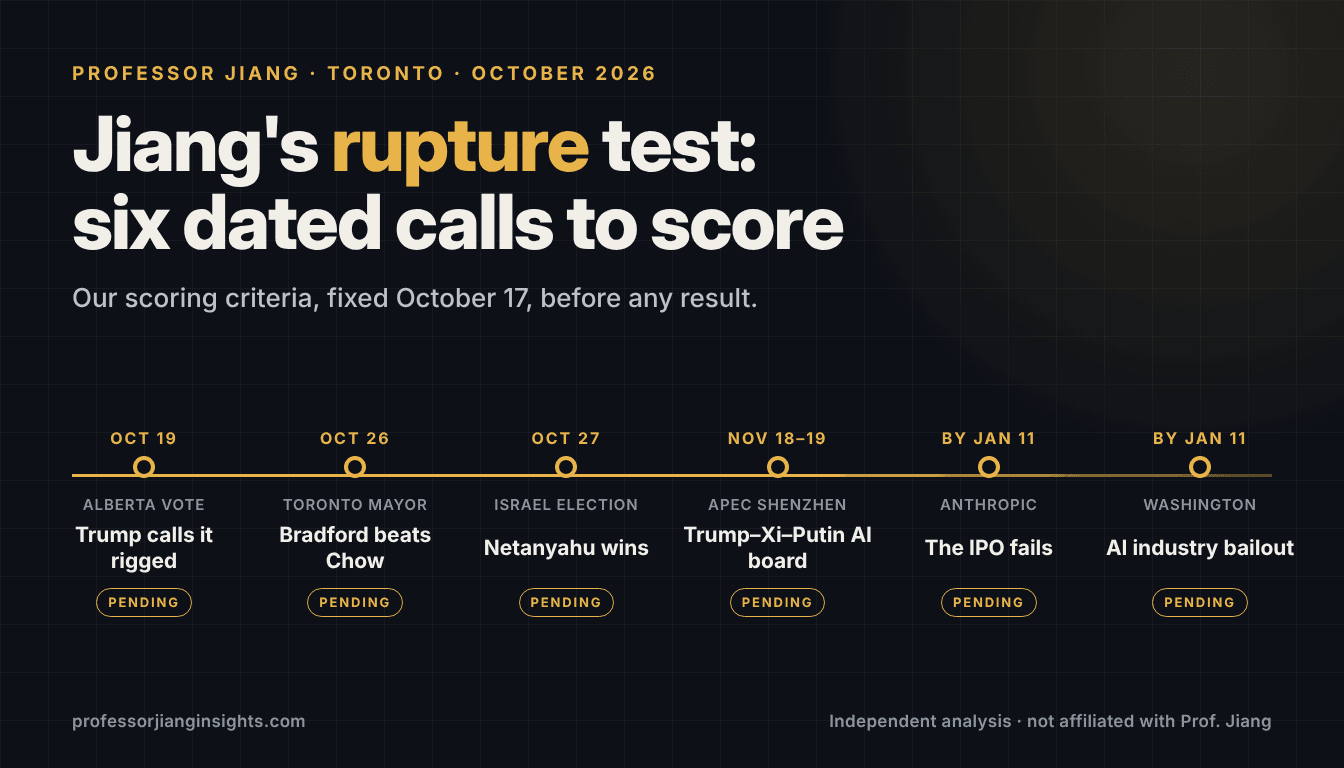
These go into our strict predictions scorecard with criteria fixed today, October 17, 2026:
- Alberta: Hit if Trump or the White House publicly calls the October 19 vote rigged or unfair, or the US government takes a formal action about it, by November 2. Miss otherwise.
- Toronto: Hit if Brad Bradford is declared mayor after the October 26 vote. Miss if Olivia Chow is.
- Israel: Hit if Netanyahu is sworn in as prime minister of the next government. Miss if someone else is. Pending until a government is formed.
- Anthropic IPO: Hit if, by January 11, 2027, the IPO is withdrawn or postponed past that date, prices below its marketed range, or closes 20% or more below its IPO price on any day within 30 days of listing. Miss if it lists and none of that happens.
- AI bailout: Hit if, by January 11, 2027, Congress passes or the White House launches new emergency funding, loan guarantees or equity stakes aimed at rescuing AI companies after a market fall. Existing chip and infrastructure programs do not count.
- APEC: Hit if Trump, Xi and Putin meet together and the three countries jointly announce an AI governance body or mechanism by November 30. Partial if the three meet without an AI body, or if an AI body is announced without all three. Miss if neither.
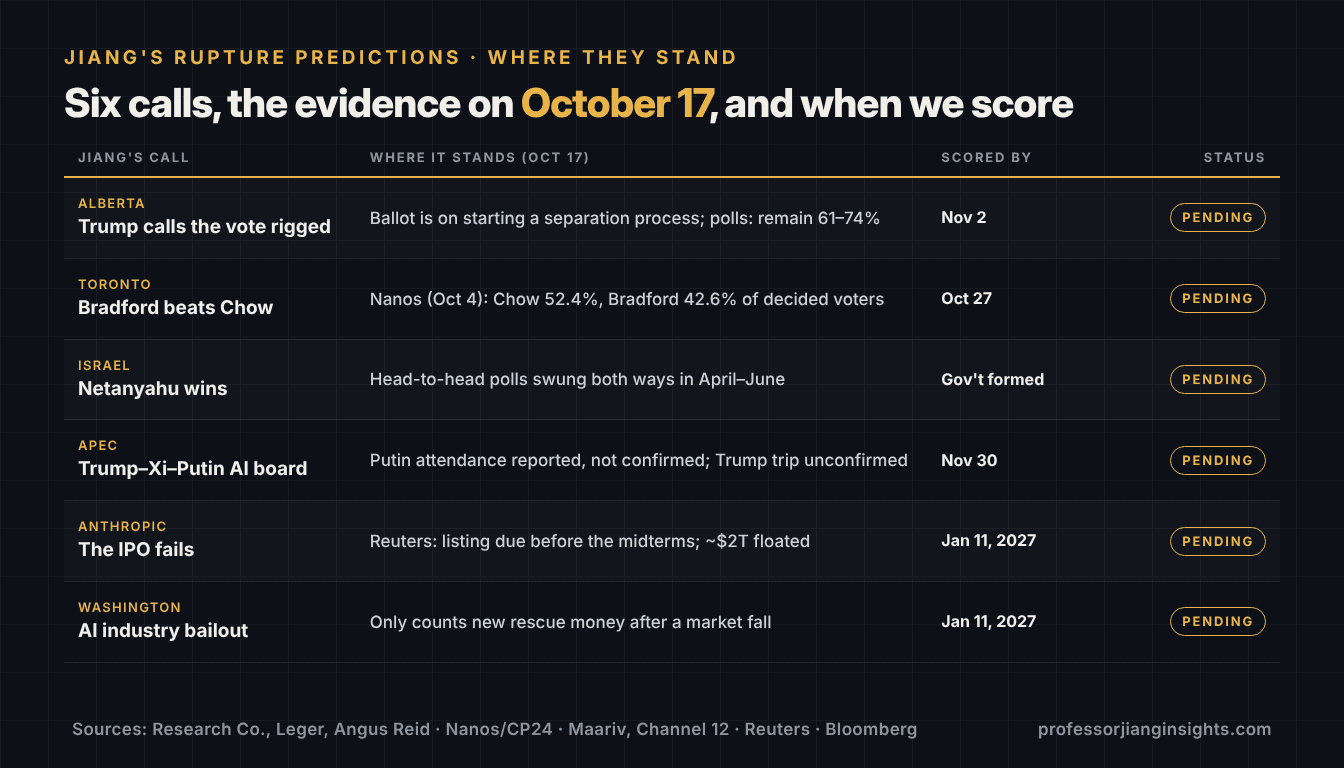
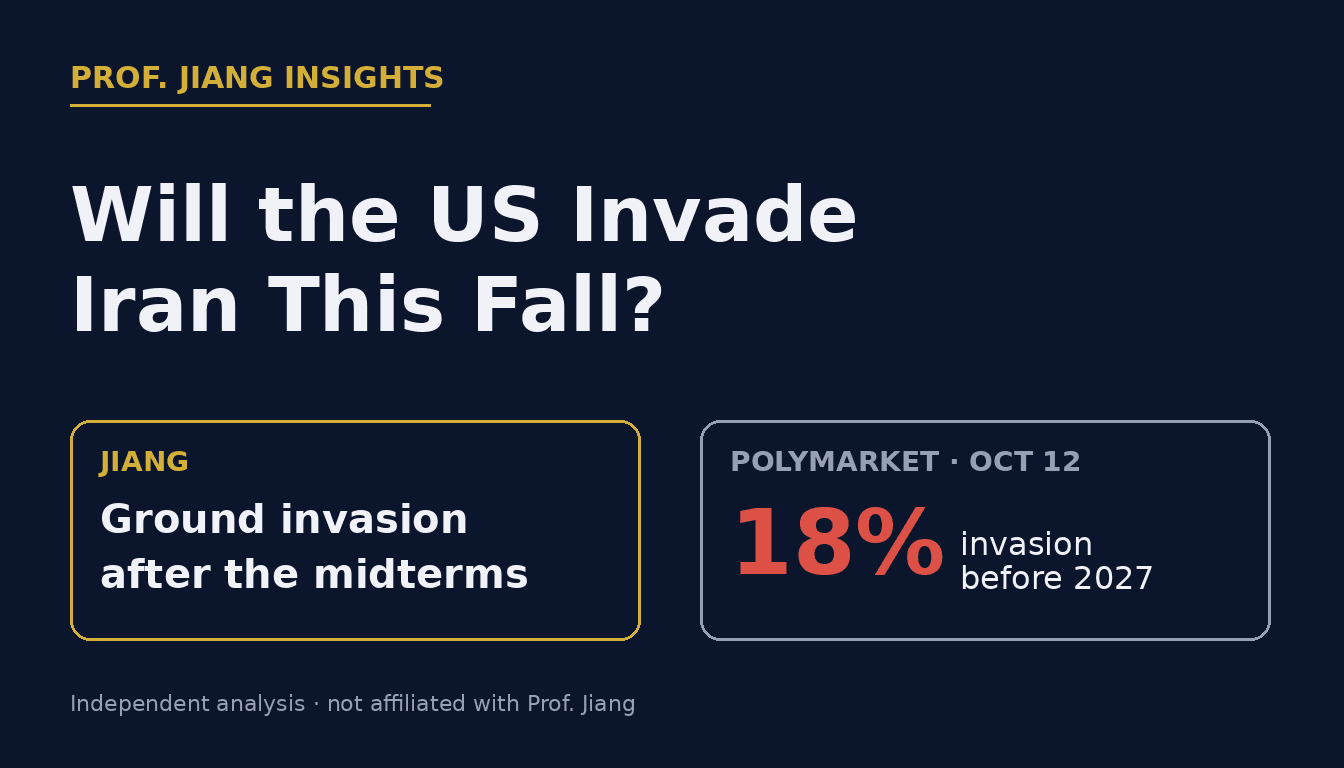
His claim that the Iran war "will escalate" is too vague to score on its own; we track the concrete version, a post-midterm ground invasion, in our Iran forecast piece. The midterm incumbent claim is excluded, as explained above.
The best case for Jiang, and the strongest objection
The steelman: Jiang is right that AI firms and incumbent finance are now fighting over real money. The stablecoin legislation he mentions in the Q&A, the GENIUS Act and the stalled CLARITY Act, is exactly a fight over who gets to hold deposits and earn the yield on them. AI spending is a large share of recent US growth, which makes a political rescue in a crash plausible on its own merits. And unlike most pundits, he published dates.
The objection: the theory explains every outcome. A Netanyahu win confirms the Middle East plan; a loss would be the old guard "fighting back," which he already says will happen. An Alberta yes is algorithmic rigging; a no is something Trump disputes. Only the specific, dated calls give the theory any risk, and four of the six above currently run against polls or reporting. That is what makes this lecture worth tracking: if he hits most of them, it will be hard to wave away.
We will update this page after each date. For how his past record holds up under the same rules, see is Professor Jiang really 77% accurate?