ANALYSIS
This article summarizes Professor Jiang Xueqin's views as we understand them from his recorded lectures. It is independent analysis, not his official statement, and Jiang Insights is not affiliated with him. Errors in summarizing are ours.
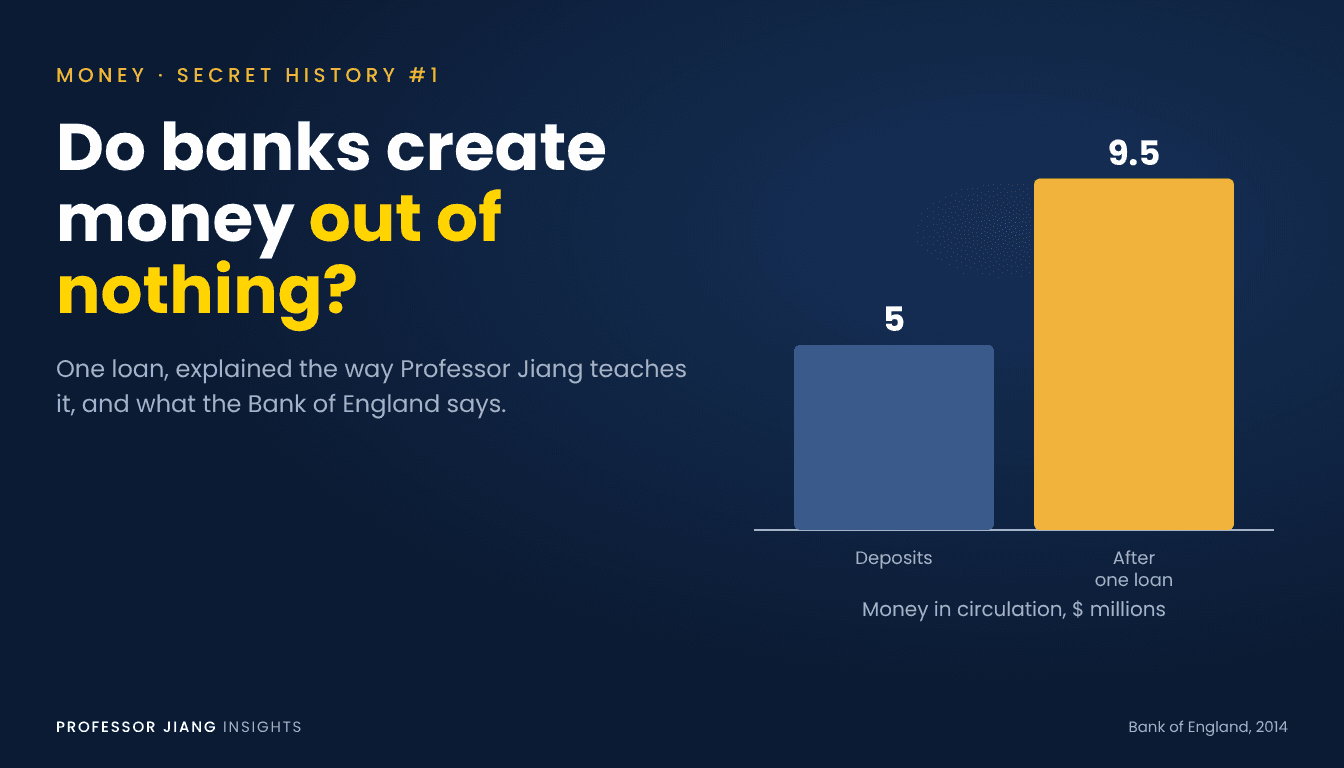
Yes. When a commercial bank makes a loan, it doesn't hand over somebody else's savings. It types a new deposit into the borrower's account, and that deposit is new money. The Bank of England said so in plain words in 2014. Professor Jiang Xueqin opens his Secret History lecture series with this fact, then pushes it much further: if money can be created at will, he argues, poverty and financial crises are choices, not accidents. Here is how money creation actually works, where Jiang is right, and where the evidence runs out.
How do banks create money?
Most people learn the textbook version: savers deposit money, the bank keeps a reserve, and it lends out the rest. In that story the bank is a middleman moving existing money from savers to borrowers.
The Bank of England's 2014 Quarterly Bulletin article "Money creation in the modern economy" described something different. Most of the money in a modern economy is bank deposits, and most of those deposits are created by banks when they lend. If you borrow $300,000 for a house, the bank credits the seller's account with $300,000 that didn't exist that morning. On the bank's balance sheet, your loan is an asset and the new deposit is a liability. No saver's account goes down.
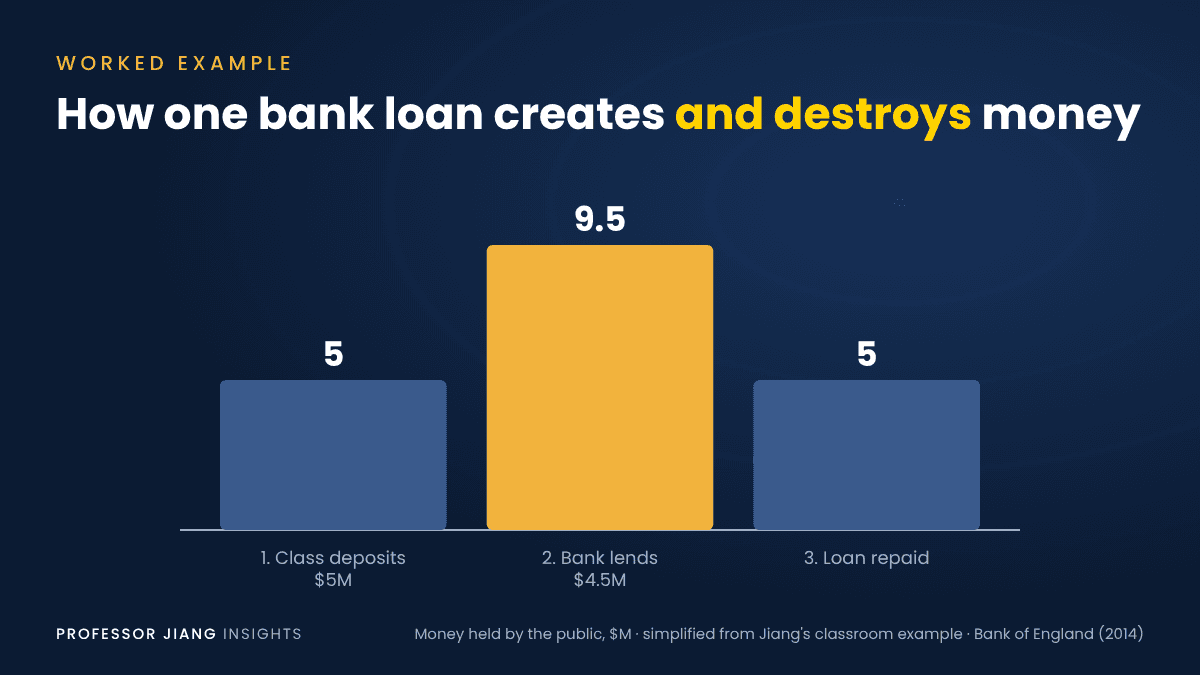
The same paper says the reverse is also true: when a loan is repaid, the deposit that settles it disappears, and money is destroyed. And it says the familiar "money multiplier" gets the causation backwards. Banks don't wait for deposits and then lend a fixed share; they lend, and the deposits and reserves follow.
Is it really "out of nothing"?
Not quite, and the strongest critics make a fair point. An economist's column on VoxEU titled "Banks do not create money out of thin air" argues that every new deposit is matched by a new debt, that banks must still attract funding and hold capital against losses, and that they can't lend profitably to anyone who walks in. "Out of nothing" is right about savings (no saver had to give anything up) and wrong if it suggests there is no cost or risk.
The real limits on money creation are capital requirements, the interest rate set by the central bank, how many creditworthy borrowers want loans, and inflation. Create money faster than the economy produces goods and services, and prices rise.
What Professor Jiang says about money creation
In Secret History #1, "How Power Works," Jiang runs a thought experiment for his students in Beijing (07:49). He opens a bank; the class deposits $5 million; a friend borrows $4.5 million to build a restaurant. How much money now exists? The students give the textbook answer, half a million in the vault. Jiang's answer is $9.5 million (11:12): the depositors still have their $5 million on paper, and the borrower has $4.5 million to spend.
His evidence is China. Over twenty years, he says, Chinese banks became the largest in the world not because savers got rich but because the banks lent money into existence to build roads and towers (11:28). Banks, he tells the class, are "allowed to print money, create money out of nothing" (12:24). That part checks out: in S&P Global's 2025 ranking of the world's largest banks by assets, China's state megabanks again held the top places.
Did goldsmiths invent modern banking?
Jiang's history of the trick starts with merchants storing gold with bankers and receiving paper receipts (13:20). The receipts traded like gold, so a banker could lend receipts instead of metal and double the paper in circulation. The danger was a run, when too many holders wanted their gold at once, and kings who borrowed for wars and refused to pay. The answer, he says, was cooperation between banking families, often sealed by marriage, which grew into what we now call central banking (21:16).
The core of this is real history. In seventeenth-century London, goldsmiths' notes circulated as money and goldsmith-bankers lent more paper than they held in metal. Kings did default; Philip II of Spain suspended payments several times in the sixteenth century. The Bank of England began in 1694 as a private company lending to the Crown, and the plan behind the US Federal Reserve was drafted by bankers and a senator at a private meeting on Jekyll Island in 1910. Where Jiang overreaches is the conclusion that this system "controls the world": most central banks today are public institutions, and whether they serve the public or the banks is an argument with evidence on both sides.
1600s
London goldsmiths' notes circulate as money
1694
Bank of England founded as a private lender to the Crown
1910–1913
Jekyll Island meeting; Federal Reserve Act passed
1929–1933
US money stock falls by about a third as loans fail
2014
Bank of England explains that loans create deposits
2025
Chinese state banks top S&P's ranking of the largest banks
If banks can create money, why is there poverty?
This is the question Jiang really wants his students to sit with. If money isn't scarce, why do people go hungry? His answer is that the powerful don't want everyone to have money, because then nobody would work. Poverty, in his account, exists to make money feel valuable: "poverty isn't what you do to yourself, it is what the powerful do to you" (27:02).
Part of this has strong support. The UN Environment Programme estimated that about 1.05 billion tonnes of food were wasted in 2022, while the FAO counted between 713 and 757 million hungry people in 2023. Amartya Sen won a Nobel Prize partly for showing that famines usually happen because people lose the means to buy food, not because food runs out. Modern hunger is mostly about distribution, prices, conflict and politics.
What doesn't follow is that poverty is maintained on purpose. Money is a claim on real goods, and goods are limited by labor, energy and time. Hand out money faster than the economy can produce, and you get inflation, as Weimar Germany, Zimbabwe and the 2021–22 price surge showed. The honest version of Jiang's point is narrower and still important: who receives new money, who gets rescued in a crisis and how much austerity a country chooses are political decisions.
Do financial crises destroy money?
Jiang says crises exist to destroy money so that people feel it is scarce again (27:34). The mechanism is real. When loans default or are called in, the deposits they created vanish. Milton Friedman and Anna Schwartz found that the US money stock fell by roughly a third between 1929 and 1933, which deepened the Great Depression. The leap is from what crises do to what they are for. Nothing in the record shows crises being staged in order to shrink the money supply.
What the record shows
On mechanics, Jiang is closer to the central banks than the textbooks are: loans create deposits, repayment destroys them, and money is not a fixed pile. On China's banks and the goldsmiths, the history supports him. The weak link is intent. He moves from what something does to what it is for, and that step needs evidence the lecture doesn't supply. Read as a lesson in where money comes from and who decides how it's distributed, the lecture is sharper than most economics classes.
This lecture is the basis of Chapter 1 of our guide to Jiang's Secret History series, which covers money, the individual and the nation in more depth. Read the first chapter free. For his warnings about the dollar, see Will the US dollar collapse?, and check Professor Jiang's latest predictions, scored strictly. New breakdowns go out first on Telegram.