ANALYSIS
This article summarizes Professor Jiang Xueqin's views as we understand them from his Predictive History recordings. It is independent analysis, not his official statement, and Jiang Insights is not affiliated with him. Nothing here is financial advice. Updated October 20, 2026.
Is a military draft coming to the US? Not yet. The last American was drafted in 1973, and restarting a draft would take an act of Congress. What does change this year is paperwork: under the 2026 defense bill, men aged 18 to 25 will be registered with the Selective Service automatically from December 2026. Professor Jiang Xueqin predicts the real thing, and ties it to a longer chain: a US debt default, the end of the dollar as the world's reserve currency, an engineered depression, then conscription. Here is each link in his argument and where the record stands in October 2026.
What did Professor Jiang predict about the dollar and the draft?
In what he framed as a capstone lecture of his Predictive History series (June 2026), Jiang laid out the sequence:
- The US government defaults on its debt, and the dollar loses its role as the single reserve currency.
- World trade carries on in a basket of the weakened dollar, gold, the British pound and the Swiss franc.
- A depression wipes out the savings of middle-class parents, removing the safety net under their adult sons.
- A national draft, across the US, Canada, Australia and Europe, absorbs young men who have dropped out of work.
Around that core he adds a reading of AI as a tool of surveillance, a forecast that Japan will outlast China in Asia, and advice on how ordinary people get through a collapse. He gave no dates. The theory behind that collapse, his three-phase model of how societies rise and fall, is covered in why do societies collapse?.
Will the US default on its debt?
Jiang describes the dollar system as a sovereign Ponzi scheme that lasts only while foreigners keep buying Treasuries, and calls the dollar's global role a historical accident that will never be repeated. The pressure is real. US gross debt reached $40.25 trillion on October 5, 2026, net interest has cost more than defense since 2024, and Moody's removed the country's last AAA rating in May 2025, following S&P in 2011 and Fitch in 2023.
But a default is a specific event, and the US has never had one on its marketable debt, apart from a small processing error in 1979. Because the debt is in dollars the US itself issues, the realistic risk is political, a debt-ceiling standoff that runs past the deadline, rather than running out of money. One correction to his history: the dollar's role does have a precedent. The British pound did the same job before the First World War. What is new is the scale.
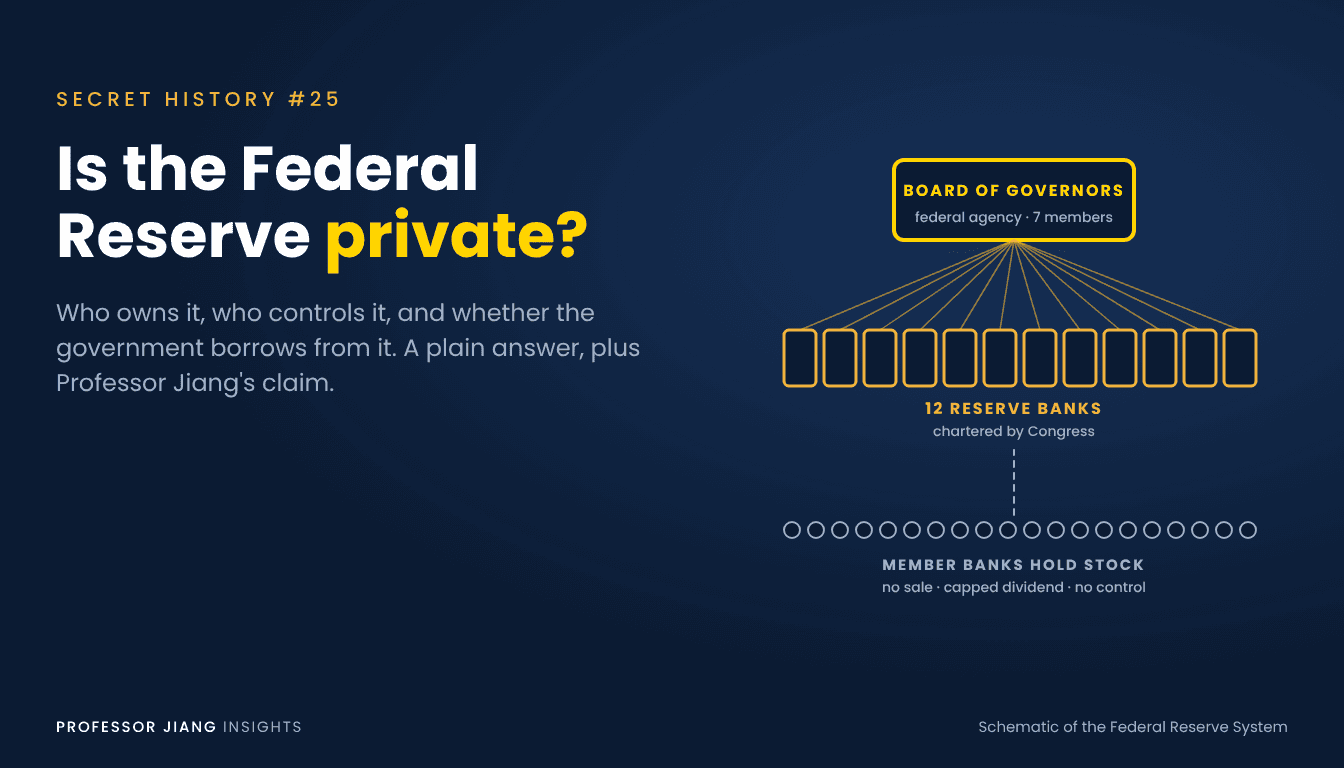
A common assumption behind default fears is that Washington borrows from the Federal Reserve. It does not: the Treasury sells bonds to the public, and the Fed buys some later in the market, as we explain in is the Federal Reserve private?
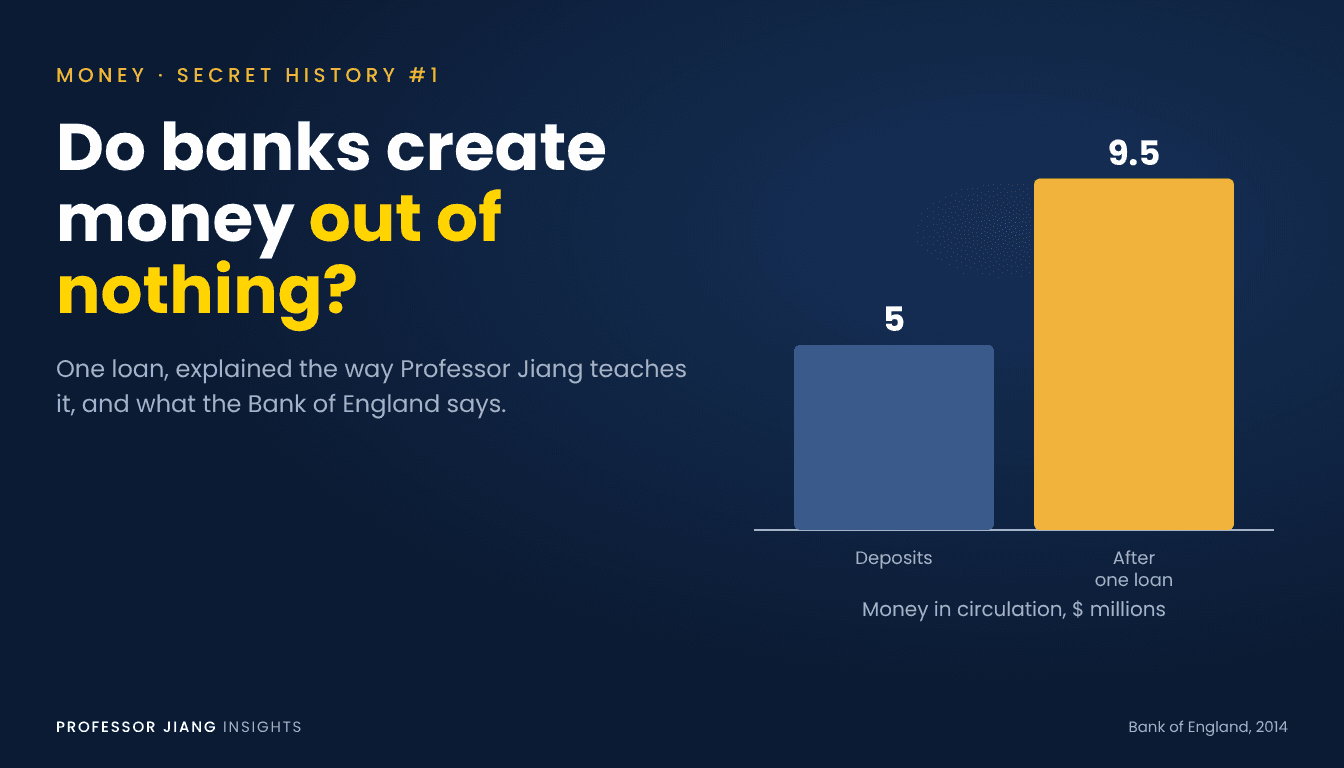
Nor does the Fed create most dollars. Commercial banks do, as deposits when they lend, and that money disappears when loans are repaid or go bad, which is why the US money stock fell by about a third in the Great Depression. We explain the mechanics in do banks create money out of nothing?
What would replace the dollar as the reserve currency?
Jiang's basket of dollar, gold, pound and Swiss franc is half right. Gold is the strongest part of it: central banks bought more than 1,000 tonnes a year in 2022, 2023 and 2024, and by market value gold has overtaken the euro as the second-largest reserve asset. The rest fits the data less well. In IMF figures for Q2 2026, the dollar held 56.7% of allocated currency reserves and the euro 20.6%. The pound held around 4–5% and the Swiss franc well under 1%. Leaving out the euro, and the Japanese yen at around 5–6%, skips the two currencies most likely to gain if the dollar slips.
To see why Jiang thinks a currency can fail at all, start with his lecture on what money actually is. It became Chapter 1, "Lead Into Gold", of How Power Works, our guide to his Secret History series, and that chapter is free to read.
Is the US bringing back the draft?
Not as of October 2026. The fiscal 2026 National Defense Authorization Act did change how registration works: the Selective Service System plans to register eligible men automatically from December 2026, using federal data instead of a form. That is the first change to registration since it was restored in 1980. It is not a draft. Inductions have not happened since 1973, and the president cannot restart them without Congress authorizing it.
Europe is further along. Lithuania brought back conscription in 2015, Sweden in 2017 and Latvia in 2023, and Germany's new military service law requires 18-year-old men to fill in a service questionnaire from 2026, with compulsory service as a fallback if volunteers fall short. Canada and Australia, which Jiang also named, have no plans for conscription.
Why Jiang thinks the draft is about young men, not war
This is the most original part of his argument. Jiang says millions of young Western men have checked out of work because wages no longer cover the basics, and spend their energy on crypto speculation, online gambling and four years of college that teach them little. A draft, in his telling, is how a state puts that unused labor back to work. He adds a twist critics rarely credit: the military often trains people better than universities do, because it needs skills that actually work, such as naval engineering, and pays for them. His explanation for why the young are squeezed in the first place, an economy tilted toward rich pensioners, is covered in is America a gerontocracy? The same squeeze one rung higher, more graduates than good positions, is what Peter Turchin calls elite overproduction.
The concern underneath is real; the share of young men neither working nor studying is a subject of serious research. The objection is about what armies want. Since 1973 the Pentagon has preferred volunteers, because conscripts serve short terms and cost a lot to train, and modern militaries need fewer, more skilled people. The scenario that would change that is a large ground war, which is why this call is linked to his forecast of a US ground invasion of Iran. If that invasion comes, watch for changes to recruitment and mobilization orders first.
AI, Stargate and the surveillance state
Jiang reads the AI build-out as an instrument of control rather than progress. He points to giant data center projects such as Stargate, announced in January 2025 by OpenAI, SoftBank and Oracle with plans for up to $500 billion of investment, and reads Peter Thiel's Zero to One (2014), with its chapter on "secrets", as an invitation to form secret societies. Drawing on Marshall McLuhan's line that the medium is the message, he argues that tools like ChatGPT weaken imagination by replacing inner thought with algorithmic feedback. These are interpretations rather than forecasts. They cannot be scored, and we note them as his reading.
Japan, China and the Middle East after the dollar
In Jiang's map of the world after the dollar, Israel becomes the military anchor of the Middle East (his Pax Judaica thesis, which we cover in What Is Pax Judaica?), China weakens and Japan rises. On China he points to the world's lowest fertility rates and to a ruling class organized around families. On Japan he cites its record of reinventing itself under threat: the Mongol invasions of 1274 and 1281, the Meiji Restoration of 1868 and the breakup of the zaibatsu conglomerates after 1945. One detail matters for his argument that Japan "eats the rich" when needed: the zaibatsu breakup was ordered by the American occupation, not chosen by Japan.
What Jiang says people should do
His advice is not financial. He dismisses billionaire bunkers as traps and argues that what survives a collapse is local community and practical skill: building, repairing, teaching, making culture. For the mind, he recommends reading physical books and primary sources, cutting back on algorithmic feeds and tools like ChatGPT, and questioning the assumptions you were raised with. Whatever one makes of the collapse forecast, that part travels well without it.
How we will score the dollar and draft predictions
Jiang gave no dates, so we set tests now, before any outcome:
- Draft: hit if Congress authorizes draft inductions in the US before January 20, 2029, the end of the current presidential term. Automatic registration alone does not count.
- Default: hit if the US Treasury misses a scheduled interest or principal payment on its marketable debt, by the same date.
- Reserve status: tracked against each IMF release; a share below 50% would mark a real break from the slow trend.
For the first half of this argument, his claim that global finance is steering the dollar down on purpose, see will the US dollar collapse? For how his dated calls have scored so far, see is Professor Jiang really 77% accurate?
1973
Last US draft inductions; all-volunteer force begins
1980
Selective Service registration restored
2011
S&P downgrades the US from AAA
2023
Fitch downgrades the US
May 2025
Moody's removes the last AAA rating
Oct 2026
US gross debt passes $40 trillion
Dec 2026
Automatic Selective Service registration begins
Jan 20, 2029
Our deadline for the draft and default calls