CAUTION
Independent analysis of Professor Jiang Xueqin's public lecture Secret History #25. We are not affiliated with him; quotes are short and timestamped, everything else is our research. This is an explanation of how an institution works, not financial advice.
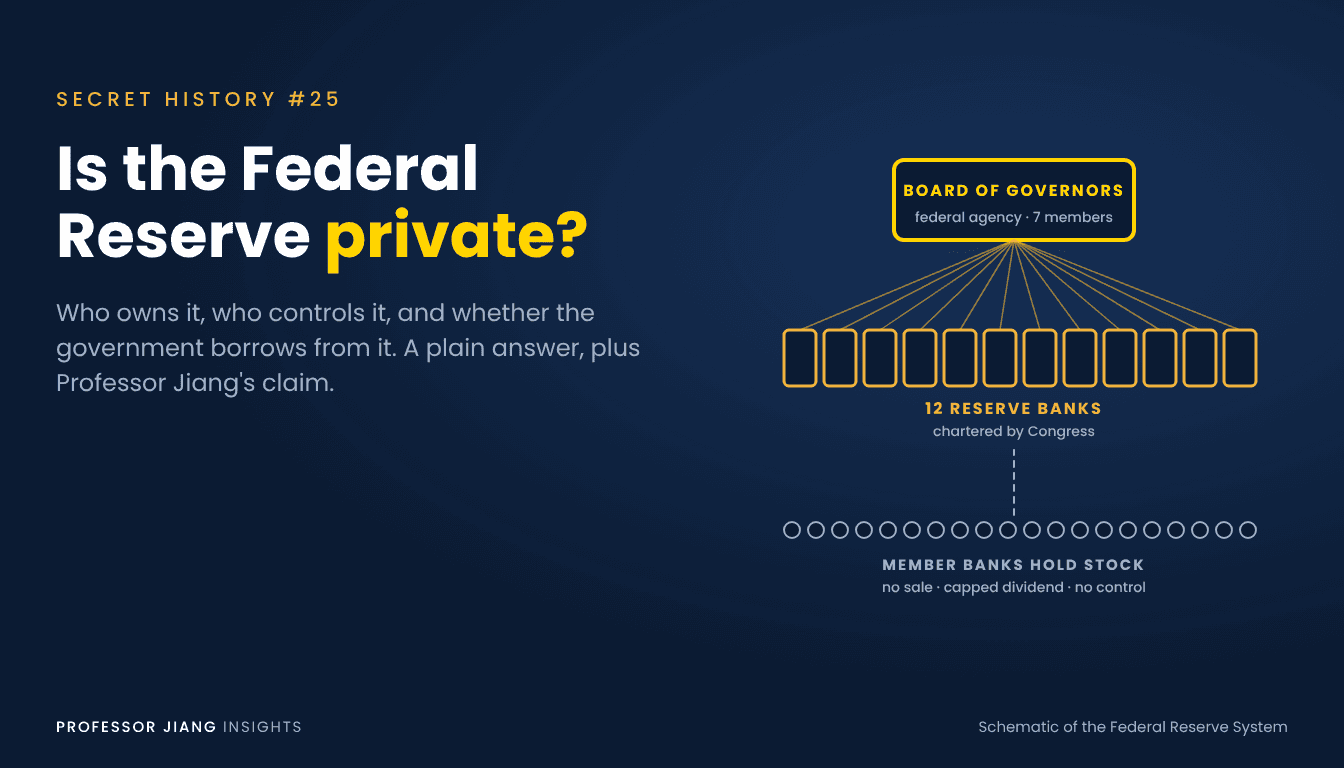
No, the Federal Reserve is not a private bank, but it is not an ordinary government agency either. It is a hybrid created by Congress in 1913: a federal Board of Governors in Washington and twelve regional Reserve Banks set up like corporations. Commercial banks own stock in those regional banks, which is where the "private" idea comes from. That stock does not carry the rights that ownership normally means.
The question keeps coming back because people with very different politics keep asking it, from gold enthusiasts to critics of Wall Street. Professor Jiang Xueqin raised it in his lecture on transnational capital, calling the Fed "a private bank" that prints money while the government "borrows from the Federal Reserve at interest" (47:58). Here is how the system actually works, and the part of his argument that stands.
Who owns the Federal Reserve?
Think of the Fed in three layers. At the top is the Board of Governors: seven members nominated by the president, confirmed by the Senate, serving 14-year terms. It is a federal agency. Below it are the twelve Federal Reserve Banks, in cities from Boston to San Francisco. They are chartered by Congress and organized like corporations, with their own boards and staff who are not civil servants. Monetary policy is set by the Federal Open Market Committee, which combines the seven governors with five of the regional bank presidents.
Commercial banks that join the system must buy stock in their regional Reserve Bank, equal to 6% of their capital (half of it paid in). But this stock cannot be sold, traded or pledged as collateral; it gives no say over interest rates; and its dividend is fixed by law. Since 2016, large banks receive the lower of 6% or the ten-year Treasury yield. As the Fed itself puts it, holding the stock is a condition of membership, not an investment.
Does the government borrow from the Fed?
This is the part of the popular story that is simply wrong. When the US government needs money, the Treasury sells bonds at public auctions to banks, pension funds, foreign governments and ordinary investors. The Fed does not buy at those auctions. It buys and sells Treasury bonds afterward, in the open market, to steer interest rates and the money supply.
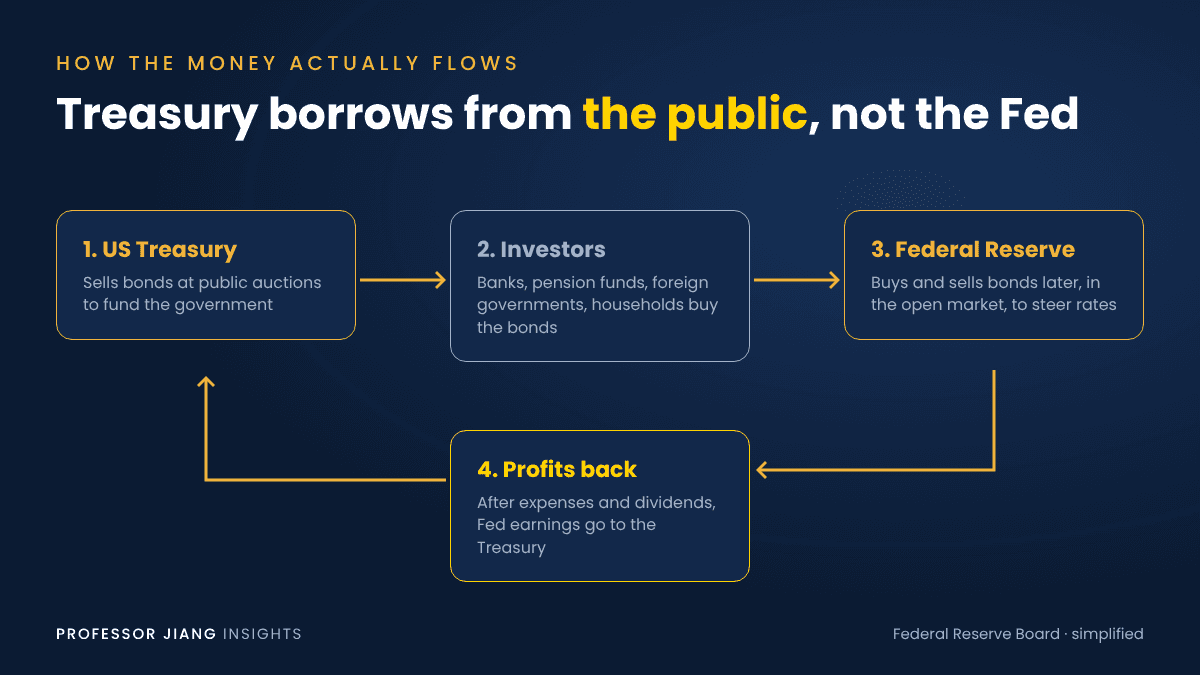
The Fed does earn interest on the bonds it holds. But after paying its expenses and the capped dividend, it sends the rest to the Treasury. In the decade after the 2008 crisis those remittances ran to tens of billions of dollars a year, more than $100 billion in 2021 alone. Since late 2022, when it began paying high interest on bank reserves, the Fed has run losses, which it records as a "deferred asset" to be paid off from future earnings before remittances resume. A private bank would not be built that way.
Why people think the Fed is private
There are real reasons. The regional banks look like corporations, with shareholders and dividends. Their boards include bankers. The Fed was designed in 1910 at a secret meeting of bankers and a senator on Jekyll Island, Georgia. And it is deliberately insulated from elected politicians: governors cannot be fired over policy disagreements, and Congress does not vote on interest rates.
Serious critics have attacked that design from both sides. Populist Democrats such as Congressman Wright Patman in the 1960s argued it served bankers; libertarians such as Ron Paul campaigned to "audit the Fed". The economist Murray Rothbard and the Mises Institute argue the ownership question is beside the point: what matters is that a small, unelected body controls money. That is a fair debate. It is a debate about independence, not about who owns the shares.
What Professor Jiang argues
Jiang's interest is historical. In his telling, modern finance runs through four "merchant oligarchies": Venice, the Dutch Republic, England and America. Its decisive invention was the Bank of England in 1694, which he describes as a private bank whose loans were guaranteed by Parliament, so that lenders were always repaid (46:24). "The Bank of England becomes Federal Reserve," he says (47:34).
The history behind this is solid. The Bank of England was founded as a private company to lend £1.2 million to King William III, and Parliament's backing made British debt the safest in Europe, a story economists Douglass North and Barry Weingast made famous in 1989. The Bank of England was nationalized only in 1946. The Federal Reserve was modeled partly on European central banks, and bankers shaped its design.
Where Jiang's description goes wrong is the present tense. Today's Fed is publicly accountable in law, returns its profits to the government and does not lend to it. His underlying point, that whoever controls the creation of money holds a kind of power voters rarely see, is the same one made by critics on the left and right. For how this connects to his forecasts about the dollar, see the engineered dollar collapse and US debt default and a draft.
1694
Bank of England founded
Private company lending to the Crown
1791
First Bank of the United States
Charter lapses 1811
1836
Second Bank's charter expires
Jackson's "Bank War"
1907
Banking panic
J.P. Morgan organizes the rescue
1910
Jekyll Island meeting
Bankers and Senator Aldrich draft a plan
1913
Federal Reserve Act
Signed December 23
1935
Banking Act
Power centralized in the Board
1946
Bank of England nationalized
1971
Dollar leaves gold
Nixon closes the gold window
2022
Fed starts running losses
Deferred asset grows
Watch the lecture
See every dated forecast Jiang has made, scored: Professor Jiang's latest predictions.
Want the whole system behind his lectures, checked against the record? Read the first chapter free, and follow new analysis on Telegram.