ANALYSIS
This article summarizes Professor Jiang Xueqin's views as we understand them from his recorded lectures. It is independent analysis, not his official statement, and Jiang Insights is not affiliated with him. Errors in summarizing are ours.
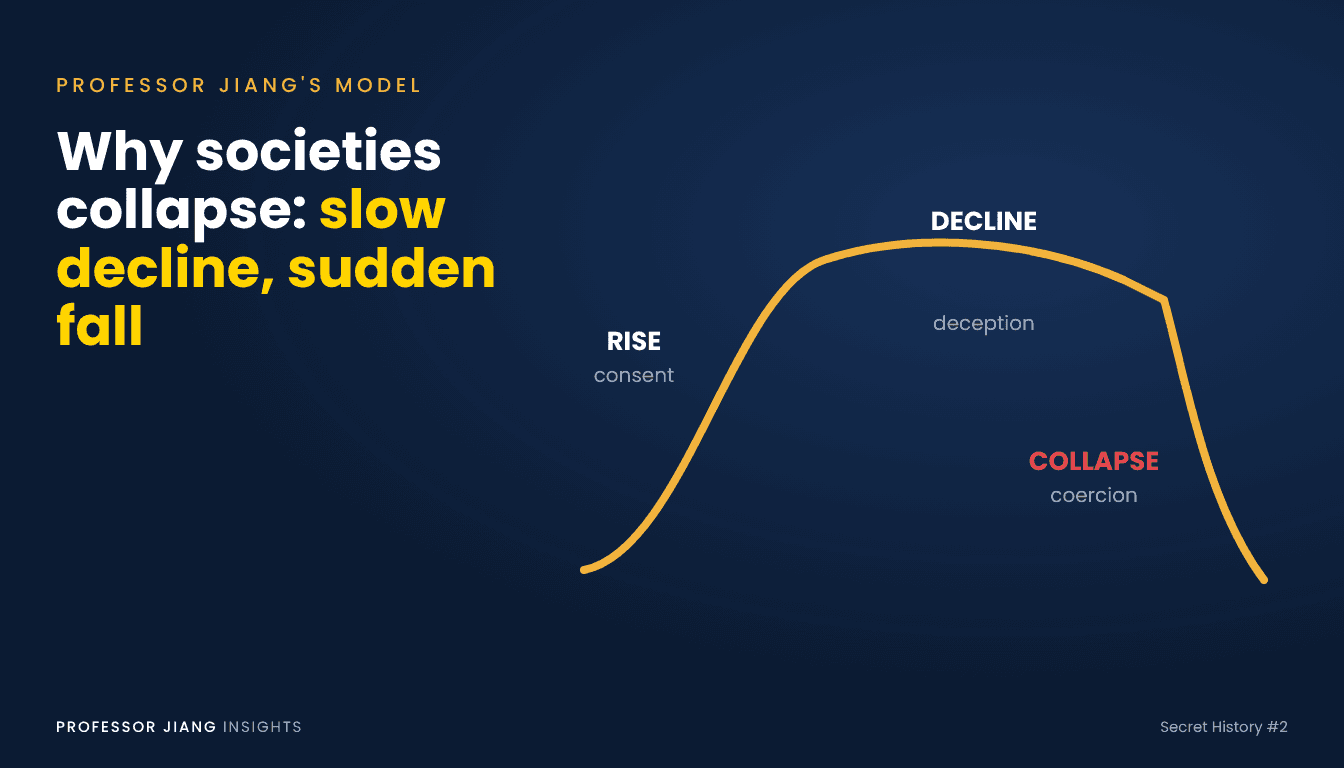
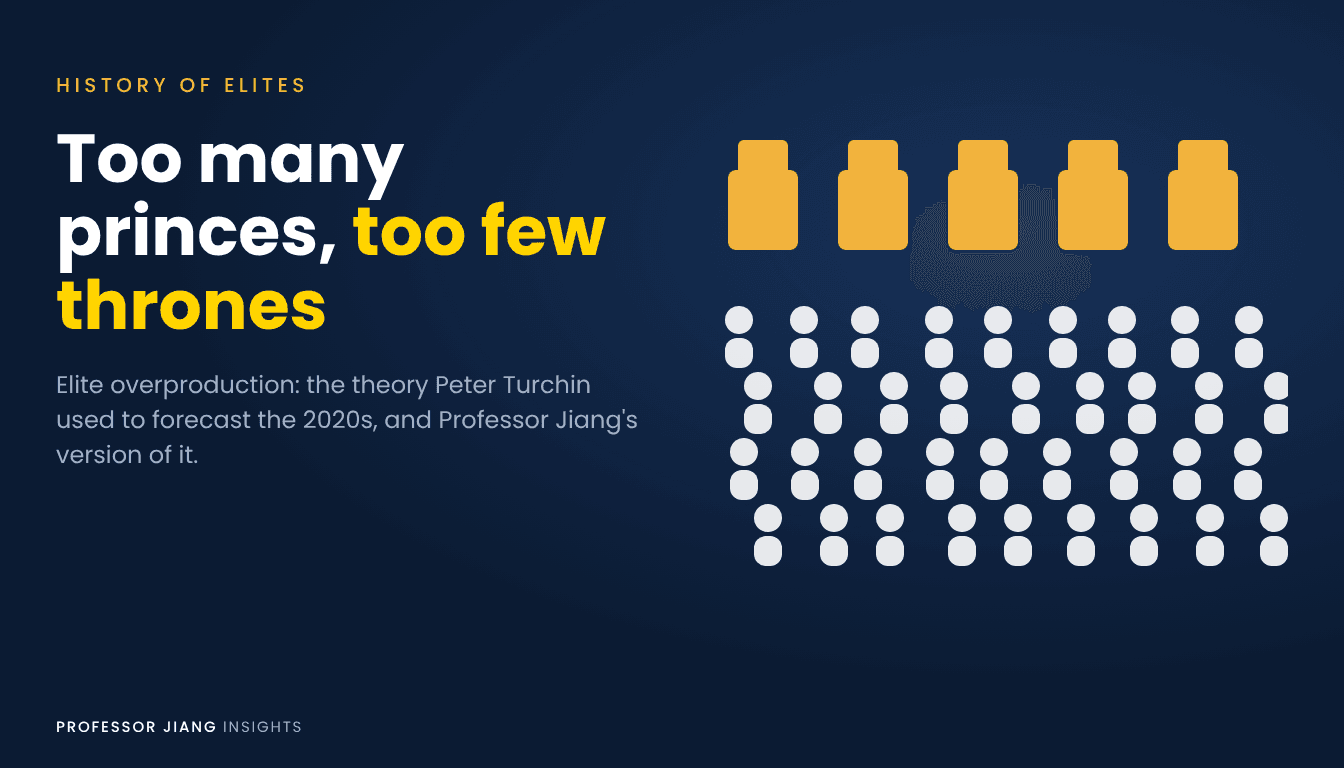
Elite overproduction is the idea that a society becomes unstable when it produces more would-be elites (people with the education, money or ambition to compete for top positions) than it has top positions to give them. The losers don't go quietly; they become rival "counter-elites" who organize the discontent of everyone else. The scientist Peter Turchin used the idea to forecast American turmoil around 2020, a decade early. Professor Jiang Xueqin makes it one of the three engines of his model of how societies collapse.
What is elite overproduction?
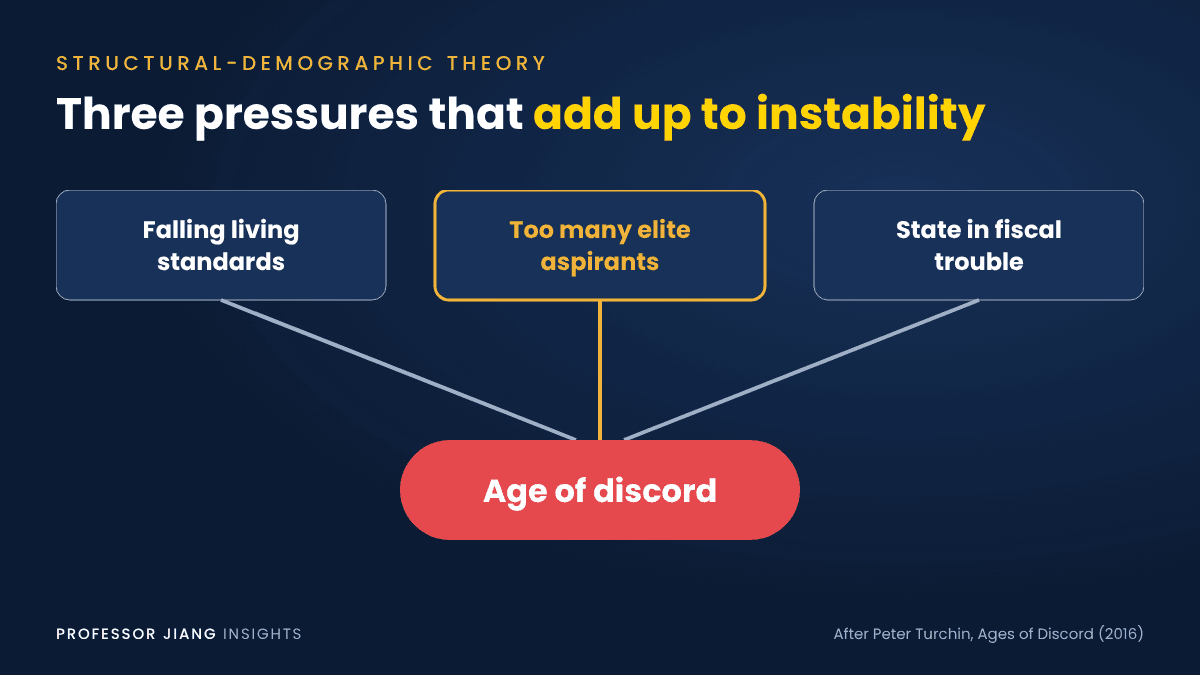
In Turchin's framework, called structural-demographic theory, instability builds from three trends that reinforce each other. Ordinary people's living standards stall or fall. The number of elite aspirants grows faster than the number of elite jobs, offices and fortunes. And the state runs into fiscal trouble, so it can't buy off either group. When all three line up, a society enters what Turchin calls an age of discord.
The key is that elite status is close to zero-sum. There is one presidency, a hundred Senate seats and a limited number of partnerships at top law firms. Produce more qualified contenders and you don't get more winners; you get more frustrated losers with the skills to cause trouble.
Who came up with elite overproduction?
Turchin, a population ecologist turned historian, developed it with Sergey Nefedov in Secular Cycles (2009) by comparing cycles of growth and crisis in England, France, Rome and Russia. He applied it to the US in Ages of Discord (2016) and for a general audience in End Times (2023). The underlying idea is older: the sociologist Jack Goldstone argued in Revolution and Rebellion in the Early Modern World (1991) that elite competition helped trigger the English Revolution, the French Revolution and crises in the Ottoman Empire and Ming China.
Did Turchin predict the 2020s?
In a 2010 letter to the journal Nature, Turchin wrote that his indicators pointed to a period of rising political instability in the United States, peaking around 2020. Those indicators included stagnating real wages, a swelling number of degree holders chasing elite jobs and rising public debt. The decade that followed, with its contested elections, unrest and polarization, turned the letter into one of the most cited forecasts in the social sciences.
1991
Jack Goldstone links elite competition to early modern revolutions
2009
Turchin and Nefedov publish Secular Cycles
2010
Turchin forecasts US instability peaking around 2020 in Nature
2016
Ages of Discord applies the model to the US
2023
End Times brings the theory to a mass audience
2025
Professor Jiang builds it into his Secret History model of collapse
What does Professor Jiang say about elite overproduction?
In Secret History #2, "How Societies Collapse," Jiang presents Turchin's theory as one of three explanations for decline (15:56). To explain it, he tells the story of John B. Calhoun's rodent utopias (16:45): animals given unlimited food and safety that ended in social breakdown. His reading is that they were fighting over status, not food, and with nowhere to go, the losers never left. (Calhoun's famous experiment actually used mice, and its colony died out more through withdrawal than violence; we cover it in our Universe 25 article.)
Jiang's human example is the one his Beijing students know best: far too many graduates of Peking and Tsinghua universities, all wanting to be the boss (21:04). Later in the lecture he makes elite overproduction the turning point of his whole model. The founding families of a society have too many children who want positions and money; the system sinks into debt; the managerial middle class turns on ordinary workers to prove its worth (36:44); and finally the elite splits into factions that drag everyone else into civil war or revolution.
Is China facing elite overproduction?
The numbers point that way. China's official unemployment rate for urban 16-to-24-year-olds passed one in five in mid-2023, after which the government paused publication and changed the method. Young Chinese have their own words for opting out: tang ping (lying flat) and bailan (let it rot), which Jiang compares to America's quiet quitting. Huge numbers of graduates now compete in the national civil-service exam for stable government posts. Whether this produces Turchin's counter-elites or simply a disillusioned generation is one of the big open questions about China's next decade.
Does elite overproduction cause revolutions?
Historians who like the idea point to the English Civil War, fought largely between factions of the gentry, and the French Revolution, where many leaders were underemployed lawyers. Critics make three objections. Elite aspirants are hard to count. The theory is easy to apply after the fact, since some elite frustration exists in every era. And many economists think inequality and wage stagnation, not elite numbers, do most of the work.
The fairest summary is that elite overproduction is a risk indicator, not a law. Its strength is that Turchin put a date on it in advance, which most theories of decline never do.
What the record shows
Jiang's summary of Turchin is accurate, and his China example fits the data. His Calhoun story needs the mouse correction, though the real outcome (a colony that stopped reproducing) arguably suits his larger argument about birth rates even better. What he adds to Turchin is the mechanism of who turns on whom: managers squeezing workers, then elite factions recruiting followers. We break down that full model in Why do societies collapse? Professor Jiang's three phases.
Our guide to Jiang's Secret History series sets out his full model of rise and fall, with diagrams and his predictions scored. Read the first chapter free, see Professor Jiang's latest predictions, and follow new breakdowns on Telegram.