Universe 25: Inside the Mouse Utopia That Collapsed
Universe 25 was John B. Calhoun's 1968 experiment giving mice unlimited food, water and safety. The colony peaked at about 2,200, then stopped breeding, broke down socially and died out. Professor Jiang Xueqin, in a September 2026 interview, argues aging Western societies already live in this 'rat utopia', with status, not food, as the missing resource.
ANALYSIS
This article summarizes Professor Jiang Xueqin's views as we understand them from his recorded interviews. It is independent analysis, not his official statement, and Jiang Insights is not affiliated with him. Errors in summarizing are ours.
Universe 25 was a 1968 experiment by the American researcher John B. Calhoun, who built a mouse utopia with unlimited food and water, no predators and no disease. The colony grew from eight mice to about 2,200, then stopped breeding, broke down socially and died out. Professor Jiang Xueqin retold the story in a September 2026 interview as "rat utopia" and argued that rich, aging societies are already living inside it. Here is what actually happened in the box, what critics say it proves, and the strongest version of his warning.
What was the Universe 25 experiment?
Calhoun, an ecologist at the US National Institute of Mental Health, spent more than two decades studying what crowding and abundance do to rodent societies, starting in 1947 with Norway rats in a pen behind his house in Maryland. Universe 25 was the 25th of his enclosures and by far the most famous: a metal pen about 2.7 meters square, lined with tunnels and nesting boxes for roughly 3,800 mice, with food and water that never ran out.
In July 1968 he put in four breeding pairs. The mice had everything except two things that could not be expanded: space, and a place in the social order.
What happened to the mice in Universe 25?
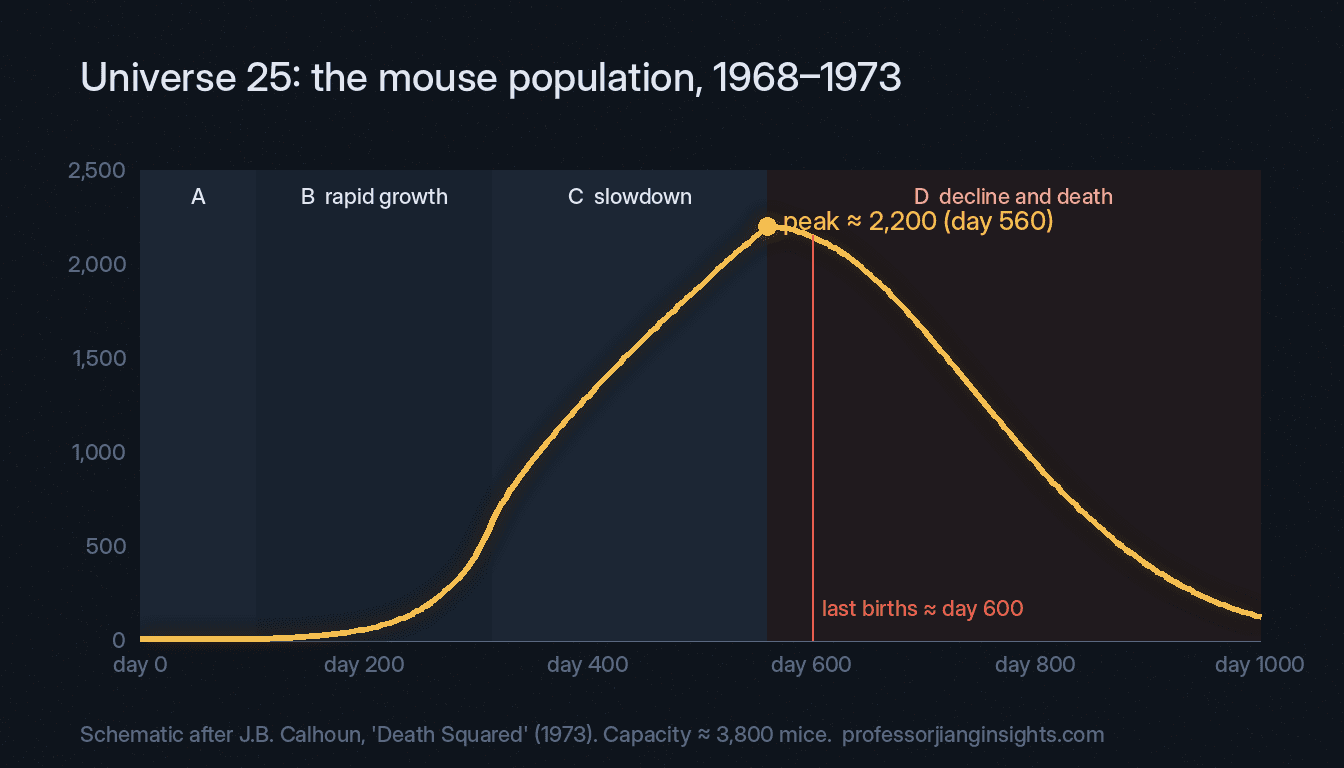
Calhoun described four phases. After a slow start, the population doubled about every 55 days, then growth slowed sharply around day 315. It peaked at roughly 2,200 mice around day 560, well short of what the pen could hold. By then the society had already come apart.
Dominant males defended territory until they wore out. Young males who could not win a place withdrew into crowded central areas, where they either attacked each other or sat passively. Females became aggressive, neglected or abandoned their young, and infant deaths soared. Calhoun singled out one group as "the beautiful ones": males that only ate, slept and groomed, never fighting or mating. Births stopped around day 600. Even mice moved to fresh, uncrowded pens did not recover normal behavior, and the colony died out.
Calhoun published the results in 1973 in the Proceedings of the Royal Society of Medicine, under the bleak title Death Squared: The Explosive Growth and Demise of a Mouse Population.
Was it rats or mice?
Both, at different stages. Jiang calls it rat utopia, and Calhoun's earlier work was on rats: his 1962 Scientific American article described a "behavioral sink", his term for the collapse of normal behavior in an overcrowded rat colony. Universe 25 itself used mice. The version Jiang tells, with frustrated outcasts ganging up on the alpha male, traumatized mothers turning on their young and gangs of juveniles, blends the two.
What does Professor Jiang say Universe 25 means for us?
Jiang's lesson, told on the Jack Neel podcast, is that more than food, shelter or safety, every social animal needs status within its group, and if it cannot get status it will take it by force. He applies that to the West. Baby boomers, he argues, hold power and money for decades longer than any generation before them, and young people are left chasing status through online hustles, influencers and crypto gambling.
His example is the line of succession. Senator Chuck Grassley, now 93 and president pro tempore of the Senate, stands third in line for the presidency after Vice President JD Vance and House Speaker Mike Johnson; Jiang called him fourth, counting the president. From there Jiang sketches a future of fortified communities for the rich elderly surrounded by spreading Skid Rows, like the film Elysium, and of societies growing more authoritarian because older voters want quiet, police and pensions more than schools.
Does Universe 25 apply to humans?
Not directly. Psychologists who studied human crowding in the 1970s found that density by itself did not produce the breakdown Calhoun's mice showed, and some of the densest places on Earth, such as Hong Kong, Tokyo and Singapore, are also among the safest. Historians of science, notably Edmund Ramsden, have traced how the behavioral sink escaped the lab and fed 1970s fears about cities and overpopulation, often well beyond what the data supported.
But Calhoun's own reading was closer to Jiang's than to the overpopulation scare. He thought the colony failed because there were far more mice than meaningful social roles, so most animals had nothing to do. That is the strongest version of Jiang's point, and it has human parallels: economists Anne Case and Angus Deaton tied the loss of stable work and standing among Americans without college degrees to rising despair. Whether that ends in collapse is a prediction, not a finding.
Is Japan planning to euthanize its elderly?
No. In the same interview Jiang predicted that if every aging nation were forced to choose between rat utopia and euthanizing its elderly, Japan alone might choose euthanasia, because of its cohesion and sense of collective sacrifice. He also said plainly that no country, Japan included, is discussing such a policy, and that the Japanese would find it abhorrent today.
The idea has a cultural echo. Chie Hayakawa's 2022 film Plan 75 imagined a Japanese government program offering death to people over 75, and Yale economist Yusuke Narita drew heavy criticism in 2023 for remarks on elderly mass suicide that he later called a metaphor. Japan has no assisted-dying law, and about 29% of its people are 65 or older, the highest share of any large country.
Jiang also described Canada's medical assistance in dying program, MAID, as aimed at the poor. MAID accounted for 4.7% of deaths in Canada in 2023, mostly people with cancer, with a median age near 78. Critics, including UN disability experts, have raised concerns about a small number of non-terminal cases where poverty or a lack of support appeared to play a role.
What the record shows
Universe 25 was real and its collapse was real. What it proves about people is narrower than its fame online suggests. Jiang's use of it is less about crowding than about status, which is the part of Calhoun's work that has aged best. His forecast that aging Western societies drift toward walled-off elderly enclaves and angry, idle young men has no date attached, so we list it without a deadline. In the same interview he tied that idle-youth problem to a coming draft; see is the draft coming back? For his view on the money side, see will the US dollar collapse?
1947
Calhoun begins rat studies in a pen behind his Maryland home
1962
Scientific American article coins the 'behavioral sink'
Jul 1968
Universe 25 starts with four pairs of mice
Day 315
Population growth slows sharply
Day 560
Peak of about 2,200 mice
Day 600
Last births; colony begins to die out
1973
Calhoun publishes 'Death Squared'
Sep 2026
Jiang applies 'rat utopia' to aging societies
Frequently asked questions
What is the behavioral sink?
A term John Calhoun coined in 1962 for the breakdown of normal behavior, such as nesting, mating and raising young, that he saw in overcrowded rat colonies.
Who was John B. Calhoun?
An American ecologist and behavioral researcher (1917–1995) who worked at the US National Institute of Mental Health and built a series of rodent enclosures to study crowding, ending with Universe 25.
What were 'the beautiful ones' in Universe 25?
Calhoun's name for males that withdrew from social life entirely. They ate, slept and groomed themselves, looked healthy, and never fought or mated.
Did all the mice in Universe 25 die?
Yes. Births stopped around day 600, the population aged without replacement, and the colony died out. Mice moved to new enclosures did not resume normal breeding.
What is the lesson of Universe 25?
Calhoun argued that a society with far more members than meaningful social roles breaks down even when material needs are met. Critics say the results do not transfer directly to humans, since human density alone does not produce the same collapse.