Jiang Xueqin Books: Every Title by Professor Jiang
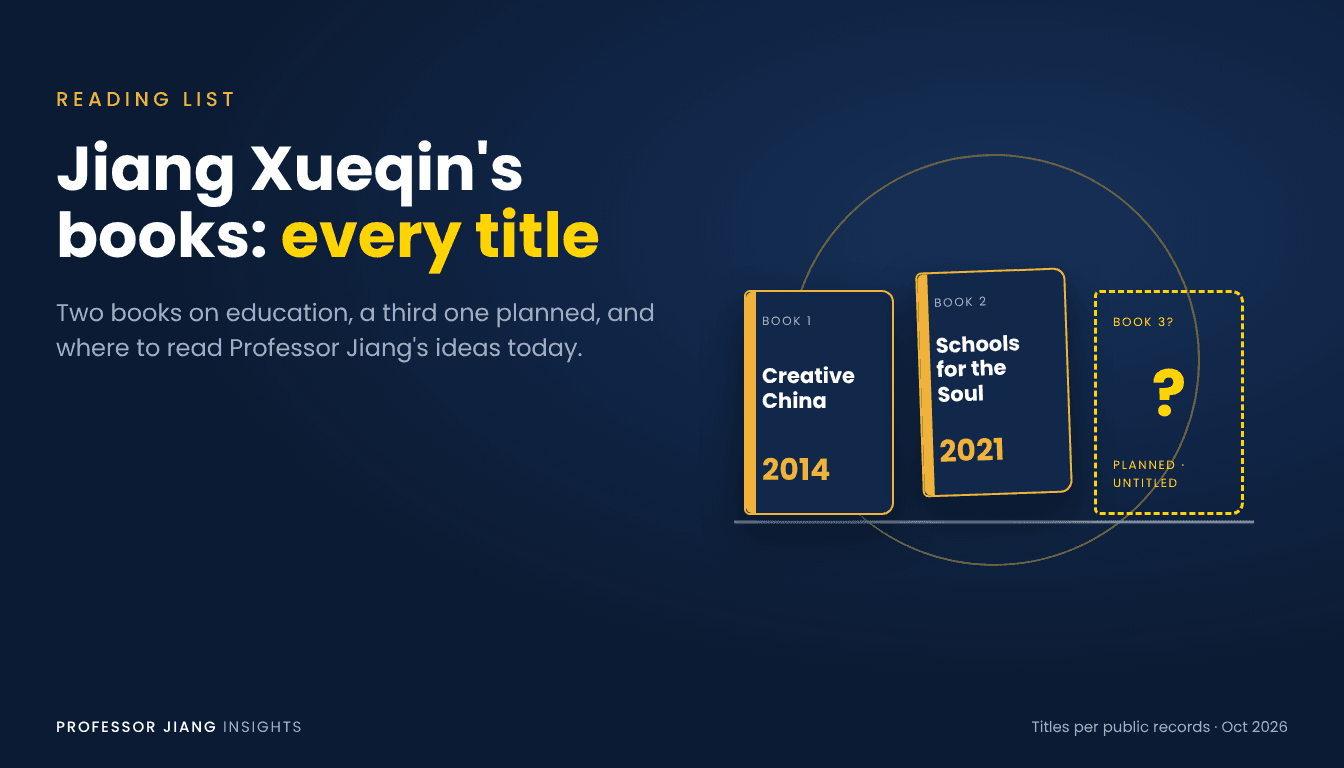
Jiang Xueqin, known online as Professor Jiang, has written two books, both about education and both published in China: Creative China (2014) and Schools for the Soul (2021). He said in December 2025 that he plans a new book, but none is announced yet. Independent guides cover his ideas, including our own, How Power Works.
ANALYSIS
Jiang Insights is independent and not affiliated with Professor Jiang. One of the books below, How Power Works, is our own guide and we sell it. We say so where it appears.
Professor Jiang Xueqin has written two books, and neither is about geopolitics. Creative China (2014) and Schools for the Soul (2021) both come out of his first career as an education reformer in China. As of October 2026 there is no Predictive History book by Jiang himself. If you want his history and forecasting system in book form, your options are independent guides written by other people, and we list them below with what each is good for.
What books has Professor Jiang written?
Two, according to his Wikipedia entry and every profile we checked. Both predate his YouTube fame by years, and both are about how schools should teach:
- Creative China (创新中国教育), 2014, Central Compilation & Translation Press, Beijing. In Chinese.
- Schools for the Soul, 2021. Publisher and language not confirmed in public sources.
That surprises a lot of people who found him through "The Iran Trap" or the Secret History series. The man the internet calls Professor Jiang spent the 2000s as a journalist and the 2010s as a high school administrator, and his books record that second life, not his current one. For the full background, see who Professor Jiang Xueqin is.
Creative China (2014): the education reformer's book
Creative China, published in Chinese as 创新中国教育 (ISBN 978-7-5117-2072-6), is the book of Jiang's reform years. Between 2008 and 2012 he was deputy principal of Shenzhen Middle School and then ran the international division of Peking University's affiliated high school. In both jobs he pushed creativity-focused, discussion-led teaching inside a system built around one exam, the gaokao.
If you read Chinese, treat it as the origin story of the lecturer. The habits that make Predictive History watchable (one big idea per class, students pushed to reason rather than memorize, a teacher who argues with his own material) are the methods he was campaigning for a decade earlier. We found no English edition in print.
Schools for the Soul (2021)
Schools for the Soul is the less documented of the two. Public sources give the title and the year and place it with his writing on education. We could not confirm a publisher or an English retail edition, so be careful with confident secondhand summaries of what it says. The date is the interesting part: 2021 is the year before he started teaching history and philosophy at Moonshot Academy in Beijing, the classes that turned into Predictive History.
Is there a Predictive History book?
Not yet. In the Q&A of his final Secret History lecture in December 2025, Jiang said he is planning to write a book and has an agent. As of October 2026 no title or release date has been announced. Until then, his long-form material lives on the Predictive History YouTube channel, which he started in 2023 to record classes for his students, and in the Predictive History newsletter on Substack. When he announces the book, we will update this page and say so at the top.
Most people looking for "the Jiang book" want the same thing: the Secret History and Geo-Strategy ideas in one place, in order, without forty hours of video. Two books now try to do that, from very different angles.
Books about Professor Jiang
The Professor of Everything: Jiang Xueqin, Predictive History, and the Making of a YouTube Seer (KBA13 Insight, October 2026) is by Kamaruzzaman Bustamam Ahmad, a professor of anthropology of religion at Universitas Islam Negeri Ar-Raniry in Indonesia. It is an outside study, not a summary. It asks whether Jiang's forecasting is real skill or a mix of hindsight, algorithms and charisma, drawing on Isaiah Berlin and Philip Tetlock. It is not affiliated with Jiang.
How Power Works is our own guide to the Secret History series, written by this site's editor and sold here. It turns the lectures into 19 chapters with diagrams, everyday examples and a ledger that checks his claims against the record. It is unofficial: Jiang did not write or endorse it, though he has publicly allowed creative use of his lectures. The first chapter is free if you want to see whether the format works for you before buying.
FACT CHECK
Which one fits you? The Professor of Everything if you want to judge Jiang as a phenomenon. How Power Works if you want his system itself, organized and checked. Creative China if you read Chinese and want to know where the teacher came from.
Books behind his lectures: what Jiang draws on
Since Jiang hasn't written the big book himself, the next best thing is the shelf his lectures pull from. These are the works he returns to most in the lectures we have covered:
- Isaac Asimov, Foundation. Jiang names Asimov's fictional psychohistory as the inspiration for Predictive History. Read it for the ambition, not the method.
- Peter Turchin, End Times (2023). The most readable version of elite overproduction, one of the engines in Jiang's model of how societies collapse.
- Enuma Elish. The Babylonian creation epic sits at the heart of his account of how early empires justified their power.
- Homer and Genesis. He reads them side by side as two opposite answers to the problem of forgiveness.
- John Milton, Paradise Lost. Read through a Gnostic lens, it anchors his lectures on the hidden god and the rebel hero.
One caution. Jiang reads widely and fast, and he uses these books as springboards rather than authorities to summarize faithfully. Going to the originals is the quickest way to see where his synthesis is strongest and where he stretches a source to fit.
Where to read Professor Jiang in English today
Before YouTube, Jiang wrote op-eds for CNN, The Wall Street Journal, the Chronicle of Higher Education and the Chinese edition of The New York Times, mostly about Chinese schooling. Today his own writing goes out through the Predictive History newsletter on Substack. For his forecasts, we keep a strict scorecard of every call against what happened: start with Professor Jiang's latest predictions, then see how his prediction accuracy holds up overall.
New analyses go out first on Telegram.
Frequently asked questions
Has Professor Jiang written a book?
Yes, two, both about education and both published in China: Creative China (2014) and Schools for the Soul (2021). Neither covers Predictive History or his geopolitical forecasts.
Is there a Predictive History book?
Not yet. In December 2025 Jiang said he is planning to write a book, but as of October 2026 no title or date has been announced. Independent guides exist, including our own How Power Works, which is unofficial.
Did Professor Jiang write How Power Works?
No. How Power Works is an independent guide to his Secret History lectures, written by Adrian Vale for Jiang Insights. Jiang did not write, review or endorse it.
What books influenced Professor Jiang's Predictive History?
He names the psychohistory of Isaac Asimov's Foundation novels as an inspiration, leans on Peter Turchin's work on elite overproduction, and builds many lectures on ancient texts such as the Enuma Elish, Genesis and Homer.