ANALYSIS
This article summarizes Professor Jiang Xueqin's views as we understand them from his recorded lectures. It is independent analysis, not his official statement, and Jiang Insights is not affiliated with him. Errors in summarizing are ours.
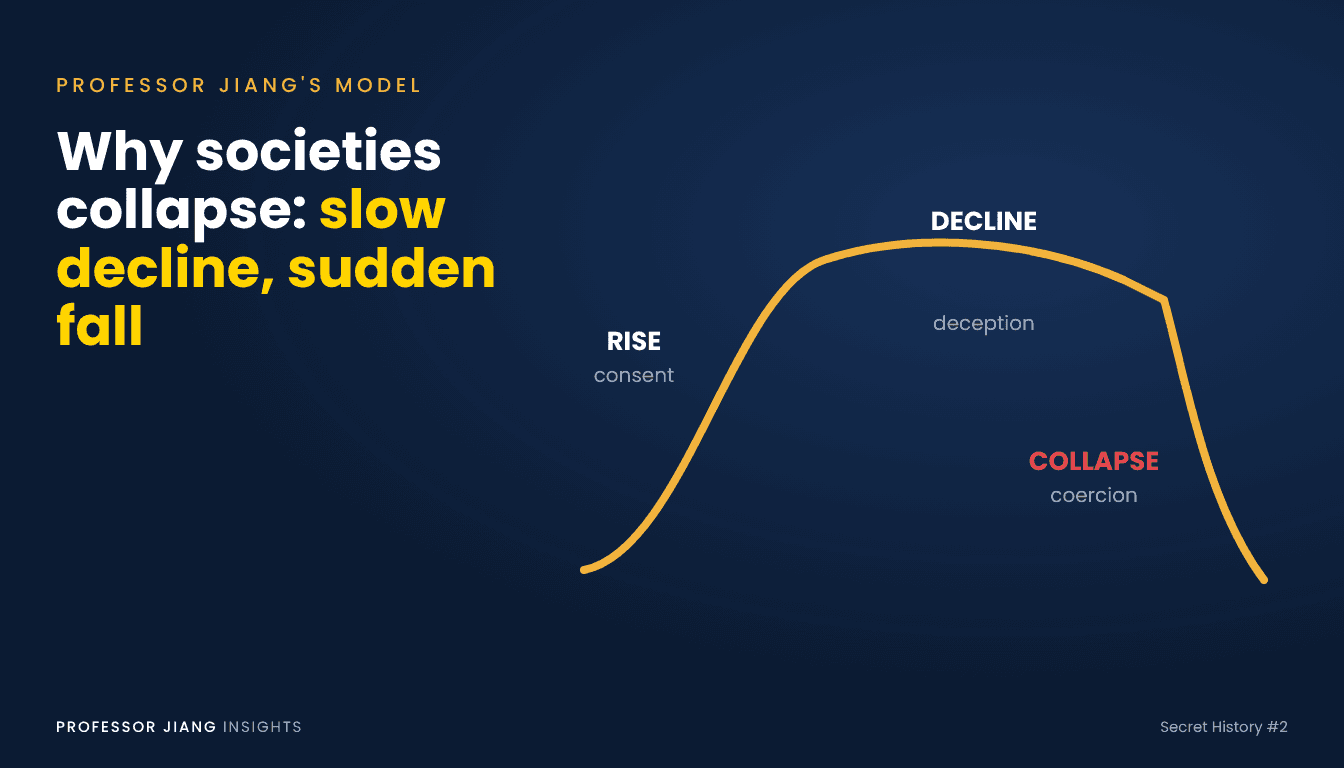
Societies collapse, in Professor Jiang Xueqin's model, in three phases: a steep rise built on consent, a long decline run by deception, and a sudden collapse enforced by coercion. In his second Secret History lecture he combines three famous theories of decline into one machine and uses it to make five predictions about the West. Here is the model, the evidence behind each piece, and where it is hardest to test.
What are the main theories of why societies collapse?
Jiang starts from three (10:21). Thomas Piketty's financialization: when returns on capital (about 5% a year) outrun real growth (about 2%), money flows into markets rather than production, and wealth concentrates. Peter Turchin's elite overproduction: too many would-be elites fighting over too few top positions. And Oswald Spengler's life cycle: civilizations grow from village to town to city to megacity, becoming more abstract, individualistic and childless until they die.
Outside Jiang's lecture, two more theories dominate the field. The archaeologist Joseph Tainter argued in The Collapse of Complex Societies (1988) that societies keep adding complexity to solve problems until the returns turn negative. And six centuries ago the North African historian Ibn Khaldun described dynasties founded by groups with strong solidarity that go soft and divided in the cities they conquer, usually within a few generations.
Who runs a society, according to Professor Jiang?
At the core, Jiang says, sit a few founding families, at most a hundred or so; Rome, for all its size, was run by about two hundred (30:47). They hold power through three pillars: finance, religion (today's religion being science and technology) and intelligence (31:28). His metaphor for the rest is a corporation (33:50): the families are owners, ordinary people are workers who produce real wealth, and the middle class are managers.
In the rise, owners let managers run things and treat workers well, and we call that democracy. Then the families produce too many heirs who want money and positions, the company goes into debt, and the managers turn on the workers to prove they're still needed (36:44). Finally the elite splits into factions, each recruiting part of the middle class and the people, and the result is civil war or revolution. Foreign invaders often arrive by invitation: a faction hires mercenaries, and the mercenaries take over (39:30). History offers vivid cases: in the 1340s a Byzantine claimant brought Ottoman troops into Europe to win a civil war, and a century later the Ottomans took Constantinople.
What are Professor Jiang's three phases of society?
This is the most reusable part of the lecture (43:00):
- Rise: open and meritocratic, ruled by consent, focused on unity. Critics are heroes.
- Decline: bureaucratic, ruled by deception, focused on stability. Things stop improving.
- Collapse: authoritarian, ruled by coercion, focused on survival. Critics are enemies.
His illustration is a class lunch (46:26). In the consent phase the students debate McDonald's versus KFC and vote. In the deception phase the teacher says there are free burgers at McDonald's today. In the coercion phase he says he'll beat them up if they don't come. Political thinkers have described the same arc for a long time: Polybius's cycle of governments, and Antonio Gramsci's argument that ruling classes govern through consent and fall back on force when consent fails.
Why do societies collapse so suddenly?
The curve, Jiang says, is a steep rise, a slow decline and a sudden collapse (48:11). A society can prepare for a plague, a drought or a war. It can't prepare for all of them arriving together, and by then the people who could have warned it are being silenced (49:41). The Roman philosopher Seneca made the same observation two thousand years ago: growth is slow, ruin is fast. The scientist Ugo Bardi calls it the Seneca effect.
His claim that 1950s China was as open as 1950s America is the part that needs a footnote. In 1956 Mao invited criticism in the Hundred Flowers campaign; within a year the Anti-Rightist Campaign had labeled roughly half a million critics as enemies. It is Jiang's model on fast-forward.
What does Professor Jiang predict for the West?
With the model built, he makes five predictions for the next five to twenty years, in no fixed order (50:26). Here is where each stands as of October 2026:
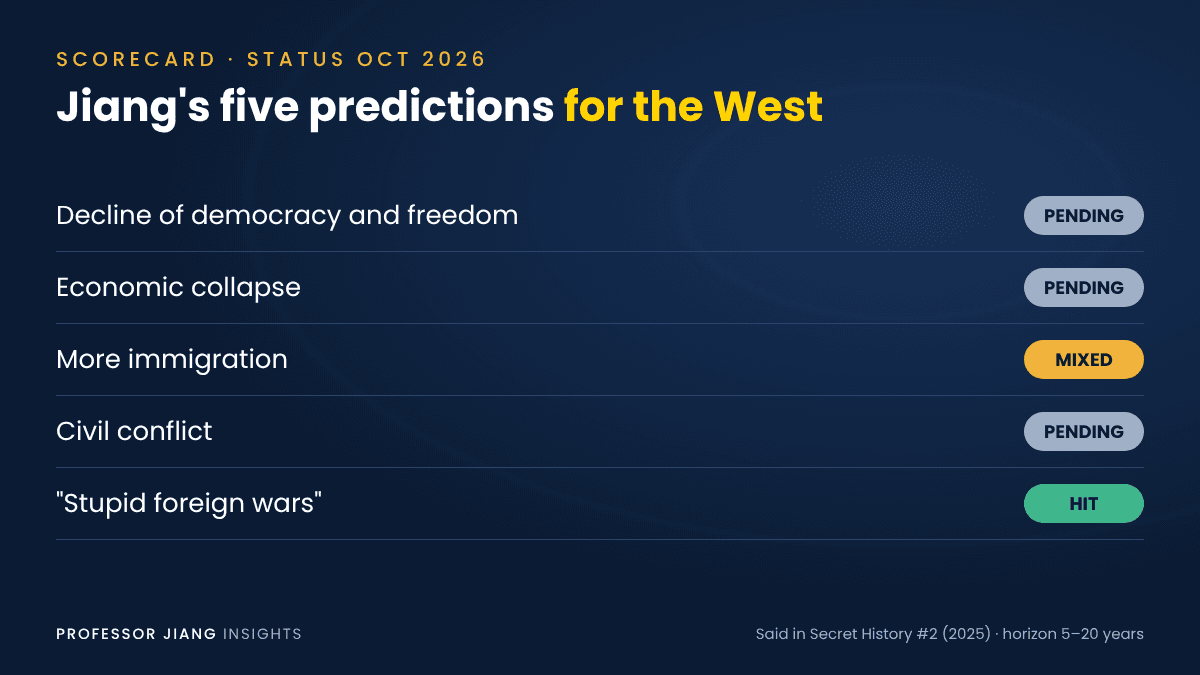
- Decline of democracy and freedom: pending. V-Dem's annual reports have counted more countries becoming less democratic than more democratic for over a decade.
- Economic collapse: pending. Oil passed $100 during the 2026 Iran war, but there has been no systemic crash.
- More immigration: mixed. The US cut immigration sharply in 2025 and Canada lowered its targets in late 2024.
- Civil conflict: pending, with warning signs such as the 2024 riots in England and rising political violence in the US.
- "Stupid foreign wars": the US has been at war with Iran since February 28, 2026.
Asked whether wars are used to distract people, he says that is exactly what they're for: rulers choose between war and revolution. He also gives his own test for being wrong: if Trump, Putin and Xi became best friends tomorrow, his model would fail (55:17). We track each of these strictly on Professor Jiang's latest predictions.
Is the model right?
The strongest objection is that it explains too much. Every society shows some signs of decline at any moment, so "slow decline, sudden collapse" can't be caught out on timing. Political scientists who test the idea that leaders start wars to distract their publics find weak and mixed evidence. And Spengler predicted the West's death in 1918; a century of depression, world war and unrest later, it is still here.
What survives is a practical checklist: the gap between financial and real returns, elite competition, trust, birth rates, how institutions treat their critics, and whether shocks arrive one at a time or together. Turchin built a forecast from similar indicators and was right about the 2020s. Jiang's addition is a sharper focus on who gains at each stage, and a willingness to put dates on it.
What the record shows
Each piece of Jiang's model has serious scholarship behind it, from Piketty and Turchin to Ibn Khaldun and Tainter. The combination is his own, and its value depends on the predictions it produces. One of the five, foreign war, has already arrived; the rest are open. For the experiment he uses to explain status competition, see Universe 25, and for his overall record, is Professor Jiang really 77% accurate?
The rise-and-fall model is Chapter 2 of our guide to Jiang's Secret History series, with diagrams and worked examples. Start with the first chapter, free, and get new breakdowns on Telegram.