ANALYSIS
This article summarizes Professor Jiang Xueqin's views as we understand them from his recorded lectures. It is independent analysis, not his official statement, and Jiang Insights is not affiliated with him. Errors in summarizing are ours.
By the numbers, America has drifted toward gerontocracy, rule by the old. Donald Trump became the oldest president ever inaugurated in 2025, Joe Biden ended his reelection bid at 81, and senators have served into their nineties. Professor Jiang Xueqin argues that the deeper problem isn't old politicians but rich pensioners: the one group that gains from almost every trend squeezing younger Americans. Here is what gerontocracy means, what the data says about age and power, and where his argument is strongest.
What is a gerontocracy?
A gerontocracy is a system in which the oldest members of a society hold power. The word comes from the Greek geron, old man. Ancient Sparta was governed partly by the Gerousia, a council of 28 men over sixty plus the two kings. The modern example everyone cites is the Soviet Union around 1980, when Leonid Brezhnev, Yuri Andropov and Konstantin Chernenko died in office within three years of each other, and the system's inability to change was hard to miss.
How old are America's leaders?
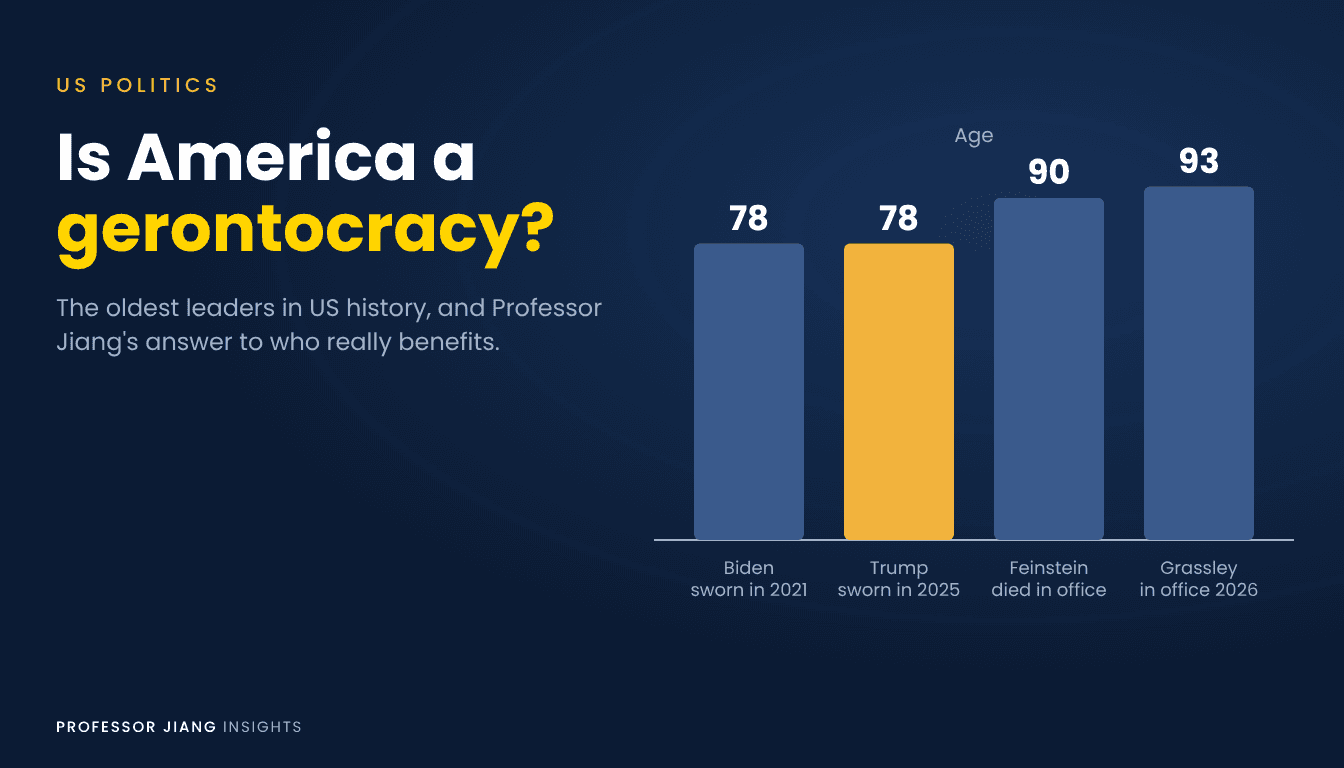
Older than ever. Biden was 78 at his inauguration in 2021 and withdrew from the 2024 race at 81 after a debate that raised questions about his age. Trump returned in January 2025 at 78, the oldest president ever sworn in. Senator Dianne Feinstein died in office in September 2023 at 90. Senator Chuck Grassley, born in 1933, has continued to serve into his nineties. Senate leader Mitch McConnell froze mid-sentence at two press appearances in 2023. Congress has no term limits, incumbents rarely lose, and seniority brings power, so the people at the top stay there.
Jan 2021
Joe Biden inaugurated at 78
2023
Mitch McConnell freezes at two press appearances
Sep 2023
Dianne Feinstein dies in office at 90
Jul 2024
Biden ends his reelection bid at 81
Jan 2025
Donald Trump inaugurated at 78, the oldest ever
What does Professor Jiang say about gerontocracy?
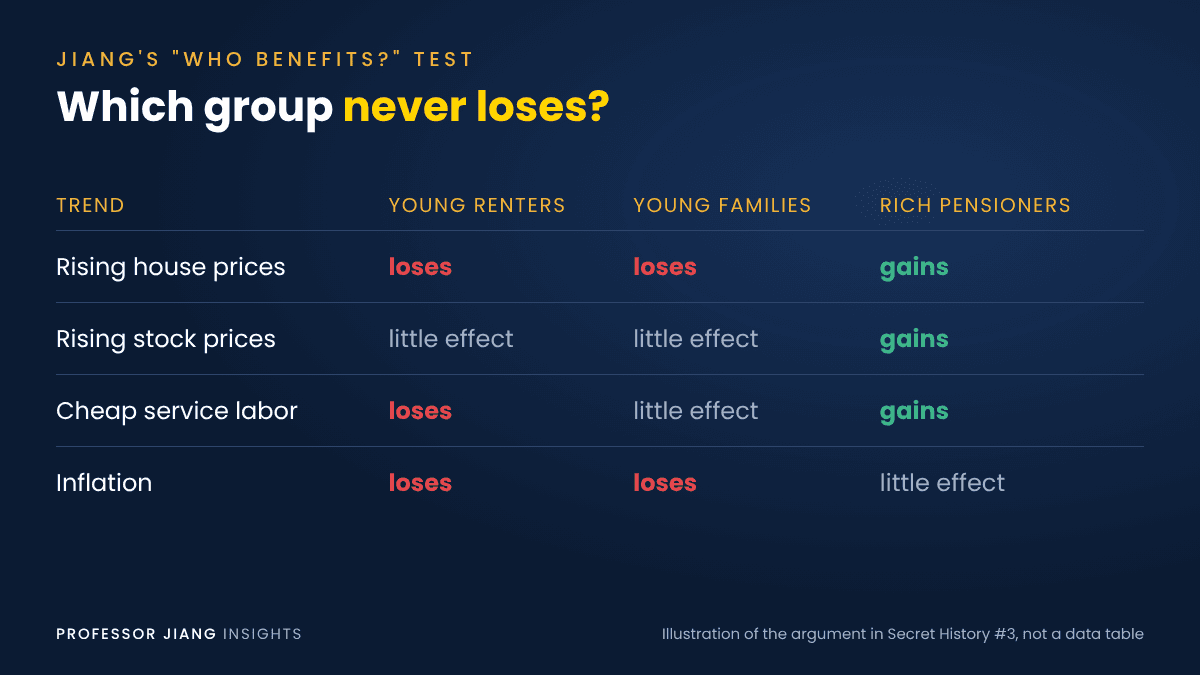
In Secret History #3, "Death by Gerontocracy," Jiang lays out the signs of Western decline (unaffordable housing, inflation, booming stocks alongside a weak real economy, mass immigration, falling birth rates, record debt) and then teaches his core method: "Whenever you have a problem, you always ask yourself who benefits" (30:57). His answer is rich pensioners (31:13). They own the homes, often more than one, so they gain when prices rise. They own the shares. They need caregivers, cooks and gardeners, so they gain from cheap immigrant labor. And inflation, low birth rates and government spin barely touch them.
He is careful to say that most old people aren't rich; the problem is that there have never been so many old, rich people at once. Then he draws a table (39:39): the young are rebellious and open-minded, the elderly reactionary and focused on safety. A society run by the elderly, he predicts, will lock down at the first virus, build surveillance and speech laws, push digital money, fill prisons, import labor and fight "war after war" (40:31). "Elderly people are perfectly happy to send young people to die for their glory."
Who owns America's wealth?
The Federal Reserve's distributional accounts back the core of Jiang's argument. The baby-boom generation holds roughly half of all US household wealth, and the top 10% of households own about 93% of stocks. Older Americans also vote at much higher rates than younger ones, which gives their interests outsized weight. Housing is the clearest case: research on immigration and housing, such as Albert Saiz's study of US cities, finds that sudden population inflows push up rents and prices in the short run, which helps owners and hurts renters, who skew young.
Will Social Security run out?
Jiang predicts pension systems will go bankrupt within five to ten years (36:47), because they were designed for people who would die soon after retiring. The 2025 Social Security trustees' report projected that the main retirement trust fund will be exhausted in 2033, inside his window. "Bankrupt" overstates it: after 2033, incoming payroll taxes would still cover about 77% of scheduled benefits unless Congress acts. The ratio of workers to beneficiaries, now under three, is heading toward about 2.3 by 2035. His claim that there are already more pensioners than workers is wrong for Social Security, but the direction is right.
CAUTION
Jiang tells his students not to put money into a pension. That is his view, not financial advice. For many employees, a workplace retirement plan with an employer contribution is free money they would give up by not joining. Check your own plan's terms.
Is gerontocracy really the problem?
The strongest objection is Japan. It is the oldest major society on earth, yet housing is cheap across most of the country, large-scale immigration is recent, and there is no appetite for foreign wars. If old age produced Jiang's list automatically, Japan should show it most clearly. Many economists also blame zoning, monetary policy and globalization for the trends he lists, with older homeowners as beneficiaries rather than planners.
What survives is the incentive argument. In the US, UK, Canada and Australia, the people who gain from the status quo are older on average than those who lose, they vote more, and policy has tilted their way for decades. Some items on Jiang's list are already law: Britain's Online Safety Act passed in 2023. Others, such as implanted microchips, have no basis in any government plan.
What the record shows
America's leadership is older than at any point in its history, and the wealth data supports Jiang's "who benefits" answer. His pension warning is directionally right and early on timing. His bleakest conclusion, that the young can do nothing, is the least supported: generational politics has shifted before. The "war after war" part of his forecast connects to his warnings about a return of the draft, and his view of aging societies to Universe 25.
Gerontocracy is Chapter 3 of our guide to Jiang's Secret History series. Read the first chapter free, track Professor Jiang's latest predictions, and follow us on Telegram.