Is Trump Trying to Lose the Iran War? Jiang's Theory
Professor Jiang Xueqin argues Trump is not trying to win the Iran war. In an April 2026 interview he said Trump is using peng sha, a Chinese tactic of ruining rivals by giving them what they want, letting war hawks own the outcome while preparing an exit through JD Vance and Tulsi Gabbard. The theory concerns intent and cannot be proven directly.
ANALYSIS
This article summarizes Professor Jiang Xueqin's views as we understand them from his recorded interviews. It is independent analysis, not his official statement, and Jiang Insights is not affiliated with him. Errors in summarizing are ours.
Is Trump trying to lose the Iran war? Professor Jiang Xueqin thinks winning was never the point. In an April 2026 interview with Jack Neel, he argued that Trump is using a Chinese tactic called peng sha: give the war's backers everything they want, so that failure lands on them, while keeping an exit ready through JD Vance and Tulsi Gabbard. There is no public evidence of such a plan; this is a reading of motives. Here is the theory, what it rests on, and how it fits what Trump has done since.
What does Jiang mean by "Trump wants to lose"?
His claim is narrower than the podcast title. He says Trump has "no ego in this thing": whether America wins or loses is not a factor in his calculations. What matters, in Jiang's view, is a third term and a mission Trump believes is God-given, to free America from what Jiang calls the transnational financial elite, the military-industrial complex and the deep state. Starting the war hands those rivals the stage. If it goes badly, they own it.
His account has a tension worth noticing. Later in the same interview he says the war "will only escalate" and that there can be no off-ramp, because the Pentagon will not walk away from its sunk costs. The two threads fit together only if Trump personally steps back while the machine he no longer steers keeps going.
What is peng sha?
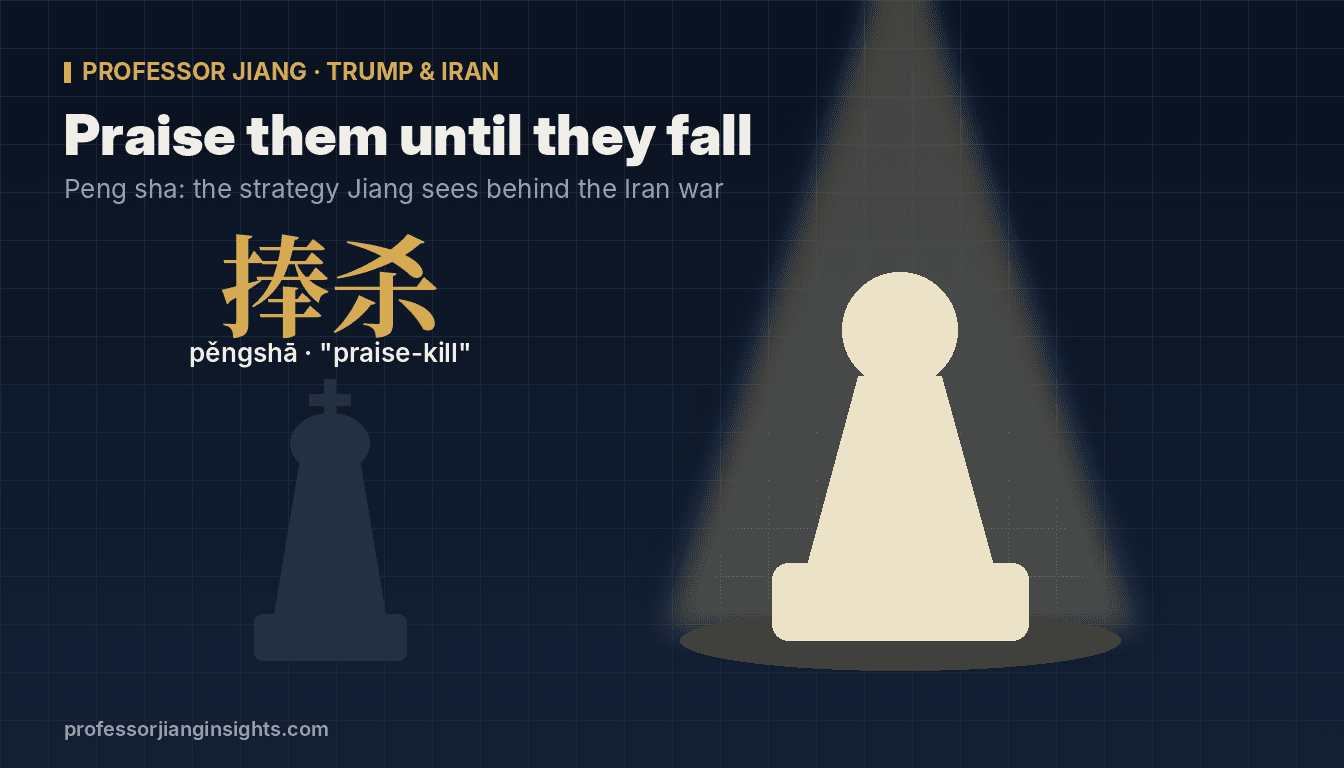
Peng sha (捧杀) translates roughly as "praise-kill": ruining someone by flattering and indulging them until they overreach. Jiang says Chinese managers use it on rivals. He pairs it with the Greek idea of hubris and the proverb that those the gods would destroy, they first make proud. The familiar English line actually ends "first make mad", a 17th-century rendering of an older Greek sentiment, but the point he draws is the same. His parenting version: you love a child by refusing the candy, not by handing over whatever he demands.
Why Jiang points to Jared Kushner
Kushner holds no government post, yet with envoy Steve Witkoff he has been at the center of Trump's second-term diplomacy, from Gaza to Ukraine to Iran. Jiang's question: would a real puppet master put himself in a spotlight where every failure carries his name? His answer is that Trump, who prizes loyalty above everything, has not forgiven Kushner and Ivanka Trump for stepping away after January 6, 2021, when much of his circle distanced itself.
The public record supports part of that. Kushner left the White House in 2021, built an investment firm and stayed out of the 2024 campaign; his return as an informal negotiator came in 2025. The grudge is Jiang's inference. Neither man has suggested one.
The off-ramp: Vance and Gabbard
Jiang sees two camps in the administration: an anti-war wing around Vice President JD Vance and Director of National Intelligence Tulsi Gabbard, and hawks he lists as Marco Rubio, Pete Hegseth, Kushner and Witkoff. Why else, he asks, would a former Democrat run US intelligence? The script he expects: Trump says he was misled by the hawks, "sees the light", joins the anti-war camp, and Vance and Gabbard tell MAGA voters to forgive him because he is their best hope of ending the war. He notes that prominent MAGA voices such as Tucker Carlson opposed the war from the start, calling it a betrayal of America First.
Six months on, Trump has taken exits more than once without leaving the war. A Pakistan-brokered ceasefire began April 8, three days before the interview went out. A memorandum signed in Islamabad in June was meant to end the war and reopen Hormuz; it collapsed in July. On October 8, Trump said the US would not attack before the midterms, and on October 20 oil fell on reports of a new US-Iran compromise proposal. None of it has been framed as the Vance-Gabbard conversion Jiang described, at least not yet.
Does Trump drink alcohol?
No. Trump has said he has never had a drink, and he has tied that to his older brother, Fred Trump Jr., who died in 1981 at 42 after years of alcoholism. Jiang, who says he only learned this recently, uses it as evidence of discipline: a man who stayed sober while hosting the most lavish parties in New York was managing his image, not enjoying himself. He adds that Trump talked about running for president as far back as the late 1980s, which is accurate.
How Jiang reads Trump's first term
The shift in strategy, Jiang argues, came from what Trump experienced the first time: the Russia investigation, a 2020 defeat Jiang calls stolen, January 6, the Mar-a-Lago search and a wave of lawsuits. In the first term Trump fought the establishment head-on and took the blame; in the second he lets it lead and take the blame instead. Some of the record he cites is contested fact rather than interpretation. The Mueller report did not establish a criminal conspiracy with Russia, but it documented extensive Russian interference and did not clear Trump on obstruction. Courts, and Trump's own attorney general at the time, found no fraud on a scale that could have changed the 2020 result.
What the record shows
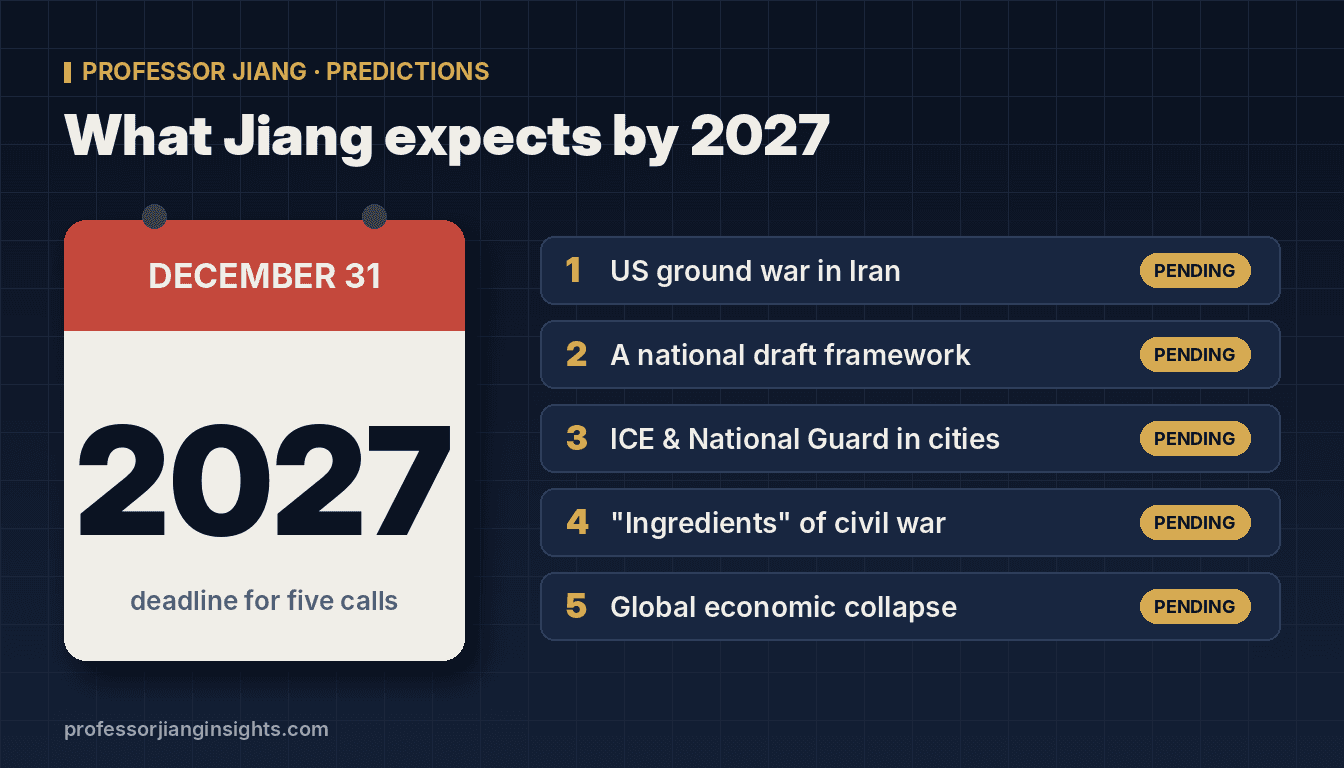
The theory explains some things well: the outsized role of Kushner and Witkoff, the open split between restrainers and hawks, and Trump's repeated willingness to take a ceasefire. It cannot be tested directly, because it is about intent. What can be tested is the escalation Jiang predicted in the same conversation, a US ground invasion, which has not happened. We score it in Professor Jiang's 2027 predictions, follow the market odds in our Iran invasion forecast, and keep every dated call on Professor Jiang's latest predictions.
Frequently asked questions
Is Trump trying to lose the Iran war?
There is no evidence of a deliberate plan to lose. Professor Jiang argues Trump is indifferent to the outcome and uses the war to put rivals in the spotlight, so they take the blame if it fails, while he keeps an exit ready.
What does peng sha mean?
Peng sha (捧杀) is a Chinese expression meaning roughly "praise-kill": ruining someone by flattering and indulging them until they overreach and fail.
Does Trump drink alcohol?
No. Trump has said he has never had a drink and has linked it to his older brother Fred Trump Jr., who died in 1981 after years of alcoholism.