Is the Draft Coming Back? What Professor Jiang Predicts
No US draft has been authorized; the last inductions were in 1973 and restarting them requires Congress. From December 2026, men aged 18 to 25 will be registered with Selective Service automatically. In a September 2026 interview, Professor Jiang Xueqin told young Americans to enlist now, arguing a national draft is coming within about four years.
· Updated
ANALYSIS
This article summarizes Professor Jiang Xueqin's views as we understand them from his recorded interviews. It is independent analysis, not his official statement, and Jiang Insights is not affiliated with him. Errors in summarizing are ours.
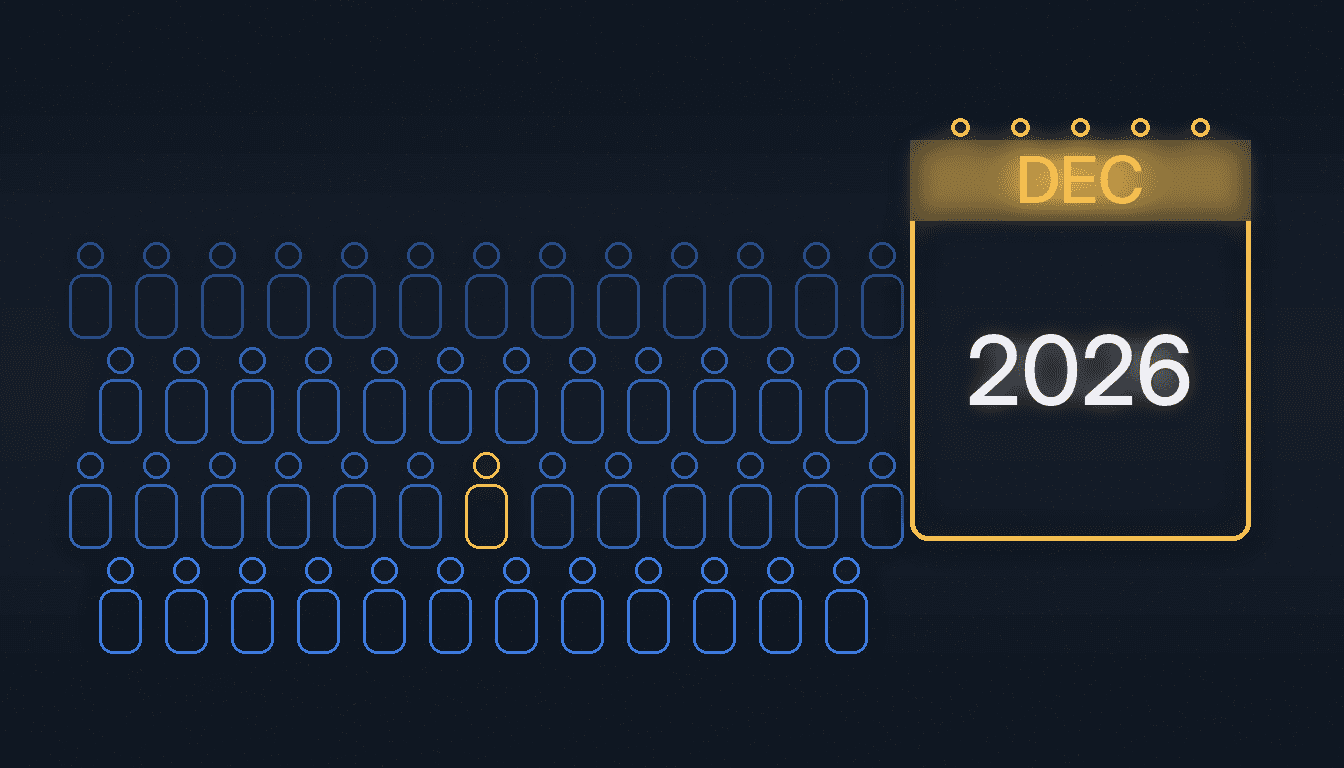
Is the draft coming back? Not as of October 2026. No one has been drafted in the United States since 1973, and restarting inductions would take a new act of Congress. What does change is registration: from December 2026, the Selective Service System will register eligible men aged 18 to 25 automatically, using federal data instead of a form. In a September 2026 interview, Professor Jiang Xueqin went further and told young Americans to enlist now, before a national draft arrives. Here is what the new law does, how a draft would work, and how his call holds up.
What changes in December 2026?
The change comes from the fiscal 2026 National Defense Authorization Act, which Trump signed in December 2025. Until now, men had to sign up themselves, often through a box on a driver's license form. Forty-six states and territories already did that automatically, and more than 60% of registrations in 2023 came through state motor vehicle offices. From December, the Selective Service will pull names from federal databases instead.
Rep. Chrissy Houlahan, the Democrat who sponsored the provision, sold it as a way to save advertising money and to stop young men from being penalized for a deadline they never knew about. It passed both chambers with votes from both parties. It does not authorize a draft, and it does not change who would be called if one came.
Who has to register for Selective Service?
Almost every man living in the US between his 18th and 26th birthdays: citizens, green card holders, refugees, asylum seekers and undocumented men. Men on temporary visas, such as foreign students, are exempt. Women are not required to register; proposals to include them have been dropped from past defense bills.
Failing to register is technically a felony, punishable by up to five years in prison and a $250,000 fine, though prosecutions are almost unheard of. The real costs are quieter: men who never registered can be barred from federal jobs, lose some state student aid, and face questions when they apply for citizenship.
How would a US military draft work?
Only Congress can restart inductions; a president cannot do it alone. If it did, a lottery by birth date would set the order. Men turning 20 that year would be called first, then those aged 21 to 25, then 19-year-olds, then 18-year-olds more than six months past their birthday. Anyone called could request a deferment or exemption, and the rest would go through physical, mental and moral screening before induction.
The last inductions took place in early 1973, at the end of the Vietnam War. Since then the US has run an all-volunteer force, and the Pentagon has told Congress for decades that it prefers volunteers: they serve longer, re-enlist more often and cost less to train.
What did Professor Jiang predict about the draft?
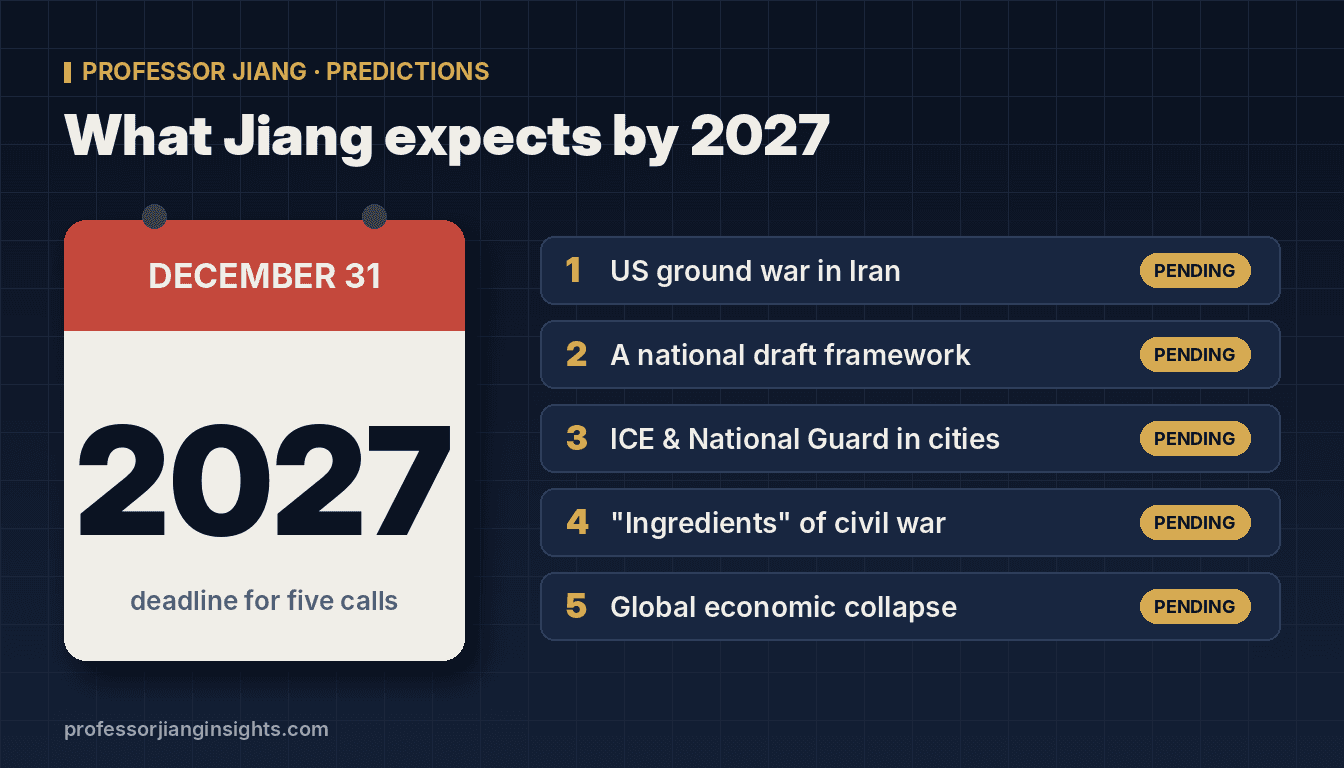
On the Jack Neel podcast on September 19, 2026, Jiang gave the most direct advice he has offered on the subject. If you are young and your family is not rich, he said, your best option for the next ten years is to join the military today, because the national draft is coming.
His reasoning has three parts. First, volunteers get to choose. He compared it to Vietnam, where enlisting could land you a desk job while draftees went to the jungle. Second, he does not see the draft mainly as a way to fight Iran. He calls it "a bureaucratic solution" to economic collapse, a way to give idle young men something to do, and points to the work programs of the 1930s. Third, timing. Join now, he argued, and in a few years you might be an administrator somewhere in the Western Hemisphere; wait four years until the Iran war worsens, and you may be sent there instead.
He added a darker idea: that open social media lets governments, working with data firms like Palantir, build psychological profiles of young men, and that when a draft comes the most outspoken would be sent first and the most compliant given safe postings. He admitted he had no idea how watching his own videos would register in such a database.
The interview builds on his June 2026 lecture, where he tied a coming draft to a dollar collapse and a depression. The new element is the advice to volunteer first.
His draft forecast leans on a broader idea: that societies run by the old start treating the young as a problem to manage. That argument is Chapter 3, "Death by Gerontocracy", of How Power Works, our guide to his Secret History lectures.
Does enlisting now protect you from a draft?
Partly, and history is on his side here. During Vietnam, hundreds of thousands of young men enlisted in the Navy, the Air Force or the National Guard precisely to avoid being drafted into the Army infantry, and enlistees could often pick their specialty. A volunteer today also signs a contract with a chosen job and set terms, which a draftee would not get.
The weaker part is the claim that a draft is needed. Jiang is right that recruiting has turned around: all five services met their fiscal 2026 targets early, reaching 103% of the active-duty goal, and the Navy signed 45,000 recruits three months ahead of schedule. But that cuts against a draft. A military filling its ranks with volunteers has little reason to ask Congress for conscripts.
Two details need correcting. Jiang suggested that many new recruits are undocumented immigrants trying to stay in the country, but undocumented immigrants cannot enlist; only green card holders can. And the 1930s programs he cited were voluntary. The Civilian Conservation Corps put about three million young men to work between 1933 and 1942, but nobody was drafted into it. The first peacetime draft came in 1940, as war approached.
The strongest version of his point survives those corrections. Across Europe, service schemes are returning as an answer to both security and idle youth: Lithuania, Sweden and Latvia restored conscription, and Germany now requires 18-year-old men to fill in a service questionnaire. Automatic registration in the US is a small step in the same direction, even if it is not a draft.
What would make a real draft likely?
A large ground war. Volunteers can sustain air and naval campaigns, but Jiang's own scenario for 2028 has US troops stuck on the ground in Iran, a draft being called and protests across the country. That is why this call is tied to his forecast of a US ground invasion of Iran. The warning signs would come in a rough order: stop-loss orders that keep soldiers past their contracts, large reserve and Guard mobilizations, missed recruiting targets, and only then a bill in Congress authorizing inductions.
How we will score the draft prediction
Jiang's clearest timeline is his wait-four-years line, so we set the test at four years from the interview: a hit if Congress passes, and the president signs, a law authorizing draft inductions before September 19, 2030. Automatic registration, new questionnaires or wider age limits do not count. The call sits on our predictions scorecard with his other open forecasts; for how his dated calls have scored so far, see is Professor Jiang really 77% accurate?
1940
First US peacetime draft
1973
Last draft inductions; all-volunteer force begins
1980
Selective Service registration restored
Dec 2025
Defense bill orders automatic registration
Sep 19, 2026
Jiang: young people should enlist now
Dec 2026
Automatic registration begins
Sep 19, 2030
Our deadline for the draft call
Frequently asked questions
Is there going to be a draft in 2026?
No draft has been authorized. Restarting inductions requires an act of Congress. What changes in December 2026 is that eligible men aged 18 to 25 are registered with the Selective Service automatically.
What age do you have to register for the draft?
Men must be registered from their 18th birthday until their 26th. From December 2026 this happens automatically using federal data.
Do women have to register for Selective Service?
No. Proposals to require women to register have been debated in past defense bills but were dropped, and the 2026 change applies only to men.
What happens if you don't register for the draft?
It is a felony with penalties of up to five years in prison and a $250,000 fine, though prosecutions are extremely rare. Men who never registered can be barred from federal jobs and some state aid, and it can complicate a citizenship application.
Can immigrants be drafted?
Most immigrant men living in the US, including green card holders, refugees, asylum seekers and undocumented men, must register and could be called in a draft. Men on temporary non-immigrant visas are exempt.