ANALYSIS
This article summarizes Professor Jiang Xueqin's views as we understand them from his recorded lectures. It is independent analysis, not his official statement, and Jiang Insights is not affiliated with him. Errors in summarizing are ours.
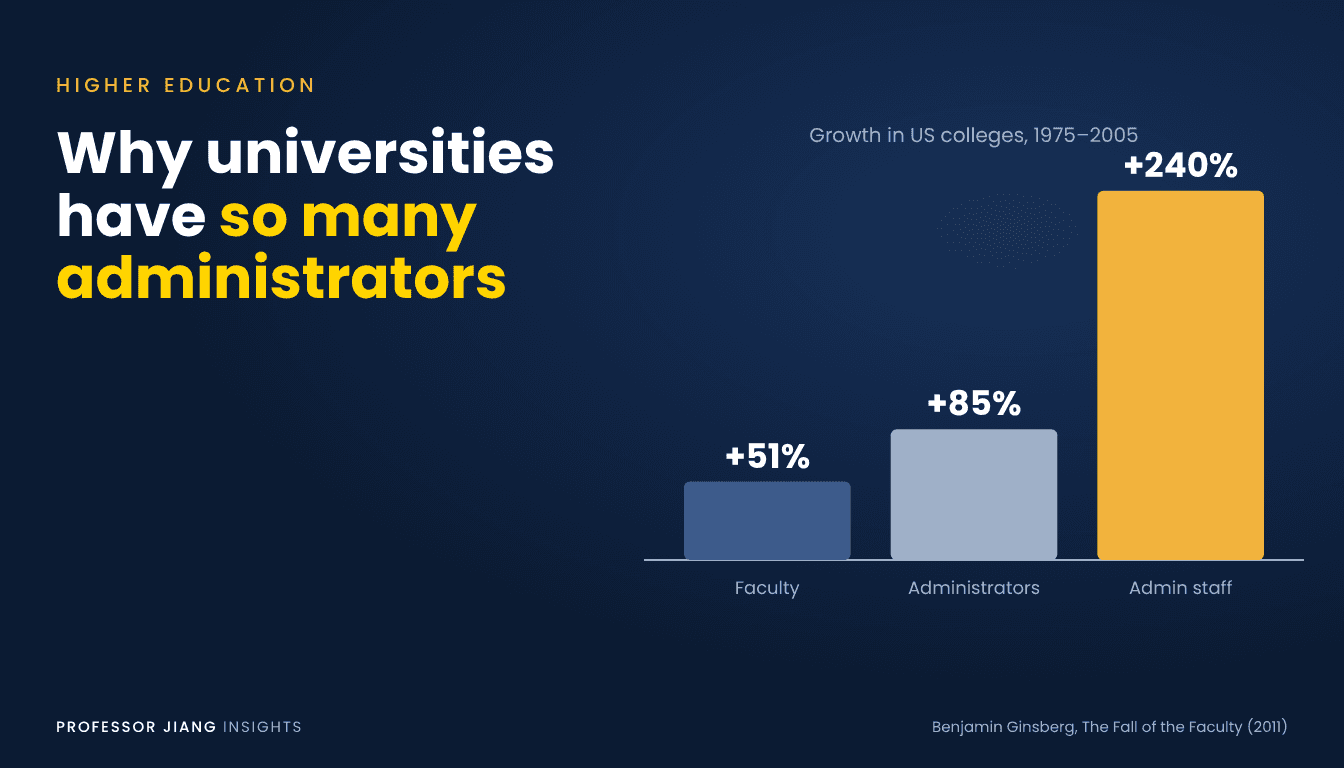
American universities have added administrators far faster than professors for half a century. The political scientist Benjamin Ginsberg found that between 1975 and 2005 the number of faculty grew by about 50%, while administrators grew by about 85% and administrative staff by about 240%. The usual explanations are regulation, student services and the race for prestige. Professor Jiang Xueqin offers a blunter one: bureaucrats create problems so they can be paid to solve them. Here is the evidence for each.
How fast has university administration grown?
Ginsberg's book The Fall of the Faculty (2011) made the numbers famous, and later studies of individual systems show the same shape. In his lecture, Jiang shows charts from the University of California, Illinois and Sweden (20:51): teaching staff roughly flat, management swelling, management pay rising while teaching pay stagnates, and academics spending close to a fifth of their time on paperwork. At many large universities, non-faculty professional staff now outnumber faculty.
Why has university administration grown?
There are real reasons. Federal and state rules on financial aid, research grants, discrimination, disability access, campus safety and data privacy all require staff. Students now expect mental-health services, career offices and housing support. Fundraising and research administration have become industries of their own. And the economist Howard Bowen proposed a simpler rule in 1980, the "revenue theory of cost": in the pursuit of prestige, universities raise all the money they can and spend all the money they raise.
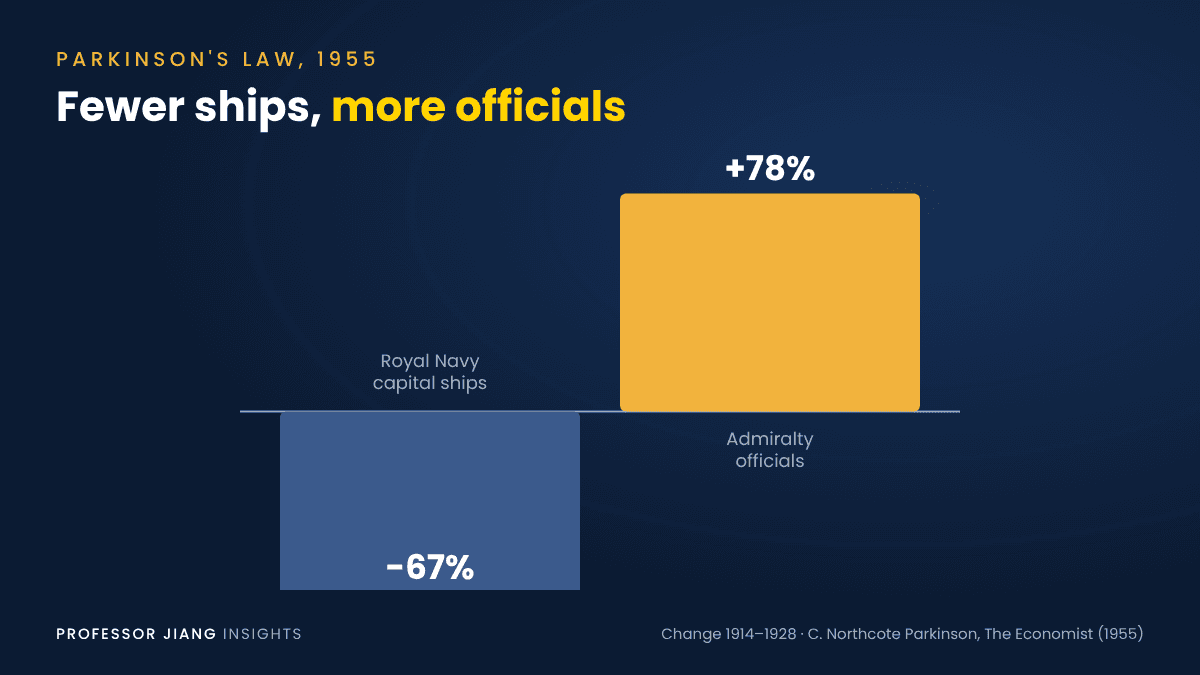
There is also an older, less flattering explanation. In a 1955 essay in The Economist, the historian C. Northcote Parkinson noted that between 1914 and 1928 the number of capital ships in the Royal Navy fell by about two-thirds, while the number of Admiralty officials rose by nearly 80%. Parkinson's law, that work expands to fill the time available, was a joke with a table behind it. Bureaucracies grow because the people in them hire subordinates, and nobody inside has a reason to stop.
What does Professor Jiang say about university bureaucracy?
In Secret History #8, "Death by Bureaucracy," Jiang starts with Yale's 2015 Halloween controversy and asks his class to choose between a "safe space" and a "free space" (01:57). He sets aside the usual explanations for campus conflict (spoiled students, consumerism, ideology) and argues that universities have become bureaucracies that serve their administrators (11:16).
Professors teach and do research, he says; deans don't have real jobs, so they "make problems for everyone in order to create solutions" (15:57). Thirty years ago a Yale student with a problem went to a professor; today there are twenty offices to complain to. He sees the same pattern beyond campus: in government, in the military, where officers have multiplied relative to soldiers, and in hospitals and insurers. He connects it to Kafka's The Trial, Hannah Arendt's study of totalitarianism and James C. Scott's Seeing Like a State, arguing that bureaucracies drift away from reality and measure success by their own growth.
Are many colleges going bankrupt?
Jiang predicts that within five to ten years many American universities will go bankrupt as management costs drain them (29:00). Small private colleges have been closing or merging at a steady pace, pushed by falling numbers of college-age students and rising costs, and the Federal Reserve Bank of Philadelphia has published research on predicting which will close next. Whether this becomes the wave he expects is open; it's on Professor Jiang's latest predictions scorecard.
Is college still worth it?
When a twelfth-grader asks Jiang what he would do in her place, he says he probably wouldn't go to university, calling it a ripoff that pays for administrators' comfort, and recommends reading, asking questions and learning real skills (01:01:08). The data gives a more mixed answer. Federal Reserve Bank of New York figures have long shown US graduates earning substantially more on average than people with only a high-school diploma, though a large share of recent graduates work in jobs that don't need a degree, and returns vary enormously by field and price.
FACT CHECK
Before deciding, compare three numbers for your own case: the full cost of the degree, median earnings in the field you'd study, and the cost of learning the same skills another way.
What the record shows
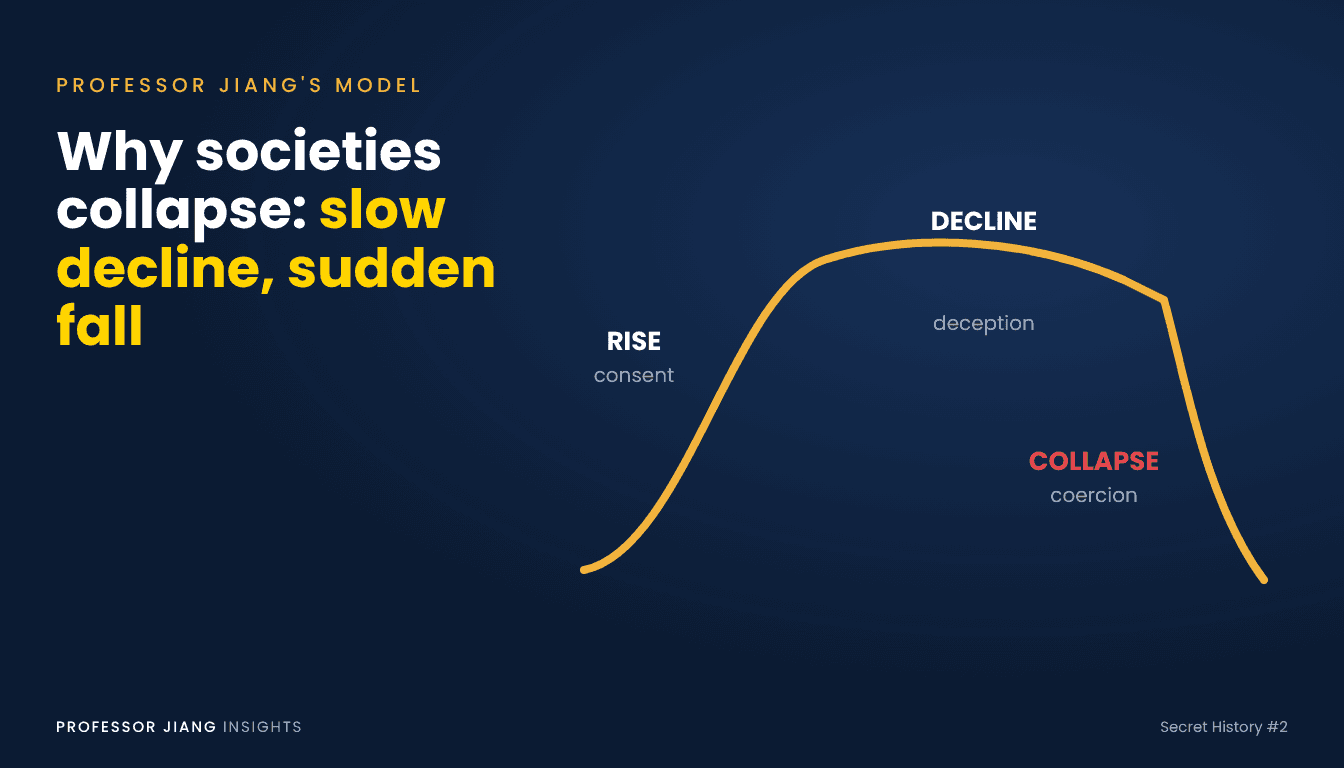
The growth of administration is real and well documented, and Parkinson saw the same incentives seventy years ago. Some of it reflects legitimate new duties, and the economist William Baumol showed that services like teaching naturally get more expensive relative to manufactured goods. Jiang's contribution is to treat bureaucracy as the signature of a society in decline, the deception phase of his model in why do societies collapse. For how elite universities pick their students, see why Ivy League admissions are so complicated.
Bureaucracy is Chapter 5 of our guide to Jiang's Secret History series. Read the first chapter free, and follow new breakdowns on Telegram.