ANALYSIS
This article summarizes Professor Jiang Xueqin's views as we understand them from his recorded lectures. It is independent analysis, not his official statement, and Jiang Insights is not affiliated with him. Errors in summarizing are ours.
Ivy League admissions weigh essays, interviews, recommendations, activities and "character" alongside grades and test scores because of a decision made a century ago. In the 1920s, Harvard, Yale and Princeton moved away from exam-based entry partly to limit the number of Jewish students, as the sociologist Jerome Karabel documented in detail. Professor Jiang Xueqin, a Yale graduate, argues the system still works the same way: it selects for future power, not talent. Here is the history, what the data shows today, and his inside account.
How did Ivy League admissions start?
Harvard was founded in 1636 by Puritan colonists, and training an educated ministry was among its early purposes (Jiang, 03:54). Yale followed in 1701 and Princeton in 1746. For most of the nineteenth century these colleges admitted sons of the Protestant elite through entrance exams that a well-prepared applicant could pass. Meanwhile the country built two other kinds of university: land-grant colleges under the Morrill Act of 1862, training farmers and engineers, and German-style research universities, starting with Johns Hopkins in 1876.
When did holistic admissions start?
In the early 1920s the number of Jewish students passing the exams rose sharply, reaching over a quarter of Harvard's freshman class. Harvard's president, A. Lawrence Lowell, openly proposed a quota in 1922. When the faculty rejected it, Harvard achieved the same result another way: limits on class size, interviews, photographs, questions about religion and family background, and a new emphasis on "character" and "manliness." Yale and Princeton adopted similar systems. Jewish enrollment at Harvard fell to around 15%. This is the story Karabel tells in The Chosen (2005), drawing on the universities' own archives.
1636
Harvard founded
1862
Morrill Act creates land-grant colleges
1876
Johns Hopkins opens as the first US research university
1922–1926
Lowell proposes a Jewish quota; 'character' admissions replace it
1930s
Harvard uses the SAT to award national scholarships
1947
Henry Chauncey founds the Educational Testing Service
2023
Supreme Court ends race-conscious admissions in SFFA v. Harvard
Where did the SAT come from?
Under president James Conant (1933–53), Harvard wanted to compete with research universities for talent, so it used the Scholastic Aptitude Test to find scholarship students from across the country. Conant's dean Henry Chauncey went on to found the Educational Testing Service in 1947, which still runs many of the tests students take today. The journalist Nicholas Lemann tells the story in The Big Test (1999). The result was a two-track system that still exists: tests to find outsiders, and holistic judgment that leaves room for insiders.
What did SFFA v. Harvard change?
In June 2023 the Supreme Court ruled in Students for Fair Admissions v. Harvard that race-conscious admissions were unconstitutional. Evidence at trial showed that Asian-American applicants received systematically lower "personal" ratings than other groups with similar academic records, which critics compared directly to the 1920s. Jiang makes the same comparison in his lecture: the tools once used on Jewish applicants, he says, are now used on Asian ones (10:24).
Do legacy applicants have an advantage?
A large advantage. A 2023 study by Raj Chetty, David Deming and John Friedman found that at the same test scores, applicants from the top 1% of family income were more than twice as likely to be admitted to Ivy-Plus colleges as middle-class applicants, driven mainly by legacy preferences, recruited athletes and non-academic ratings. Some universities have dropped legacy preferences, and California banned them at private colleges in 2024. Harvard admitted about 3.6% of applicants for the class of 2028.
What does Professor Jiang say about Ivy League admissions?
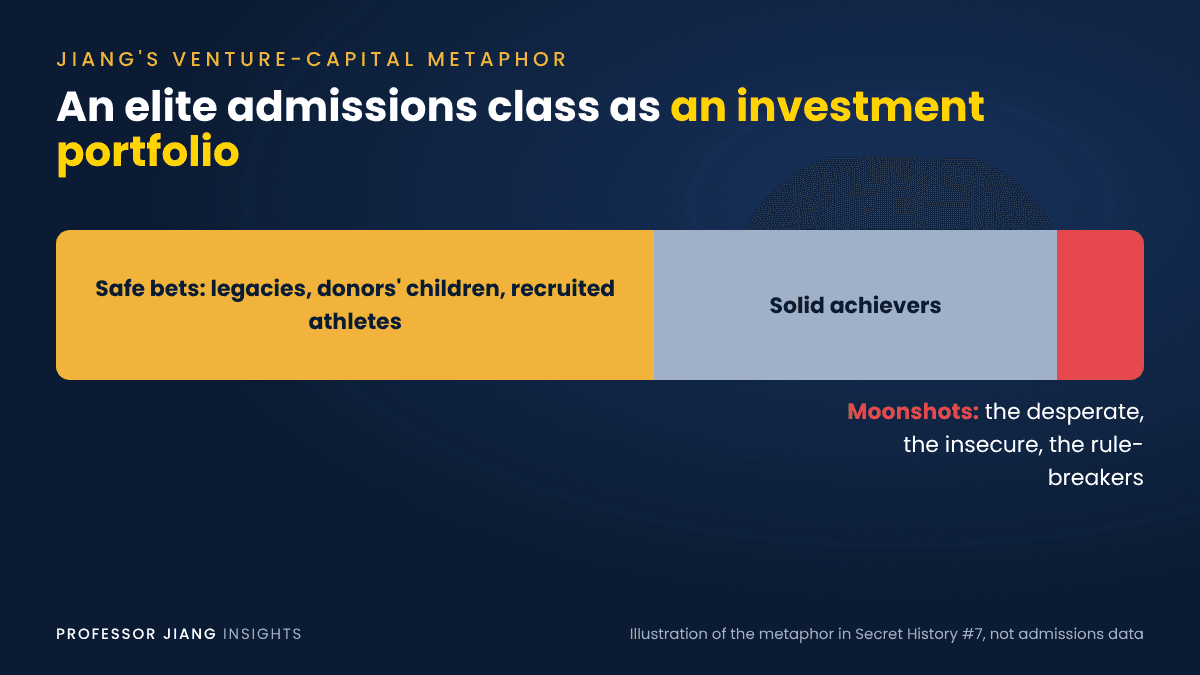
In Secret History #7, "Death by Meritocracy," Jiang gives his students a test (12:28). Harvard has one place and four applicants: China's best young mathematician, America's best high-school basketball player, the best student in the world, and a third-generation legacy. The class picks the legacy, and Jiang agrees. Elite universities, he says, behave like venture capital funds (15:39): most places go to safe bets who will succeed anyway, and a small share to risky applicants who might change the world and carry the brand with them. "Harvard is not interested in academics. It's interested in power" (11:00).
He then dissects his own Yale application (18:48): a Toronto public school, tenth in a class of two hundred, an SAT of 1400, a dull essay. What admissions read between the lines, he says, was a poor immigrant who had fought his way into a better school against his principal's wishes: desperate, insecure and willing to break rules. He calls that profile "dissociative personality disorder," which is a misuse of a clinical term; the management scholar Laura Empson's phrase, the "insecure overachiever," describes it better. (More on his background in our profile of Professor Jiang.)
Does going to Harvard make you successful?
It depends who you are. Economists Stacy Dale and Alan Krueger found that students who were admitted to highly selective colleges but went elsewhere earned about as much as those who attended, except for students from low-income and minority families, who gained more from the elite school. Chetty's team found that attending an Ivy-Plus college sharply raises the chance of reaching the top 1% or an elite job. Both findings support Jiang's portfolio picture: for rich kids the brand adds little, for outsiders it opens doors.
What the record shows
Jiang's most provocative claim, that "character" was invented to keep Jewish students out, is documented history. His venture-capital metaphor fits the admissions data on legacies and athletes. The term "meritocracy" itself was coined as a warning: Michael Young's 1958 satire imagined a society where the clever rule by right and everyone else is told they deserve their place. For Jiang's companion argument about how universities are run, see why universities have so many administrators; for his history of schooling, who invented kindergarten.
Meritocracy is Chapter 4 of our guide to Jiang's Secret History series. Read the first chapter free, and follow new breakdowns on Telegram.