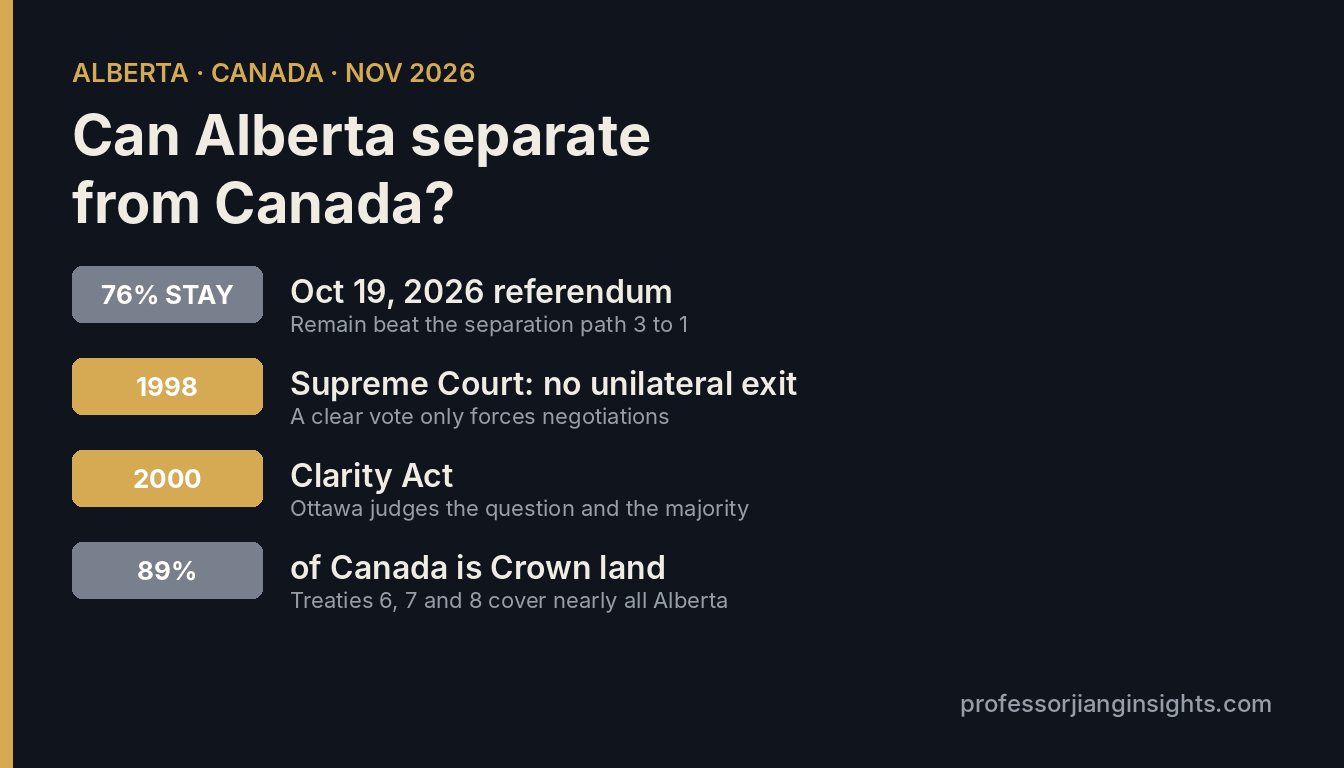
Alberta cannot leave Canada on its own. Under the Supreme Court's 1998 Quebec Secession Reference, no province has a right to secede unilaterally; a clear majority on a clear question would only oblige Ottawa and the other provinces to negotiate a constitutional amendment. And for now the question is closed: on October 19, 2026, about 76% of Albertans voted to remain in Canada rather than start a separation process, and Premier Danielle Smith promised there would be no second vote while she leads.
What did Alberta vote on in October 2026?
Albertans were not voting on independence itself. The question asked whether Alberta should remain a province or whether the government should begin the legal process toward a later, binding separation referendum. Smith added it to the ballot in May after a citizen petition, alongside nine other questions on issues like immigration. Polls had shown remain ahead all year, and the result matched: about three in four voted to stay, on roughly 1.8 million ballots counted by the morning after.
The next day Smith told the province, "Alberta will remain a province of Canada," and said she would not call another referendum on separation for as long as she is premier. She has since told separatists in her United Conservative Party to accept the result or leave, with a leadership review and a provincial election in October 2027 ahead of her.
How could a province legally leave Canada?
The rules come from Quebec, which held two referendums: in 1980 (about 60% No) and in 1995, when No won by roughly 50.6% to 49.4%. Ottawa then asked the Supreme Court whether Quebec could secede on its own. In 1998 the court answered no, under both Canadian and international law. But it added a duty that many outside Canada miss: if a clear majority votes for secession on a clear question, the rest of Canada must negotiate in good faith. Those talks would have to cover debt, borders, minority rights and Indigenous peoples, and any deal would need a constitutional amendment.
Parliament turned that ruling into the Clarity Act in 2000. It lets the House of Commons decide whether a referendum question is clear and whether the majority is clear before any negotiation starts, and rules out questions that mix secession with other options. The court never said which amending formula would apply. Scholars still disagree on whether it would need seven provinces with half the population or the unanimous consent of all ten plus Parliament.
Who owns Alberta's land?
About 89% of Canada's land is Crown land, roughly 41% federal and 48% provincial (Natural Resources Canada). In Alberta the province itself manages most of it, including the oil sands leases that fund its budget, while Ottawa controls the national parks such as Banff and Jasper. Crown land is held by the Crown in right of Canada or of the province and run by elected governments; the monarch does not personally own it. The harder knot is the treaties. Treaties 6, 7 and 8, signed with the Crown between 1876 and 1899, cover almost all of Alberta, and First Nations leaders have long argued that those are agreements with the Crown that a breakaway province could not simply inherit.
What Professor Jiang says about Alberta
Educator Jiang Xueqin, who grew up in Toronto, takes an unusual line. On Robinson's Podcast he called it "a very strong possibility" that Alberta chooses to secede, then argued it cannot happen, because there is no legal mechanism and most of the land belongs to the Crown. Canada, he says, is not a true democracy but a resource colony and offshore financial center for the City of London, and Trump's talk of a 51st state is really a move by America's new tech and crypto elite against that old financial order.
Parts of that hold up. The Crown land figure is real, and unilateral secession is indeed off the table. "No mechanism" goes too far: the 1998 ruling created a path, just a slow and negotiated one. And the vote did not need the King to stop it; Albertans did that themselves by three to one. Before the referendum, in his Toronto lecture, Jiang predicted Trump would dispute the result. We tracked that call in Professor Jiang's Rupture predictions.
Could Alberta join the United States?
Only at the end of a very long road. Alberta would first have to leave Canada by negotiation and constitutional amendment, then win admission from the US Congress, which has added no new state since Hawaii in 1959. US officials and Elon Musk said friendly things about Alberta before the vote, but no formal offer was made. The practical obstacles are bigger than the legal ones: Alberta is landlocked, and almost every barrel it exports crosses British Columbia, Saskatchewan or the US border by pipeline.
What the record shows
Alberta's grievances with Ottawa are old and real, from pipelines to equalization payments, and they will outlast this vote. But the legal answer has not changed since 1998: a province can force a negotiation, not a departure. The October 2026 result means even the first step is now off the agenda, at least until Alberta's next premier. For Jiang's other dated calls and how they scored, see Professor Jiang's latest predictions.
1876-1899
Treaties 6, 7 and 8
Signed with the Crown; together they cover almost all of today's Alberta.
May 20, 1980
Quebec referendum
About 60% vote No.
Oct 30, 1995
Quebec referendum
No wins by about 50.6% to 49.4%.
Aug 20, 1998
Secession Reference
Supreme Court: no unilateral secession, but a duty to negotiate after a clear vote.
Jun 29, 2000
Clarity Act
House of Commons judges clarity of question and majority.
Oct 19, 2026
Alberta referendum
About 76% vote to remain in Canada.
Oct 2027
Alberta election
Next provincial vote.