ANALYSIS
This article summarizes and checks claims Professor Jiang Xueqin made in "Geo-Strategy Update #10: I Was Wrong. The Democrats Take Congress," posted on his channel on November 6, 2026. It is independent analysis; Jiang Insights is not affiliated with Professor Jiang. Quotes come from the auto-transcript and may contain small errors.
What will Democrats do with Congress? If Professor Jiang Xueqin is right, much less than their voters hope. Three days after Democrats won the House and the Senate, Jiang posted a video from Beijing in which he first explained why he had misread the midterms, then laid out what he expects from the new Congress: cooperation with Trump behind loud hearings, a pause in the Iran war until January, ground troops in Iran by March, an AI bailout and a crypto law built around stablecoins.
Below is each call with a timestamp, the context he leaves out, and the date it can be scored.
What happened in the 2026 midterms?
Democrats took both chambers on November 3. By AP's count the morning after, they held 54 Senate seats to the Republicans' 44 with two races uncalled, after flipping seats in Kansas, Iowa, Texas, Ohio, Maine, North Carolina and South Carolina. Texas was the headline: James Talarico beat Attorney General Ken Paxton for the Senate, and Gina Hinojosa unseated Governor Greg Abbott, the first Democratic governor win in Texas since 1990. Democrats also moved ahead on governorships, 26 to 20 with four races still open. Jiang calls it a "blue tsunami" and says Texas is now purple, with big consequences for 2028.
One detail matters for what comes next. Months ago Jiang floated the idea that the White House's calm about the midterms meant a plan to rig or delay them. Neither happened, and Trump accepted the outcome and congratulated Democrats in a Fox News interview, Reuters reported.
Why Professor Jiang says he was wrong about the midterms
He opens with it: "I was wrong about the midterms" (0:09), and also about Brazil's election and Alberta's independence vote. What makes the segment worth watching is the chain he describes, because each miss came from the one before.
It started in Brazil. Jiang had assumed Lula would hold Latin America's globalist center. Then Flávio Bolsonaro finished first in the October 4 first round, 47.03% to Lula's 45.16%, and Jiang concluded the nationalists were ascendant. From that he expected Alberta's independence side to reach about 40% and Republicans to have a real chance of keeping the House. Instead about 76% of Albertans voted to stay in Canada on October 19, and Lula won the October 25 runoff with 51.74%, more than four million votes ahead. Jiang says that second-round surprise is what made him flip his view and expect a Democratic sweep.
His three explanations for Bolsonaro's first-round showing were evangelical voters, social media microtargeting, and plain anti-incumbent fatigue. The first has strong data behind it, though his numbers are low: Brazil's census put evangelicals at 15.4% of the population in 2000 and 26.9% in 2022. The anti-incumbent mood is the one that held up best, since it also explains the midterms.
His defense of the method is fair: build a model, predict from it, and change the prediction when new information changes the analysis. Few commentators narrate their own misses on camera. One part of his account is hard to check. He says he spent the last two weeks predicting a Democratic sweep, but on Robinson's Podcast, released around November 1, he declined to call the result at all. If the sweep call was made in a class or stream we haven't seen, we will add it. His August line that Democrats "won't take the Senate" stays a miss, as scored in Professor Jiang's 2026 midterm predictions.
Will Democrats work with Trump?
This is Jiang's central prediction. With Hakeem Jeffries expected to become Speaker and Chuck Schumer Senate Majority Leader, he says "the agenda is pretty much set" (11:21). The next two years "will not be a vendetta," and instead of trying to remove Trump, Democrats will work with him. He describes both leaders as deeply unpopular with their own base (he cites approval of about 18% and 13%; we have not verified those figures) and as answerable to donors.
He also dismisses talk of Medicare for All or a higher minimum wage, arguing that Democrats "did absolutely nothing during the Biden years." That overstates it. In 2021 and 2022 a Democratic Congress passed the American Rescue Plan, the bipartisan infrastructure law, the CHIPS and Science Act and the Inflation Reduction Act. But his narrower point is accurate: the $15 minimum wage was stripped from the 2021 relief bill and then failed 42 to 58 in the Senate, and Medicare for All never reached a floor vote.
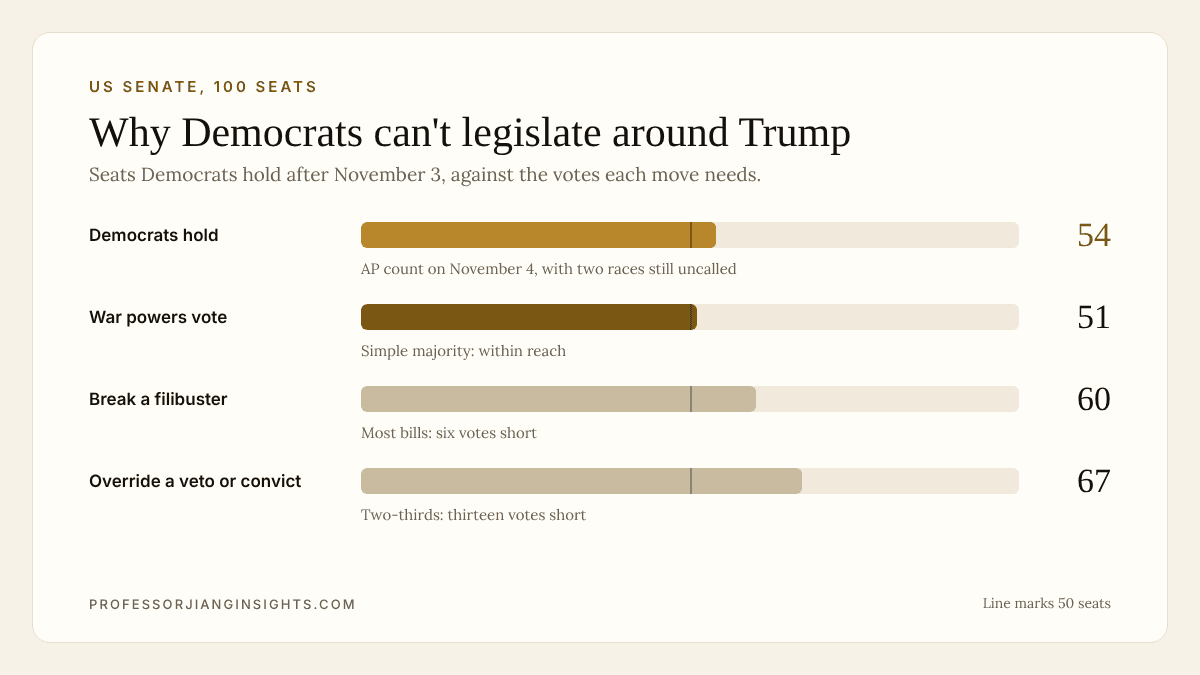
There is a structural reason he skips. Fifty-four senators are not sixty, so the filibuster still blocks most ambitious bills, and any bill that does pass faces a veto that takes two-thirds of both chambers to override. Whatever Democrats want, they can't legislate around Trump. Their real leverage sits in must-pass spending bills, oversight subpoenas and war powers resolutions, which move under expedited rules and need only a simple majority.
Jiang adds a twist about Trump himself: he does worst when he controls everything and best "when he's the underdog" (12:29), facing a hostile Congress. So in his view Trump will welcome a Democratic Congress to cooperate and compete with.
Why Democrats won't call Trump's bluff
Some analysts argue Democrats' best play is to pass bills Trump must veto, such as cutting off funding for the Iran war or forcing release of the Epstein files, so he looks bad. Jiang's answer (from 22:11) is that the strategy assumes a predictable opponent: "Trump is not predictable." What if he signs? He puts that chance at roughly 5 to 10% and argues Democrats can't afford even that, because released files could hurt their own side too.
The record supports his premise more than his odds. Trump has already signed exactly this kind of bill. In November 2025 he dropped his opposition to the Epstein Files Transparency Act, which passed the House 427 to 1 and the Senate by unanimous consent, and signed it on November 19, 2025. A president who has done that once is not a 5% bet to do it again.
Will the Iran war pause until January?
Jiang calls this "a bold prediction" (17:53). Until the new Congress is sworn in on January 3, 2027, he expects a hiatus: flare-ups and some bombings, but no major escalation. He defines escalation clearly, which makes it testable: a nuclear strike on Pickaxe Mountain, the deep tunnel site near Natanz; Marines seizing Kharg Island, which handles most of Iran's crude exports; or a bombing campaign against power and desalination plants. "None of this will happen."
After January, "all bets are off." He expects US ground troops in Iran by March, with Congress either authorizing it or staying quiet, which he says would make it complicit. That matches the deadline we already track, a ground offensive on the Iranian mainland by March 31, 2027. Polymarket priced a US invasion before 2027 at about 18% in mid-October. The full case is in will the US invade Iran? and his argument that the war can't be won is in can the US win the Iran war?.
Our read: the January pause is the most useful call in the video because it resolves in eight weeks and has a clear trigger list. It also fits the war powers point above. A Democratic Congress can force a vote to end hostilities with a simple majority, and Trump could veto it. Jiang is betting that, given that choice, Congress looks away.
Is the AI bubble bursting, and will Congress bail it out?
The first item on the fixed agenda, Jiang says (13:41), is the AI bubble collapse. He cites a fresh drop in Nvidia's share price (we could not confirm the size of this week's move) and argues that a handful of AI companies drive half of US growth. The scale claim has support: economist Jason Furman calculated that investment in information processing equipment and software accounted for about 92% of US GDP growth in the first half of 2025.
His explanation for the slide is not the usual one. Investors doubting AI profits is the surface; the real cause, he says, is that the petrodollar system is breaking. For decades China, Japan and the Gulf recycled dollars into US assets and fed the dot-com, subprime and AI bubbles. Now, he argues, the war has squeezed Saudi and Japanese liquidity, forcing sales of gold and US investments. We found no data confirming forced Saudi selling, so treat that link as his hypothesis. The wider version of the argument is in will the US dollar collapse?.
His conclusion: Washington will bail out the industry and take a national stake in companies like OpenAI, possibly up to $2 trillion including new data centers. The record cuts both ways. In November 2025 White House AI adviser David Sacks wrote that there would be "no federal bailout for AI." But in August 2025 the government took a roughly 10% stake in Intel, so a federal equity stake in a strategic tech company is no longer hypothetical.
A week later he laid out the full chain, from Anthropic's IPO to a crash, a bailout and a digital-ID "control grid", on Robinson's Podcast. We check each step in will the AI bubble burst?.
What is the CLARITY Act, and will it pass?
The Digital Asset Market Clarity Act is the bill that would set federal rules for crypto markets and split oversight between the SEC and the CFTC. It passed the House 294 to 134 on July 17, 2025, cleared the Senate Banking Committee 15 to 9 on May 14, 2026, and then stalled on the Senate floor, with prediction markets giving it about a 14% chance of becoming law in 2026.
Jiang (from 19:57) sees it as a rescue tool for US debt, which he puts at $40 trillion (it passed $38 trillion in October 2025). As petrodollar recycling fades, stablecoins backed by Treasuries let ordinary savers in Japan, China and everywhere else buy US debt through apps from banks or tech firms. One correction sharpens his point: the stablecoin rules themselves are already law. The GENIUS Act, signed July 18, 2025, requires payment stablecoins to be backed one to one by cash and short-term Treasuries. CLARITY is the market-structure layer on top. So the demand channel for Treasuries he describes already exists, and the open question is the rest of the framework.
Will Democrats impeach Trump?
No, says Jiang. An impeachment would end with a trial, nothing uncovered and Trump walking away "scot-free." Instead he expects subpoenas and theater (from 27:19): days of televised testimony in which Jared Kushner is cast as the villain of the administration, nothing that implicates Trump, and finally a presidential pardon for his son-in-law. He compares it to Iran-Contra, and the parallel is real: on December 24, 1992, George H. W. Bush pardoned former Defense Secretary Caspar Weinberger and five others before key trials.
The math favors his skepticism. The House impeached Trump twice, in 2019 and 2021, and the Senate acquitted both times. Conviction needs 67 votes, and Democrats have about 54. The behind-the-scenes deal he describes, cooperation on the war, an AI bailout, the crypto framework and defense spending, is harder to test, so we score only the parts that leave a public record.
Will Trump, Xi and Putin meet at APEC in Shenzhen?
The APEC leaders' meeting runs November 18 to 19 in Shenzhen. Russia has said Putin will attend, the Kremlin says a three-way meeting with Xi and Trump has been discussed, and nothing is confirmed. A Manifold market gave a trilateral meeting about 12% in mid-October. Jiang (from 28:52) is more confident: the summit "will happen," it will go well, and it could produce talks on a face-saving US exit from Iran and a Ukraine treaty with China as mediator. Then, he says, world events will break the peace. We track his earlier Shenzhen call, a joint AI governance board, from his Toronto Rupture lecture.
Notice the tension. A face-saving Iran exit in November sits awkwardly next to ground troops in Iran by March. Jiang reconciles them by predicting the talks will fail, which means the summit is a test of his timing, not only of his optimism.
What the record shows, and when each call resolves
Underneath all seven calls is one idea: the real contest is between elites and counter-elites, a frame he borrows from Peter Turchin (explained in what is elite overproduction?), and party labels matter less than donors and crises. The video gives that idea concrete tests. We have added the new ones to Professor Jiang's latest predictions with criteria written before the outcome:
- Iran pause: hit if, between November 6, 2026 and January 3, 2027, the US makes none of the three escalations he named.
- Ground troops: hit if US forces launch a ground offensive to seize and hold Iranian mainland territory by March 31, 2027.
- APEC: tracked through his Shenzhen call, which resolves November 30, 2026.
- AI stake: hit if the federal government takes an equity stake in OpenAI or another major AI developer or data-center firm as part of a rescue, by January 3, 2029.
- CLARITY Act: hit if it, or a renamed crypto market-structure bill, becomes law by January 3, 2029.
- No impeachment: hit if the House does not impeach Trump before the 120th Congress ends on January 3, 2029.
- Kushner: hit if Jared Kushner testifies before a congressional committee and Trump pardons him by January 20, 2029.
The first two scores arrive fast: Shenzhen in under two weeks, the Iran pause on January 3. His longer list for next year, from the draft to civil unrest, is in Professor Jiang's 2027 predictions.
Oct 4, 2026
Brazil first round
Flávio Bolsonaro edges Lula, 47.03% to 45.16%.
Oct 19, 2026
Alberta vote
About 76% vote to remain in Canada.
Oct 25, 2026
Brazil runoff
Lula wins with 51.74%; Jiang flips to a Democratic sweep.
Nov 3, 2026
Midterms
Democrats win the House and Senate, plus Texas.
Nov 6, 2026
Jiang's video
He explains his misses and predicts the next two years.
Nov 18-19, 2026
APEC Shenzhen
Possible Trump, Xi and Putin meeting.
Jan 3, 2027
New Congress sworn in
End of his predicted Iran war pause.
Mar 31, 2027
Ground war deadline
His call for US ground troops in Iran resolves.