ANALYSIS
This article summarizes and checks claims Professor Jiang Xueqin made on Robinson's Podcast with Robinson Erhardt (released around November 1, 2026). It is independent analysis; Jiang Insights is not affiliated with Professor Jiang or the podcast. Quotes come from the episode's auto-transcript and may contain small errors.
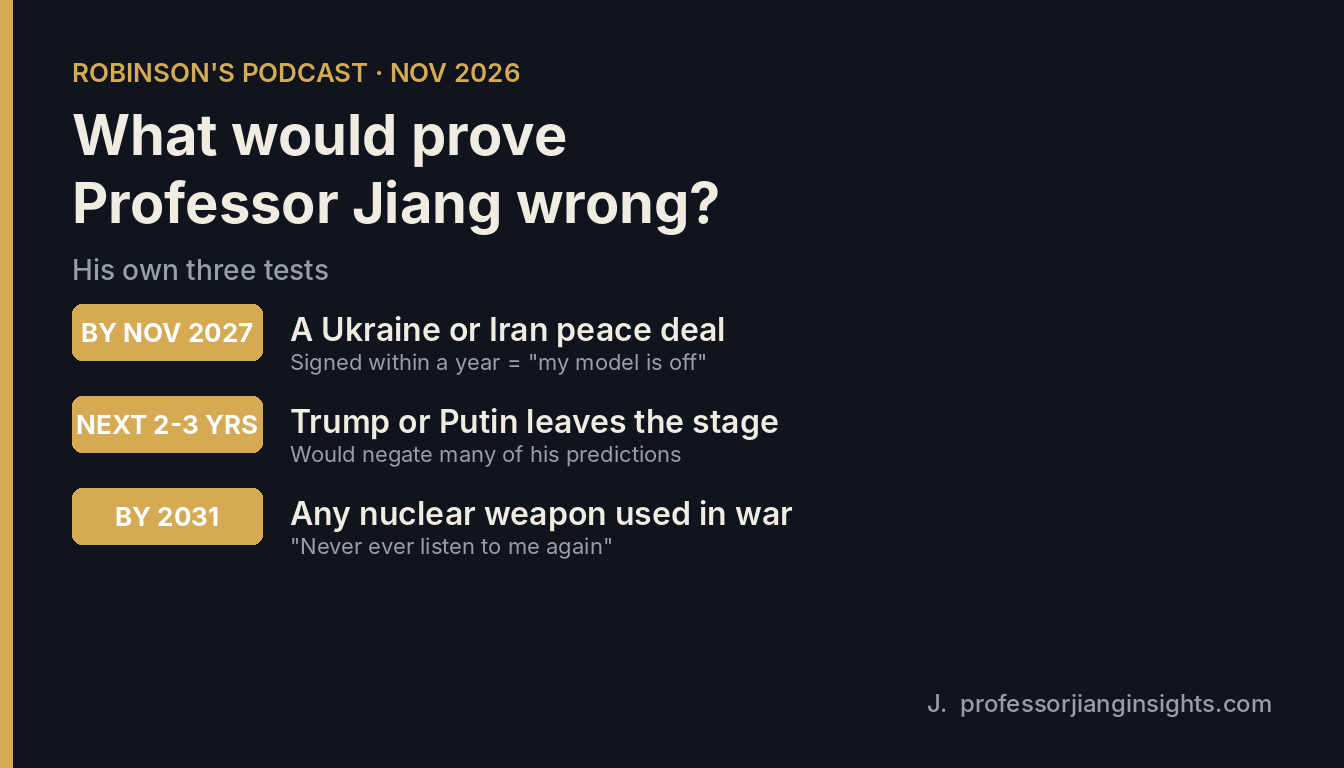
Near the end of a three-hour conversation with Robinson Erhardt, Professor Jiang Xueqin did something forecasters rarely do: he listed the events that would prove his model of the world wrong. A peace treaty in Ukraine or a US peace deal with Iran within a year. Trump or Putin suddenly leaving the stage. Any nation using a nuclear weapon in a war within the next five years. "You should never ever listen to me again," he said of that last one. In the same episode he graded his own Iran war forecast, called the US-China rivalry fake, and declined to call the midterms, which Democrats then swept.
Erhardt flew to Toronto and recorded three back-to-back conversations with Jiang in one day. This is the first, mostly about Iran, China and the collapse Jiang expects. Below is what he said, with timestamps, the context he leaves out, and the dates on which each test resolves.
What would prove Professor Jiang wrong?
Erhardt asked what could happen that nobody can predict. Jiang reframed it as what could destroy his predictions (from about 3:07:50) and gave three answers:
- Peace within a year. If Putin and Zelensky sign a deal that finally ends the Ukraine war, or Trump reaches a peace deal with Iran, "then my model is completely off."
- A major player dies or is removed. Trump or Putin leaving the scene in the next two or three years would change or negate many of his predictions. Zelensky, Macron or Merz would not, because he does not count them as major players.
- Nuclear use. If any nation state uses a nuclear weapon against another in a war within five years, "my model of the world is complete nonsense."
His reason for ruling out nuclear war is the core of his whole framework. Wars today, he argues, are not really about beating foreign enemies. They are a mask for domestic conflict between old elites and counter-elites, and nobody fighting for power at home wants to risk the world ending. A global pandemic, by contrast, would not break his model; it would only speed up the systemic collapse he already expects.
How hard are Jiang's three tests?
Naming your own falsifiers is good practice, and most pundits never do it. But the three tests are not equally hard. The nuclear test is the easiest to pass: no nuclear weapon has been used in war since Nagasaki on August 9, 1945, more than 81 years of near-misses without a detonation. Any forecaster who bets on that streak continuing will usually be right, so passing it tells us little about Jiang's model specifically.
The peace tests are where he takes real risk. Both wars have produced repeated rounds of talks, and a signed deal in either within a year is the kind of event markets regularly price above zero. The leader test cuts both ways: Trump turned 80 in June 2026 and Putin 74 in October, and US actuarial tables put the yearly death risk for an average 80-year-old man at roughly 5% [our estimate from Social Security period life tables]. Over three years that is not a small chance, and it is one Jiang has openly put outside his model.
How does Jiang grade his own Iran war prediction?
Asked when he first called the war (from about 1:57:15), Jiang pointed to a class lecture in May 2024. His forecast then: about six months of air war that would achieve nothing, because Iran had spent 20 years preparing after watching Iraq, Libya and Syria; Iran closing the Strait of Hormuz and hitting US allies; and, as a result, a full-scale US ground invasion around March 2027.
Then he marked his own work, which is rarer than the prediction itself. He says he got two things wrong. He expected Israel and the US to deal with the "axis of resistance" (the Houthis, Hezbollah and Iraqi Shia militias) before taking on Iran, and calls their resilience "a major miscalculation on my part." And he did not expect the war to be run so badly: no staged build-up, no secured supply lines, no coalition, and no public case for war. His explanation for Iran's staying power is faith, a variable he says neoliberal planners leave out because they assume everyone can be bribed or scared.
The ground-invasion date is the part that can still be scored, and it matches the deadline we already track: a ground offensive on the Iranian mainland by March 31, 2027. Polymarket priced a US invasion before 2027 at about 18% in mid-October. Our full breakdown of that call is in will the US invade Iran?, and his case for why the war cannot be won is in can the US win the Iran war?.
Is China a colony of the United States?
This is the episode's most provocative line (from about 33:58): "China is just a colony of the United States," and the rivalry between them is "all just fake." His argument is about elites, not trade. While America outsourced manufacturing to China, he says, China outsourced the selection and training of its elite to American universities. Its brightest students went to Harvard, Yale and Stanford, learned neoliberal economics, and came home to run the economy. He names Justin Yifu Lin, a former World Bank chief economist with a University of Chicago PhD, as an example. After 2008, he adds, US colleges facing budget gaps turned Chinese students into a cash cow, extending that training from China's elite to its middle class.
The education half has real support. Chinese students were the largest foreign group on US campuses for over a decade, peaking at about 372,000 in 2019/20 before falling to roughly 277,000 in 2023/24 (Institute of International Education, Open Doors), and many of China's senior economists and officials trained in the US. The "fake rivalry" half is harder to square with the record. Washington has imposed sweeping export controls on advanced chips since 2022, tariffs on Chinese goods have been raised in waves since 2018, and China cut its holdings of US Treasuries from about $1.3 trillion at the 2013 peak to below $800 billion (US Treasury TIC data). Elites can share an education and still fight over chips, ports and markets. The strongest version of Jiang's point is narrower: the two economies were built to need each other, so a real break would hurt both ruling classes. That is a fair argument. "Colony" overstates it.
Why Jiang wouldn't call the 2026 midterms
Long-term trends are easy to predict, Jiang told Erhardt (from about 3:05:15); short-term events depend on players whose incentives outsiders can't see. He applied that to the midterms: polls and prediction markets both pointed to a Democratic sweep of Congress, but he listed three unknowns, namely dark money, the social media algorithms of companies like Meta and Google, and the plans of special interests such as tech, crypto and banking money. "Democracy is just a veil," he said. Democrats did sweep both chambers on November 3. In August he had said they "won't take the Senate," and we score that call in Professor Jiang's 2026 midterm predictions.
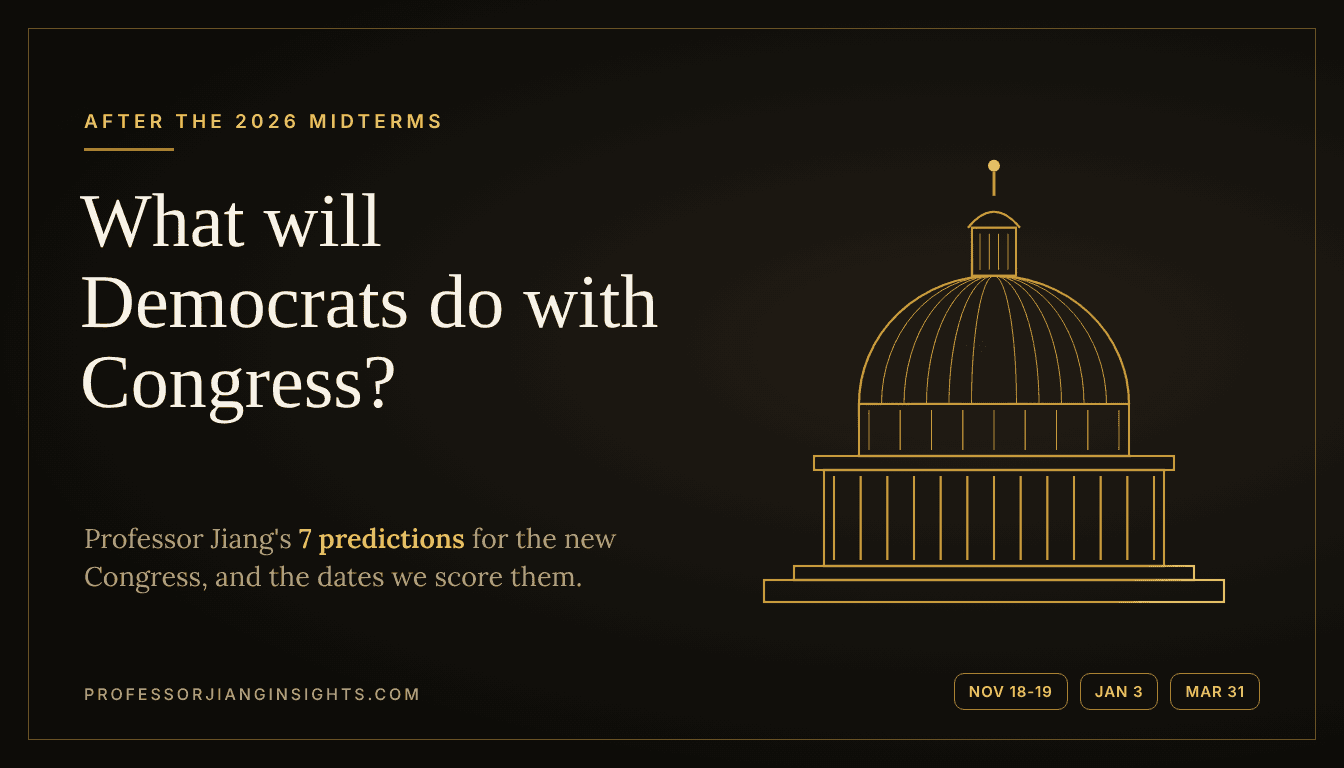
Days after the vote he admitted the miss and laid out seven predictions for the new Congress, covered in what will Democrats do with Congress?.
Can Alberta leave Canada? Jiang's Crown land argument
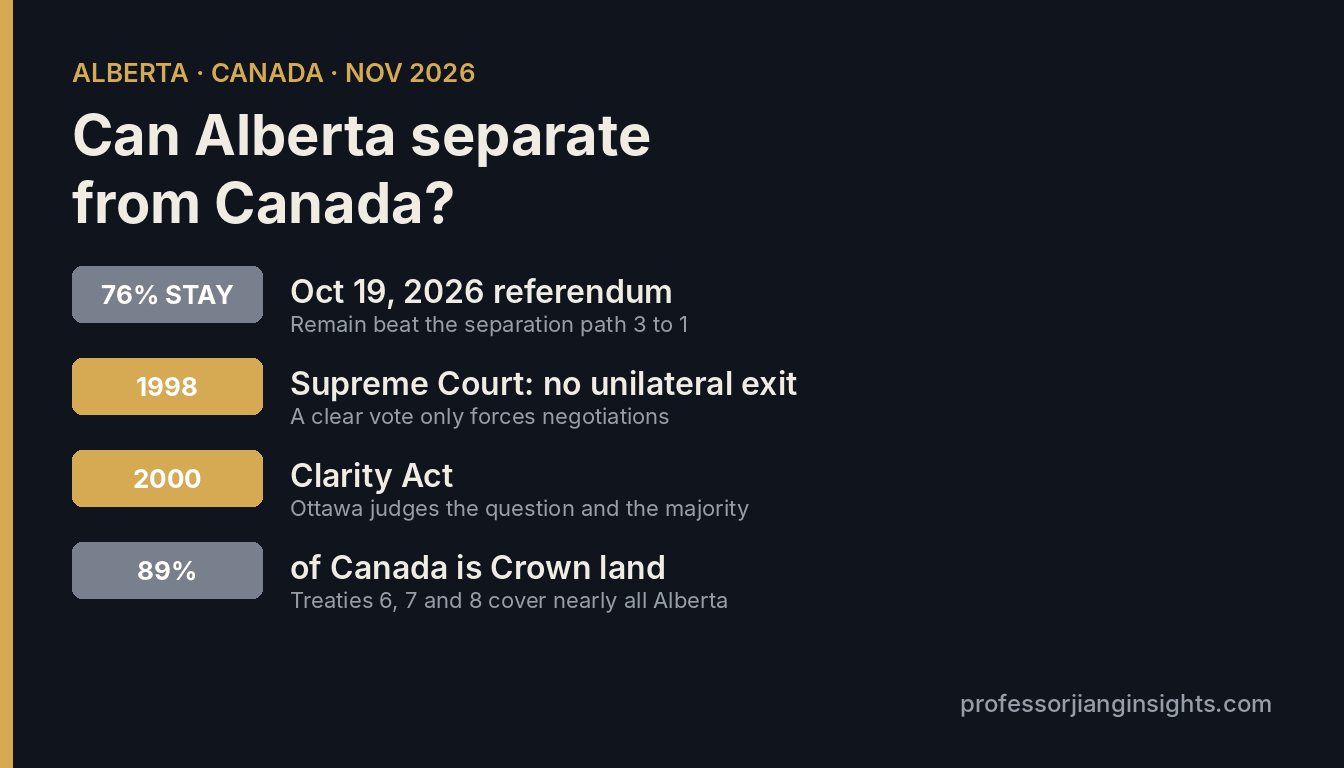
Jiang called it "a very strong possibility" that Alberta chooses to secede (from about 2:42:30), then argued it cannot actually happen: there is no legal mechanism, and most of Canada's land is Crown land "owned by the king of England." Canada, he says, is a resource colony and offshore financial center for the City of London, which is why Trump's talk of a 51st state is really a move against the old financial elite. We covered his Toronto calls on the Alberta vote in Professor Jiang's Rupture predictions.
The numbers are right; the meaning is off. About 89% of Canada's land is Crown land, roughly 41% federal and 48% provincial (Natural Resources Canada). But that land is held by the Crown in right of Canada or of each province and managed by elected governments, not owned by the monarch personally, and Alberta's own Crown land would be on the table in any negotiation. On secession, the Supreme Court's 1998 Quebec Reference is close to what Jiang says but not identical: no province can leave unilaterally, yet a clear majority on a clear question creates a duty for Ottawa and the provinces to negotiate. "No mechanism" is too strong; "no easy or unilateral one" is accurate. We walk through that legal path and the October 2026 vote in can Alberta separate from Canada?
Systemic collapse: oil, fertilizer and the AI bubble
Jiang's chain of consequences (from about 2:27:30) runs like this. If the war breaks the petrodollar, the Gulf states and Japan stop recycling money into US Treasuries; the private credit and AI data-center bubbles lose their funding; and a country carrying about $40 trillion in debt faces a sovereign debt crisis. Since the region supplies about a third of the world's oil, Asia is hit next, then food, because fertilizer inputs come from the same supply chain, then migration from Africa into Europe. A global depression, he says, would be "the best case scenario." The most likely one is a Bronze Age-style collapse lasting decades. His fuller version of the dollar argument is in will the US dollar collapse?.
One correction makes his point stronger, not weaker. Ammonia and urea are made mainly from natural gas, not oil, and helium comes out of gas processing too. The Gulf is a giant in both: Qatar alone supplies roughly a third of the world's helium, and a large share of seaborne urea passes through the Strait of Hormuz. A long closure would hit farms through gas, not crude. The theory behind the collapse forecast, his three phases of how societies rise and fall, is in why do societies collapse?.
What the record shows, and when each test resolves
This interview gives Jiang's model clear exit doors, and that makes it more useful than most of his appearances. Two of his tests come due within a year, one by March 2027 and one in 2031. We have added each to Professor Jiang's latest predictions with the criteria below, written before the outcome:
- Ukraine: his model holds if no signed peace agreement ending the Russia-Ukraine war exists by November 1, 2027. A ceasefire without a signed settlement does not count against him.
- Iran: holds if the US and Iran have not signed a peace agreement or formal deal ending the war by November 1, 2027. A temporary truce does not count.
- Ground invasion: hit if US forces launch a ground offensive to seize and hold Iranian mainland territory by March 31, 2027.
- Nuclear: holds if no state detonates a nuclear weapon against another state in a war by November 1, 2031. Tests do not count.
Erhardt recorded two more conversations with Jiang the same day. The third, on AI, released November 14, is checked in will the AI bubble burst? Professor Jiang's Anthropic test. We will add the second, on Musk and money, when our breakdown is ready.
His theory that Trump is losing the Iran war on purpose, using a tactic called peng sha, is examined in is Trump trying to lose the Iran war?.
May 2024
Iran war forecast
In a class lecture, Jiang predicts an air war followed by a US ground invasion of Iran.
Oct 2026
Recorded in Toronto
Three back-to-back conversations with Robinson Erhardt in one day.
Nov 1, 2026
Episode released
Jiang names the events that would break his model.
Nov 3, 2026
Midterms
Democrats win the House and Senate; Jiang had declined to call it.
Mar 31, 2027
Ground invasion deadline
His Iran ground-war forecast resolves.
Nov 1, 2027
Peace tests
No signed Ukraine or Iran peace deal, or his model is off.
Nov 1, 2031
Nuclear test
No wartime nuclear use, or his model is nonsense by his own words.