Who Invented Kindergarten? Prussia, Froebel and the Soldier Story Professor Jiang Told
Friedrich Froebel founded the first kindergarten in Blankenburg, Thuringia, in 1840; Prussia banned kindergartens from 1851 to 1860. In an October 2026 Toronto Q&A, Professor Jiang Xueqin shared a story he said he heard on Joe Rogan's show, and was unsure of, that Prussia created kindergarten to separate children from mothers and make soldiers. The historical record does not support that story, though research on long hours of early group care partly supports his underlying parenting concern.
ANALYSIS
This article summarizes Professor Jiang Xueqin's views as we understand them from his own recordings. It is independent analysis, not his official statement, and Jiang Insights is not affiliated with him. Errors in summarizing are ours.
Kindergarten was invented by Friedrich Froebel, a German educator who opened and named the first one in Blankenburg, Thuringia, in 1840. It was not a Prussian creation: in 1851 the Prussian government banned kindergartens, and the ban lasted nearly a decade. The question came up when Professor Jiang shared a story he had heard on Joe Rogan's show, about Prussia separating children from their mothers to make soldiers, and he said himself he wasn't sure it was true. It is worth tracing, because the real history of kindergarten, and of the Prussian schools behind the legend, is more interesting than the legend.
What did Professor Jiang say about kindergarten?
The claim came in the Q&A of Global Meet-Up #7 (Toronto): The Rupture, at about 1:49:14. A parent asked how to keep a child out of the school system. Jiang answered that society is built to make children feel unloved, and that the simplest trick is taking the child away from the parents too young.
Then the story. He said he saw it on Joe Rogan's show and was not sure it was true. In that version, Prussian soldiers would aim and deliberately miss because, having been loved, they did not want to kill. Prussia's fix was to separate mother and child early; the anxiety this caused turned into self-hatred that could be aimed at the enemy. His practical advice: keep one parent at home if you can, and delay full-time school, maybe half days at first. We could not locate the Rogan episode he had in mind, so we went to the history itself.
Who invented kindergarten?
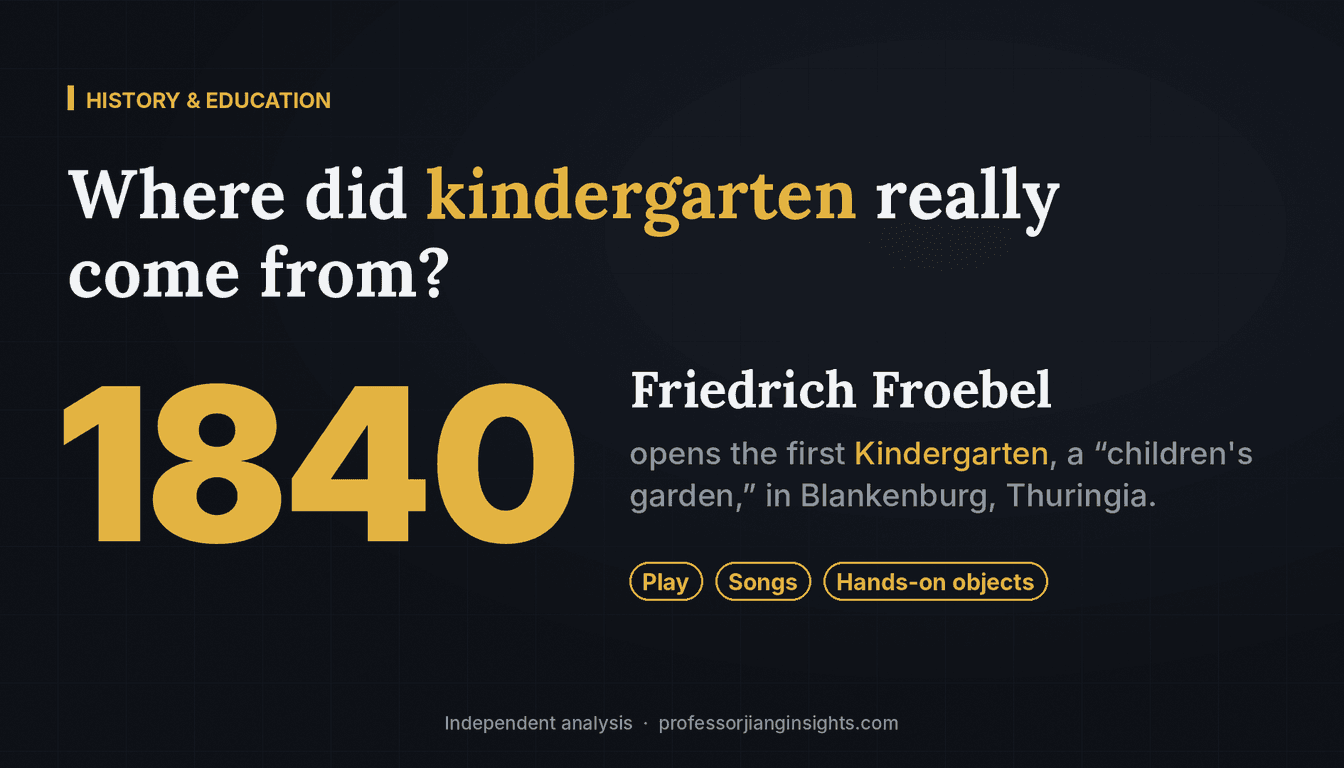
Friedrich Froebel, a German educator (1782–1852), founded the first institution he called a Kindergarten in Blankenburg in 1840. Thuringia was not part of Prussia. The name, a "children's garden," was the whole philosophy: young children grow through play, songs and hands-on objects, tended rather than drilled. After the 1848 revolutions, liberal reformers and women's groups took up the idea. Women's organizations helped found 31 kindergartens between 1848 and 1852, many open to children of every class and religion.
Early kindergartens were mostly private, voluntary and part-day, and they grew out of progressive politics and women's education rather than anything military.
Did Prussia ban kindergartens?
Yes. In 1851 Prussia's conservative minister of culture and education, Karl von Raumer, banned Froebel kindergartens. The decree cited a pamphlet by Froebel's nephew Karl and described the kindergartens as part of a socialist system meant to raise children toward atheism. Other German states followed. Froebel died the next year. The ban was lifted in 1860, and the movement then spread worldwide, reaching the US through German immigrants and, later, public school systems.
So the one German state that clearly took a position on kindergartens shut them down, because it saw them as politically subversive.
When did kindergarten come to America?
Through German immigrants, and largely through women. Margarethe Meyer Schurz, who had trained in Froebel's methods, opened a German-language kindergarten in her home in Watertown, Wisconsin, in 1856, usually counted as the first in the United States. Elizabeth Peabody opened the first English-language kindergarten in Boston in 1860 and spent the rest of her life promoting the idea. In 1873 Susan Blow opened the first lasting public school kindergarten in St. Louis, and within a few decades kindergarten had become a standard part of American public schooling.
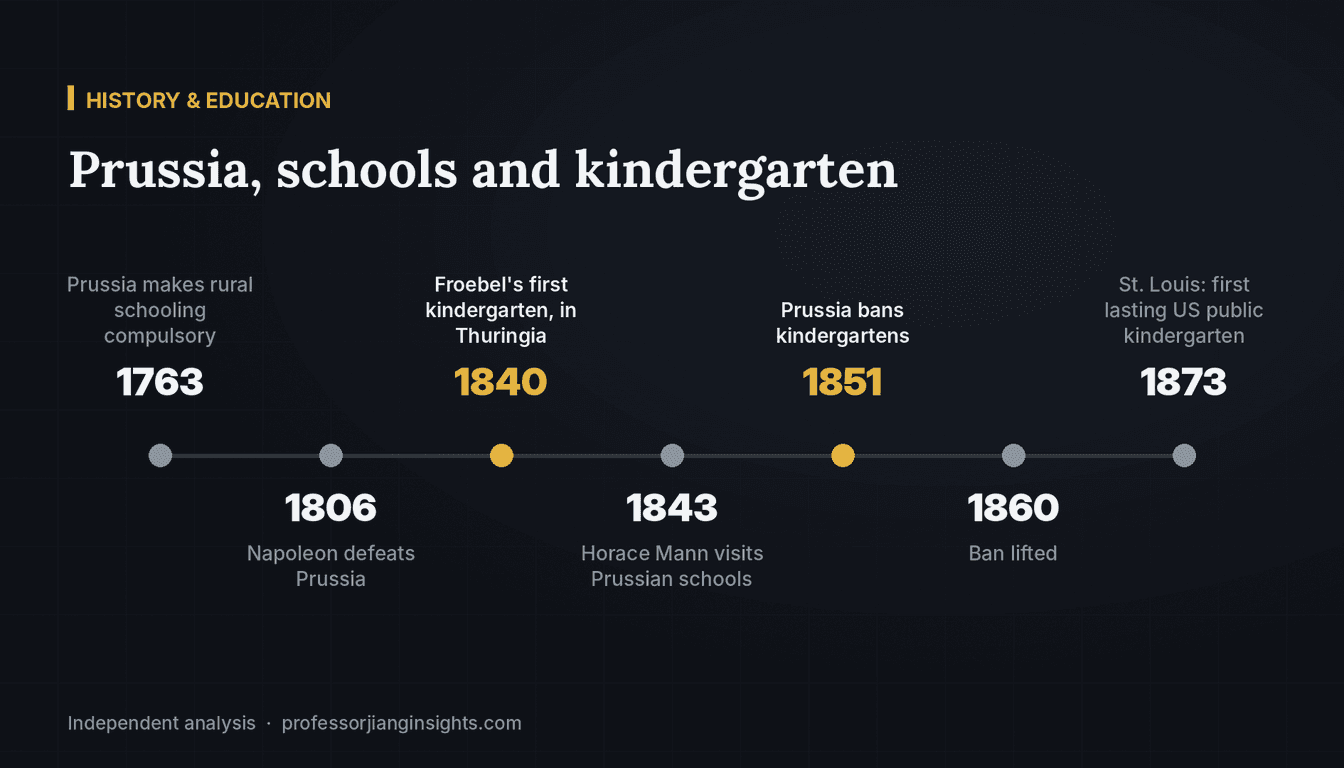
1763
Prussia makes rural schooling compulsory
1806
Napoleon defeats Prussia; Fichte calls for national education
1840
Froebel opens the first kindergarten, in Blankenburg, Thuringia
1843
Horace Mann visits Prussian schools
1851
Prussia bans kindergartens
Culture minister Karl von Raumer's decree; other German states follow.
1856
First US kindergarten, Watertown, Wisconsin
1860
Prussian ban lifted; Boston gets an English-language kindergarten
1873
St. Louis opens the first lasting US public school kindergarten
Where does the "Prussian schools made soldiers" idea come from?
The story did not come from nowhere. Prussia was a pioneer of compulsory state schooling: Frederick the Great's 1763 school regulations required rural children to attend. After Napoleon defeated Prussia in 1806, Johann Gottlieb Fichte argued that national education should shape loyal citizens of a reborn nation. Horace Mann toured Prussian schools in 1843 and used them as a model for Massachusetts, which is why American critics later traced their own system back to Prussia.
The late John Taylor Gatto, a former New York teacher, popularized the stronger version: that the Prussian model was built to produce obedient workers and soldiers, and that modern schools still run on it. Historians tend to see a real kernel in this, with the strong version overdrawn. Prussian schools did aim to make loyal subjects. But that is about elementary schools for older children, not kindergartens for three-year-olds, and Prussia's own policy on kindergarten was a ban.
Did soldiers really refuse to shoot?
The "soldiers won't kill" half of the story most likely traces to S.L.A. Marshall, a US Army historian whose 1947 book Men Against Fire claimed that no more than about 15% of American riflemen fired their weapons in combat. The figure became famous, and Dave Grossman's 1995 book On Killing built on it. Then historians went back to Marshall's notes. Roger Spiller of the Army's Combat Studies Institute found in 1988 that there was no record of Marshall asking soldiers whether they fired, and that the number of interviews he claimed did not fit his schedule.
Reluctance to kill is real and well documented in individual accounts. But the clean statistic is not, and it concerns 1940s American soldiers, not Prussians. Nothing in the record ties nineteenth-century Prussian military planners to kindergarten at all.
Is early separation bad for children? What the research says
This is where the concern behind Jiang's advice finds real support. The largest US study, the NICHD Study of Early Child Care, followed more than 1,000 children from 1991. In 2003 it reported that more hours in child care before age four and a half were linked to more assertive, disobedient and aggressive behavior, especially in center-based care. The catch: most children stayed well within the normal range, mothers' sensitivity predicted behavior more strongly than hours in care, and the researchers said they could not prove cause and effect.
So the evidence gives modest support to his advice to limit long hours of early group care where a family can afford it, and stronger support to the part he emphasized in the same answer: how warmly a child is parented matters more than where the child spends the day. What the research does not show is that kindergarten was designed to harm children.
What the record shows
As history, the story does not hold up: kindergarten began in Thuringia, Prussia banned it rather than created it, and the "soldiers won't shoot" statistic is unreliable. Jiang was upfront that he was passing on something secondhand, and the concern behind his advice, that very young children need close, warm parenting, is one the research takes seriously. This is not a prediction, so it does not enter our accuracy scorecard.
The same lecture also produced six dated predictions, from Alberta's referendum to Anthropic's IPO; we set out how we will score them. New to Jiang? Start with who Professor Jiang Xueqin is.
Frequently asked questions
Why is it called kindergarten?
Froebel chose the German word Kindergarten, "children's garden," because he believed young children grow like plants: through play, songs and hands-on objects, tended by adults rather than drilled.
When did the first kindergarten open in the United States?
Margarethe Meyer Schurz opened a German-language kindergarten in Watertown, Wisconsin, in 1856. Elizabeth Peabody opened the first English-language one in Boston in 1860, and St. Louis opened the first lasting public school kindergarten in 1873.
Was the Prussian education system designed to create obedient workers and soldiers?
Prussian elementary schools did aim to produce loyal subjects, and reformers like Fichte tied education to national revival after 1806. The stronger claim, popularized by John Taylor Gatto, that modern schools were engineered to make obedient workers and soldiers, is seen by most historians as overdrawn.
Did Prussia invent compulsory schooling?
Prussia was an early pioneer: Frederick the Great's 1763 school regulations required rural children to attend school. Massachusetts later borrowed from the Prussian model after Horace Mann's 1843 visit.