Professor Jiang on Diary of a CEO: 'Financial 9/11', NYC Siege and Messi Predictions, Checked
Jiang Insights checks the predictions Professor Jiang Xueqin made on The Diary of a CEO: a future 9/11 aimed at US bank accounts, a 'siege' of New York City tied to a Trump third term, Lionel Messi as Argentina's president, a China–Japan conflict and Russian attacks on NATO Europe. We test each claim and set dated scoring criteria.
ANALYSIS
This article summarizes and checks claims Professor Jiang Xueqin made on The Diary of a CEO with Steven Bartlett (September 2026). It is independent analysis; Jiang Insights is not affiliated with Professor Jiang or the podcast. Quotes come from the episode's auto-transcript and may contain small errors.
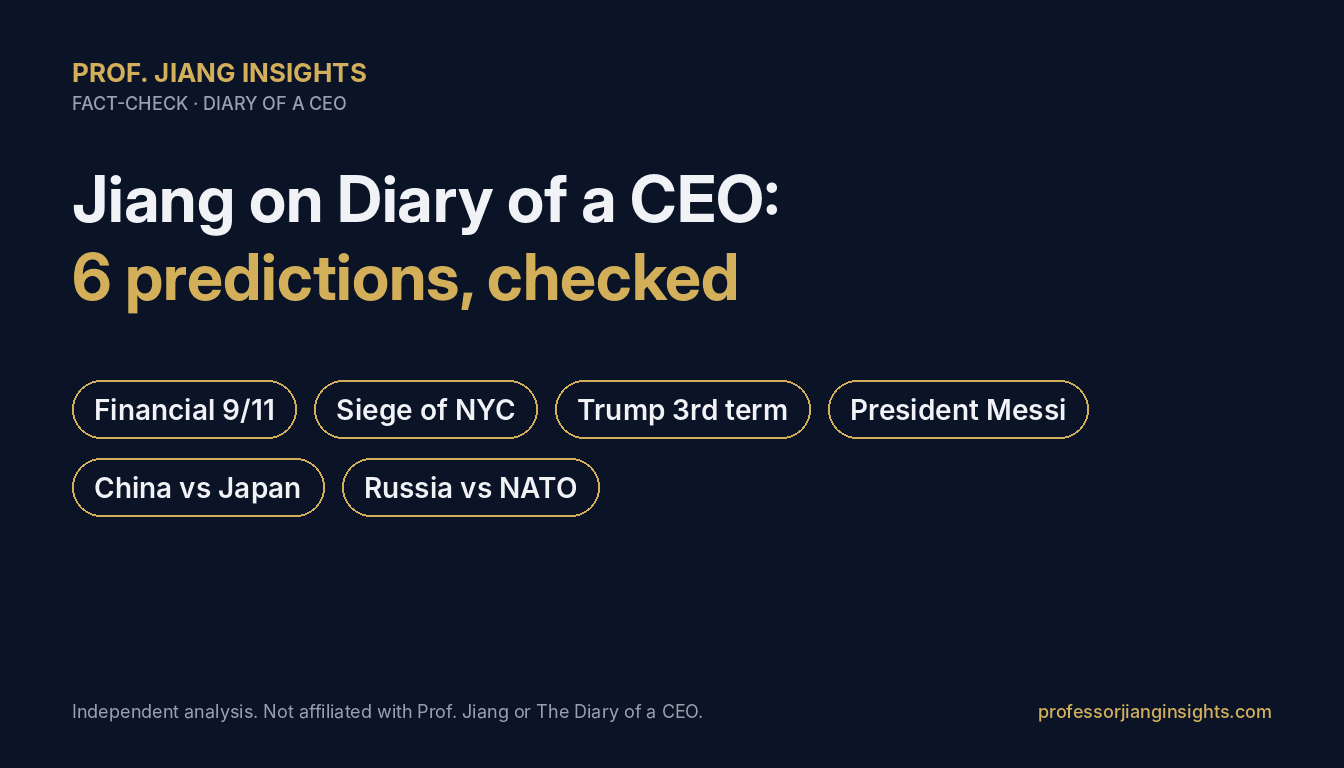
On The Diary of a CEO, Professor Jiang Xueqin made his most quotable predictions yet. If America suffers another 9/11, he said, it will hit the financial system, wiping out bank accounts rather than buildings. He also predicted a "siege" of New York City tied to a Trump third term, Lionel Messi as Argentina's president, a China–Japan conflict, Russian strikes inside NATO Europe, and a slow "collapse of civilization" over 20 years. Some of these can be checked. Several can't. Here is what holds up, what doesn't, and the dates on which we will score each one.
What did Professor Jiang predict on Diary of a CEO?
Recorded in New York shortly before the 25th anniversary of 9/11, the Diary of a CEO interview opens with Jiang's big-picture thesis. Technological progress, he argues, equals specialization times globalization. The Iran war is breaking global trade, so progress has peaked, and the decline ahead looks like the Bronze Age collapse of around 1200 BCE. He then offered what he called "three fun but horrifying predictions" built around the anniversary, and added more as Bartlett pushed him:
- A future 9/11-style attack would target US financial infrastructure.
- A "siege of New York City" if Trump secures a third term.
- Lionel Messi becomes president of Argentina.
- China and Japan drift into conflict over Taiwan and Southeast Asia.
- Russia strikes inside NATO Europe and moves to full mobilization.
- The Iran war "will only escalate."
The "financial 9/11": could an attack wipe out Americans' bank accounts?
Jiang's argument is about psychology, not engineering (from about 58:40). The original 9/11, he says, worked by traumatizing Americans into "self-destructive violence": twenty years of wars that drained the Treasury and the military's prestige. Another attack on skyscrapers would no longer shock a public that has grown used to that kind of violence. What would? You tap your phone to buy a coffee, the payment fails, and hours later you learn that an attack on bank data centers has erased your savings, with no timeline for getting them back.
As a threat scenario, this is not fringe. Iran-linked hackers knocked US bank websites offline in waves during 2012 and 2013, and the Justice Department indicted seven Iranians over the campaign in 2016. The banking industry took the "data destroyed" scenario seriously enough to build Sheltered Harbor, a standard under which banks keep encrypted, offline copies of customer account data so that balances can be restored if core systems are wiped. The July 2024 CrowdStrike outage, a faulty software update rather than an attack, showed how quickly card payments and bank apps can go dark.
Two things cut against the scariest version. Deposits are insured by the FDIC up to $250,000 per depositor, per bank, and that guarantee does not depend on any one data center surviving. And "wiped out" is not the same as "lost": account records exist in several places precisely so they can be rebuilt. A multi-day outage would be frightening and politically explosive. Permanent loss of savings at national scale is a much harder thing to pull off.
How we score it: Jiang framed this as conditional ("if another 9/11 happens"), so it only becomes testable if a mass-casualty or nationally traumatic attack occurs. Until then it stays logged and unscored.
Will there be a "siege" of New York City?
Prediction number one, in Jiang's own numbering, was a siege of New York City (from about 49:00). His chain runs like this. Trump gets a third term, either by declaring a national emergency and setting constitutional limits aside, or by running for vice president in 2028 with Donald Trump Jr. at the top of the ticket and taking over when his son resigns. Democratic cities answer with open revolt, refusing to send federal taxes and refusing to cooperate with ICE. Local and federal law enforcement collide, and the president moves against the cities.
The legal steps are weaker than he suggests. The 22nd Amendment bars anyone from being elected president more than twice, and the 12th Amendment adds that no one "constitutionally ineligible to the office of President shall be eligible to that of Vice-President." Most constitutional scholars read those lines together as closing the running-mate route, though a minority argue the 22nd Amendment only bans being elected, not serving. His precedents are real: Lincoln suspended habeas corpus in 1861, and Franklin Roosevelt ordered the internment of Japanese Americans in 1942. But neither president extended his own term. And the Supreme Court did not stand by helplessly on internment, as he implied; it upheld it, in Korematsu v. United States (1944).
The part that deserves attention is the confrontation itself, because the template already exists. In June 2025 Trump federalized California's National Guard over Governor Gavin Newsom's objection to respond to protests against ICE raids in Los Angeles. He later sent Guard troops into Washington, D.C., and moved to deploy them in Chicago and Portland, setting off court fights. A standoff between a Democratic city and federal forces no longer needs a third term to happen.
How we score it: the two halves separately. Third term: hit if Trump is serving as president after January 20, 2029. Siege: hit if, before that date, federal troops or federalized National Guard are deployed into New York City over the objection of the city or state and stay for at least 30 days while city authorities openly refuse to cooperate. Anything less is a miss.
Will Lionel Messi become president of Argentina?
This was the call that surprised Bartlett most. In a July livestream, Jiang had tied it to the World Cup: a Messi winner in the final would become a national demigod and an unbeatable candidate once Javier Milei leaves office, "in maybe five years." Argentina then lost the July 19 final 1–0 to Spain after extra time, the result Jiang himself had leaned toward. On the podcast he kept the Messi call anyway (from about 1:10:25).
His reasoning here is the weakest in the interview. He says Argentina is moving closer to Israel and the United States, that Israel's split between religious nationalists and secular citizens could push secular Israelis to emigrate, and that Argentina is being prepared as a destination, with Messi's popularity, and a renewed push to reclaim the Falkland Islands, making that acceptable to Argentines. He offered no evidence for the emigration plan, and he flagged one supporting detail as something listeners should "fact check": that Israeli citizens get immediate access to Argentina's healthcare and pensions. We found no such pension rule. Argentina's public hospitals have long treated foreigners free of charge, which may be where the idea comes from.
On paper, Messi qualifies: Argentina's Constitution requires a president to be at least 30 and Argentine-born. The next presidential election is in October 2027, and we found no public statement from Messi suggesting political ambitions.
How we score it: hit if Messi becomes president of Argentina through the 2027 or 2031 election; miss otherwise. The July version, which depended on Argentina winning the World Cup, is void because its condition failed.
Is China going to war with Japan?
Jiang set himself against the Western consensus here. People in China, he says, don't expect an invasion of Taiwan; they expect a clash with Japan. His case is geographic. Japan is a resource-poor sea power with the world's oldest population, so if American protection fades it needs secure access to Southeast Asia, and Taiwan sits on the route. China, in his telling, avoids looking like the aggressor and uses North Korea as a proxy to pressure Japan and South Korea. The United States benefits from the tension, he adds, because it pushes Taiwan's chipmakers toward Arizona.
The trigger he cites is real. In November 2025, Prime Minister Sanae Takaichi told Japan's parliament that a Chinese attack on Taiwan could be a "survival-threatening situation", the legal threshold for deploying Japan's forces. Beijing responded with a travel advisory against Japan, and Chinese tourism to Japan fell sharply. The Arizona point holds too, though he lowballed it: TSMC has committed about $165 billion to US chip plants, not $20 billion.
Pressed by Bartlett, though, Jiang retreated from a war call. He said he was not claiming China would attack Japan, only that conflict between them was growing through alliances, embargo threats and proxies. That is hard to score. We will count it as a hit only if Chinese and Japanese forces exchange fire, or one country imposes a blockade or embargo on the other, before the end of 2030.
Will Russia attack NATO countries in Europe?
On Europe, Jiang was unhedged: Russia "has no choice." Ukraine's drone campaign against Russian refineries is built and financed in Europe, so Russia cannot win a war of attrition while Europe's factories are safe. Moscow must therefore provoke Europe into mass mobilization, betting that European voters would rather topple their governments than fight. The first step, he says, is Russia declaring total war and calling up its reservists, which he puts at three million or more.
He has escalation to point to. Russian drones crossed into Polish airspace in September 2025, and NATO jets shot several down; European governments have blamed Russia for a long sabotage campaign. He also cited a drone incident at a German airport in August and a tit-for-tat closure of consulates, details we have not independently verified. The strongest point against him: Russia has avoided general mobilization since its September 2022 partial call-up drove hundreds of thousands of men to leave the country, a cost the Kremlin has worked hard not to repeat.
How we score it: hit if, before December 31, 2027, Russia declares general mobilization, formally declares war, or openly claims a strike on the territory of a NATO member.
What did Jiang say about the Iran war?
Jiang thinks the war "will only escalate." Iran's strongest move, in game-theory terms, would be for its allies, the Houthis, Hezbollah and Iraqi militias, to strike unpredictably across shipping routes until global trade becomes uninsurable. He was careful not to predict that Tehran would actually do it. He did predict the American answer: strikes on Iran's power and desalination plants, which he called worse than a nuclear weapon for a city of 10 million like Tehran. Asked what he would do in Trump's place, he said he would "push all in."
One detail of his regional map checks out exactly. The "Mecca Accords" he described exist: on August 7, 2026, Saudi Arabia, Turkey and Pakistan signed the Makkah Joint Defence Agreement, which declares that an attack on one is an attack on all. Since the interview, though, the escalation he forecast has paused. On October 8, Trump said the US would not attack Iran before the midterms. Our breakdown of Jiang's ground-invasion forecast covers what happens after November 3.
The facts he got wrong, and the ones he undersold
The supply-chain section carries his whole collapse thesis, so the numbers matter. Several he understated. He said China produces 70% of the world's gallium, a metal used in chips and radar; the US Geological Survey puts China's share of primary gallium output at 99% in 2025. Spruce Pine, North Carolina, really does supply most of the world's high-purity quartz, as he said, which supports his point that dependence runs in both directions.
The Bronze Age analogy is where he overreaches. That collapse played out over decades and combined drought, famine, migration and war, in a world of palace economies with no substitutes for copper or tin. Modern economies can stockpile, substitute materials and rebuild supply chains in years. "Collapse of civilization within 20 years" is his headline claim and the least testable thing he said. We don't score it.
Why Jiang says he was stopped at the US border
Midway through (from about 1:03:20), Jiang said he was sent to secondary inspection at Toronto's Pearson airport on August 5, on his way to Los Angeles to record The Theo Von Show, and again on a later trip. His explanation is that his commentary on the 1996 "Clean Break" memo, a policy paper prepared for Benjamin Netanyahu by a study group led by Richard Perle, angered powerful people in Washington. Bartlett's reply was "So it's a theory," and that is the fair reading. Jiang says officials never gave him a reason, and secondary inspection happens to many travelers for routine causes. It may be political. Nothing public shows that it is.
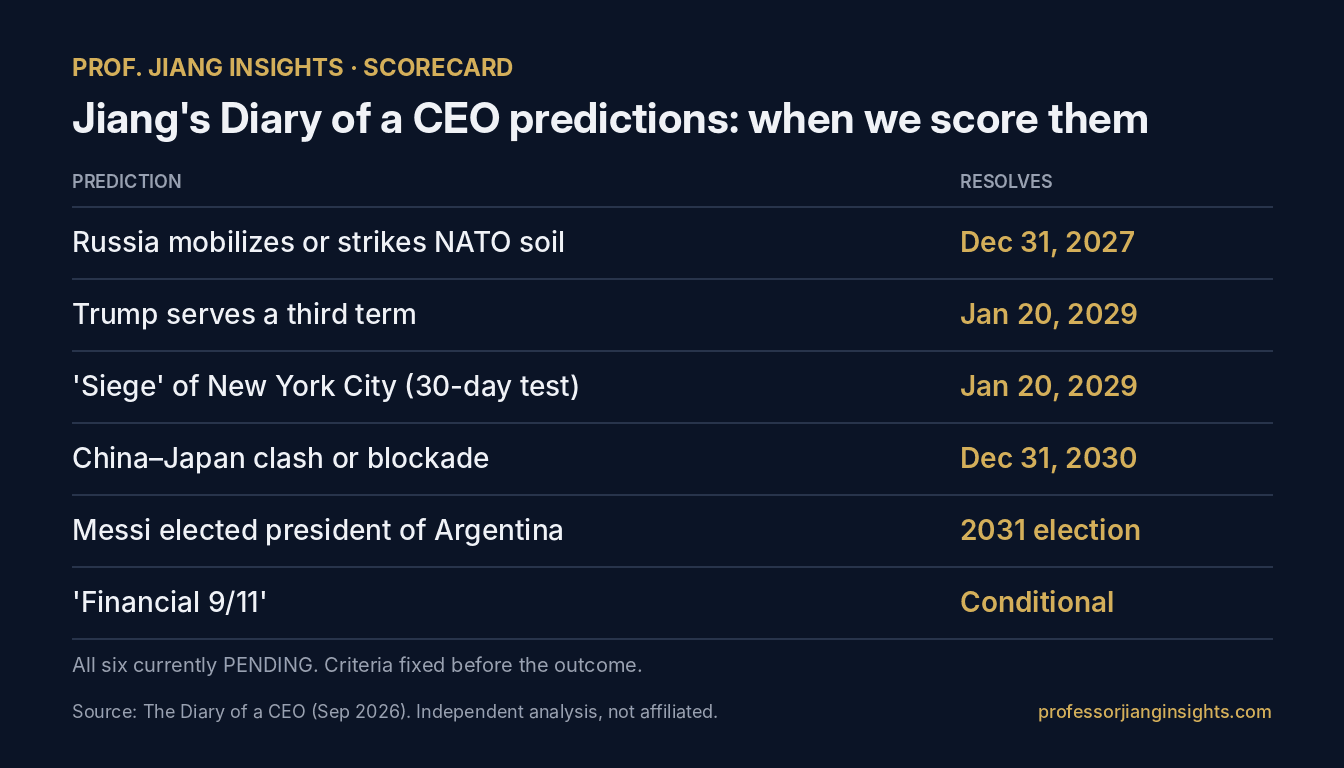
How we will score Jiang's Diary of a CEO predictions
- Financial 9/11: conditional; scored only if a 9/11-scale attack occurs.
- Trump third term: resolves January 20, 2029.
- Siege of New York City: resolves January 20, 2029, on the 30-day deployment test above.
- President Messi: resolves after Argentina's 2031 presidential election.
- China–Japan clash or blockade: resolves December 31, 2030.
- Russia mobilizes or strikes NATO territory: resolves December 31, 2027.
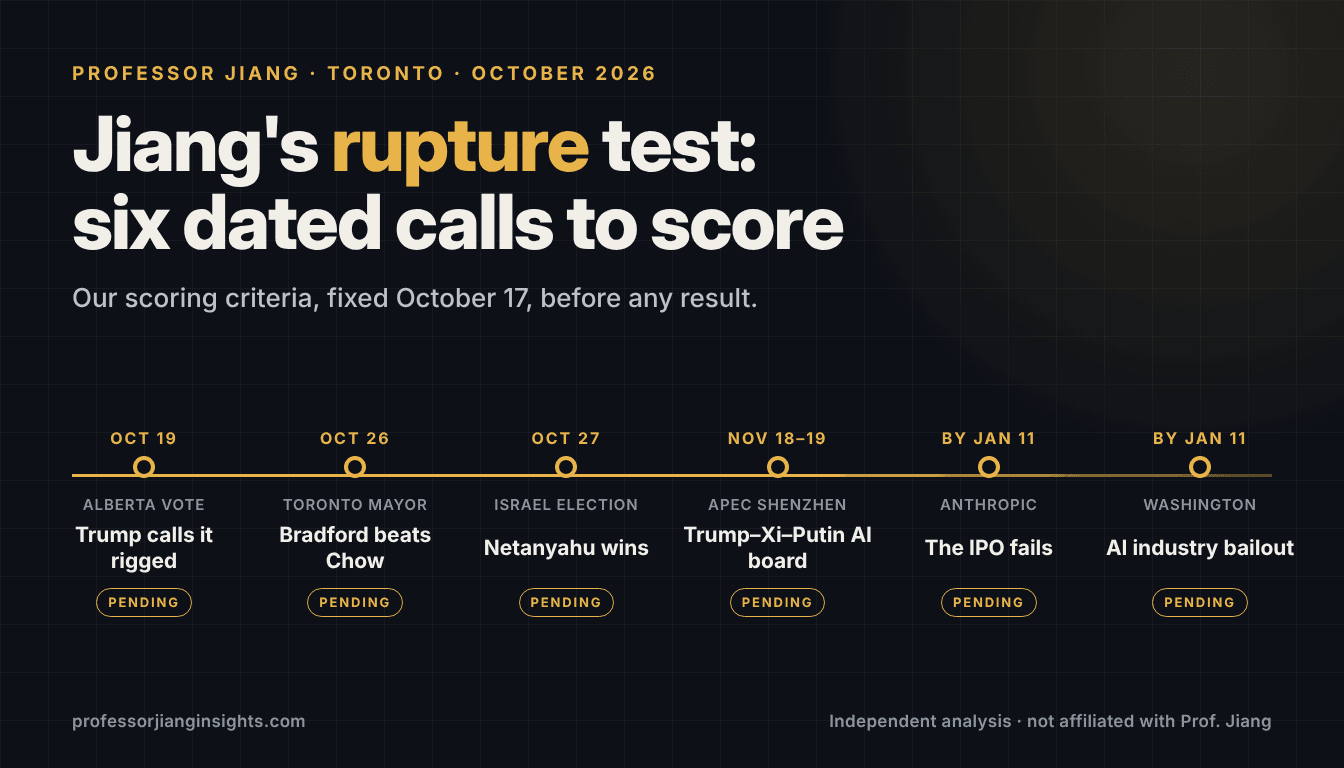
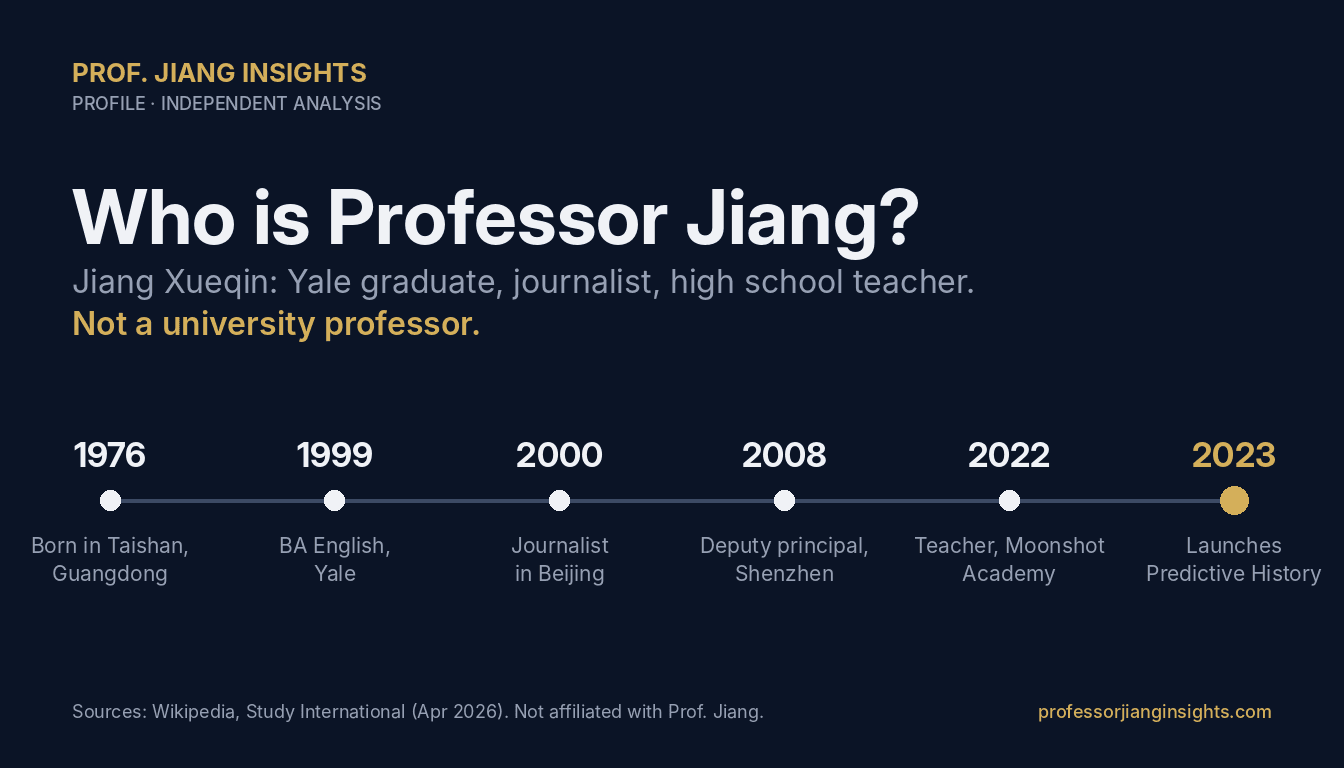
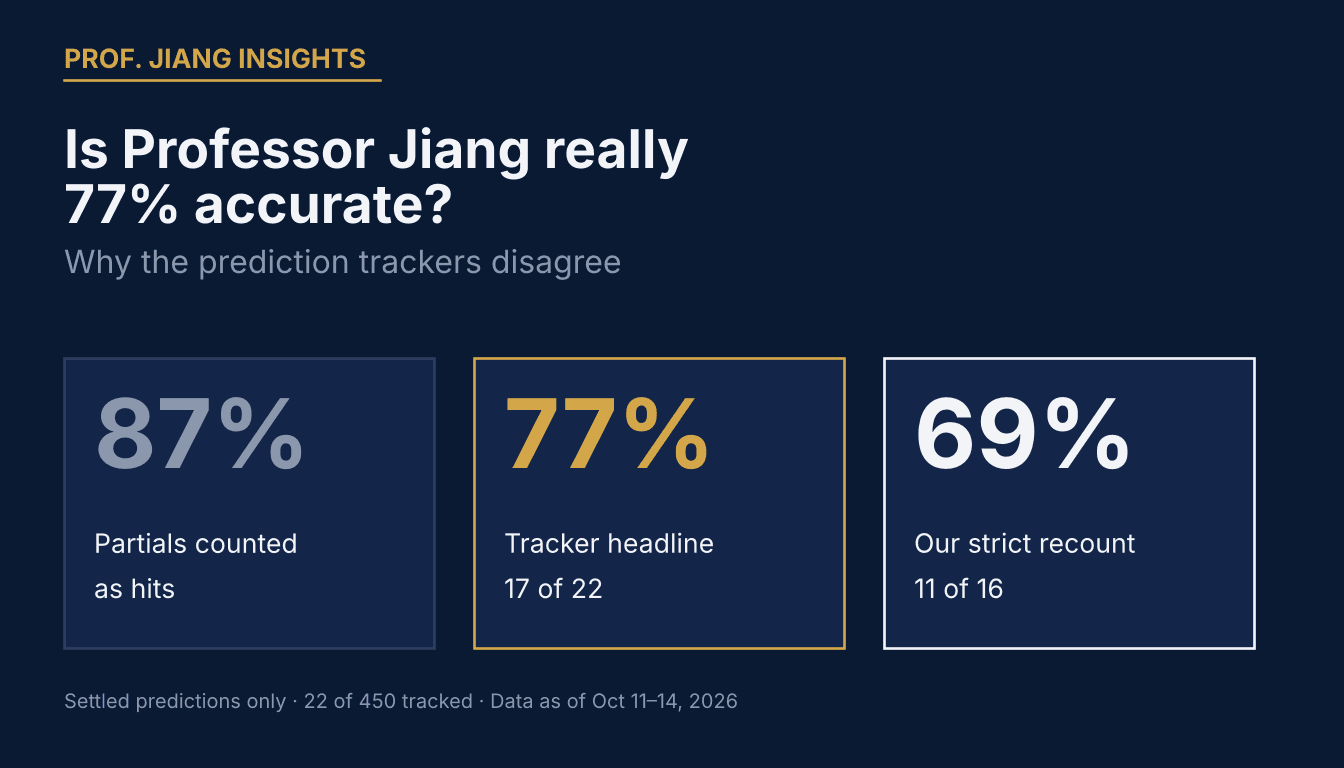
For how calls like these feed into his overall record, see our recount of his 77% accuracy figure. For his background and the "professor" title, see our profile of Jiang Xueqin. The first of his 2026 calls to resolve are his midterm predictions, which we score on November 4.