Is Professor Jiang Really 77% Accurate? Why Trackers Disagree
Jiang Insights' analysis finds that the 77% accuracy figure for Professor Jiang Xueqin comes from the fan tracker jiangpredictions.com and covers only 22 of 450 tracked predictions. A rival tracker's 87% counts partially correct calls as hits. After removing reported events and a double-counted hedge, our recount puts his settled record near 69–74%, with a wide margin of error.
ANALYSIS
This article analyzes how third-party fan trackers score Professor Jiang Xueqin's predictions. It is independent analysis; Jiang Insights is not affiliated with Professor Jiang or with either tracker. Tracker figures are as published on October 11–14, 2026 and will change. Errors in our recount are ours.
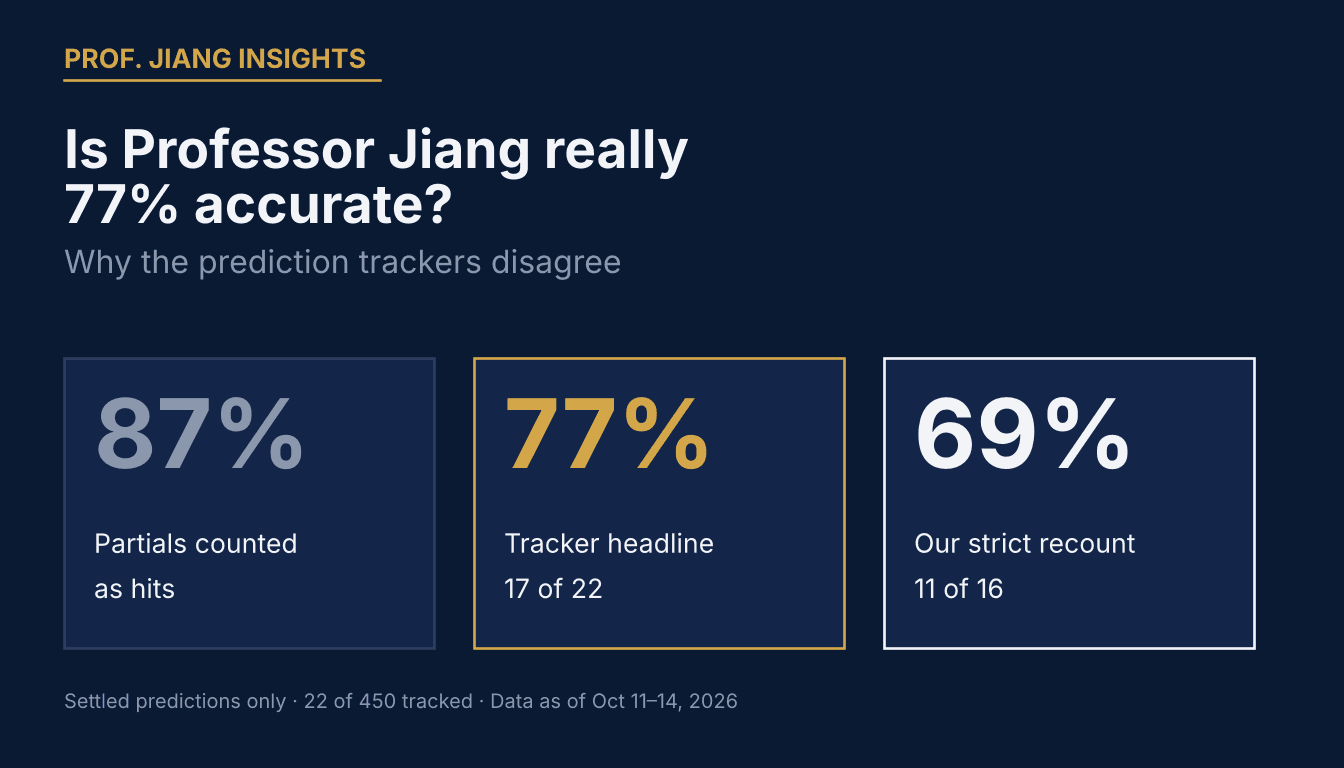
Is Professor Jiang really 77% accurate? The number is honest arithmetic, but it rests on 22 settled calls out of 450 tracked, about 5% of the record. The largest fan tracker, jiangpredictions.com, counts 17 hits and 5 misses. A smaller tracker, jiangprediction.com, advertises 87% because it counts "partially correct" calls as correct; scored strictly, its own data gives 44%. When we recount the 77% list, removing items that were never forecasts and scoring a hedge as one call, Jiang lands between 69% and 74%. With samples this small, anything from the mid-40s to about 90% is statistically consistent with his record.
Where does Professor Jiang's 77% accuracy figure come from?
It comes from jiangpredictions.com, an independent fan project that says it has pulled 450 predictions out of 182 Predictive History lectures. As of October 11, 2026 it lists 17 confirmed, 5 wrong, 15 "likely confirmed", 10 "likely wrong", 342 pending and 61 unverifiable. The formula is confirmed divided by confirmed plus wrong: 17 of 22, or 77.3%. The other 428 items are left out of the score.
Most of the pipeline is automated. A language model reads transcripts and extracts claims; a daily pass checks Google News headlines; a second model has to agree before a verdict changes. Credit where due: the site keeps an append-only log of status changes and publishes its misses next to its hits. That is more transparency than most pundit scorecards offer.
The headline still hides two things. Only 4.9% of the tracked predictions are actually scored, and 61 of them (13.6%) are unverifiable by the tracker's own count. And the early verdicts, including the Trump 2024 call, were bulk-imported on May 22, 2026 with their status already set, so the audit log cannot show how those were judged.
Why does another tracker say Jiang is 87% accurate?
The 87% figure belongs to jiangprediction.com, a one-off analysis frozen at March 2026. It lists 40 predictions: 7 correct, 7 partially correct, 2 wrong, 16 pending and 5 unfalsifiable. Its 87% is (7 + 7) ÷ 16. Every partial hit counts as a full hit. Score the same 16 strictly and you get 7 of 16, or 44%. Give half credit for partials and you get 66%. One dataset, three possible headlines: 44%, 66% or 87%.
Its method note adds a bigger caveat. The predictions were extracted from 9 of the most prediction-dense transcripts, out of 131, using YouTube's auto-generated subtitles. Picking the densest lectures is not dishonest, but it means the sample is not his full output. The page is also inconsistent with itself, citing both 131 and 135 lectures and both 33 and 40 unique predictions.
So the trackers mostly disagree because of rules, not because they watched different lectures. The 77% throws out partials and leaners. The 87% counts partials as wins. Neither is "Jiang's accuracy" in any settled sense.
Which of Jiang's "confirmed" predictions hold up?
We went through all 22 settled items on the 77% list. Most of the verdicts are fair. A handful should not be in the numerator.
- Not predictions at all (P088, P105). The Khamenei decapitation strike is scored as a hit, yet the tracker's own note calls it a reported event: in Game Theory #9 Jiang describes the strike after it happened, and the "predicted" date is listed as N/A. The destruction of the Iranian navy has the same N/A date and is phrased in the past tense. Both count as confirmed.
- A hedge scored twice (P002a, P002b). In Geo-Strategy #5 (May 2024) Jiang said "I think he'll pick Nikki Haley" while also naming JD Vance as possible. The tracker splits this into a miss for Haley and a hit for Vance as a "strong alternative". His stated pick was Haley. That is one call and one miss.
- Default outcomes and same-month calls (P016, P071, P325). No nuclear weapons in the Iran war and no significant Chinese involvement were the expected outcomes; almost any analyst would have said the same. The trade wars on Canada and Mexico were a Trump campaign promise, and he signed the first tariff orders on February 1, 2025, the same month the tracker dates Jiang's call. All three were right. None shows much forecasting skill.
- Very wide windows (P018). A US–Iran war lasting "many weeks, possibly many years" covers almost any outcome. We kept it in, but it is a cheap hit.
Some hits are genuinely strong. Jiang called a US war with Iran in April 2024 with a two-to-four-year window (P011). He said Iran would close the Strait of Hormuz (P026). In May 2024 he named Mojtaba Khamenei as the next Supreme Leader (P041), when that was far from the consensus view. Those calls carried real information, and a fair scorecard should say so.
How accurate is Professor Jiang really? Our recount
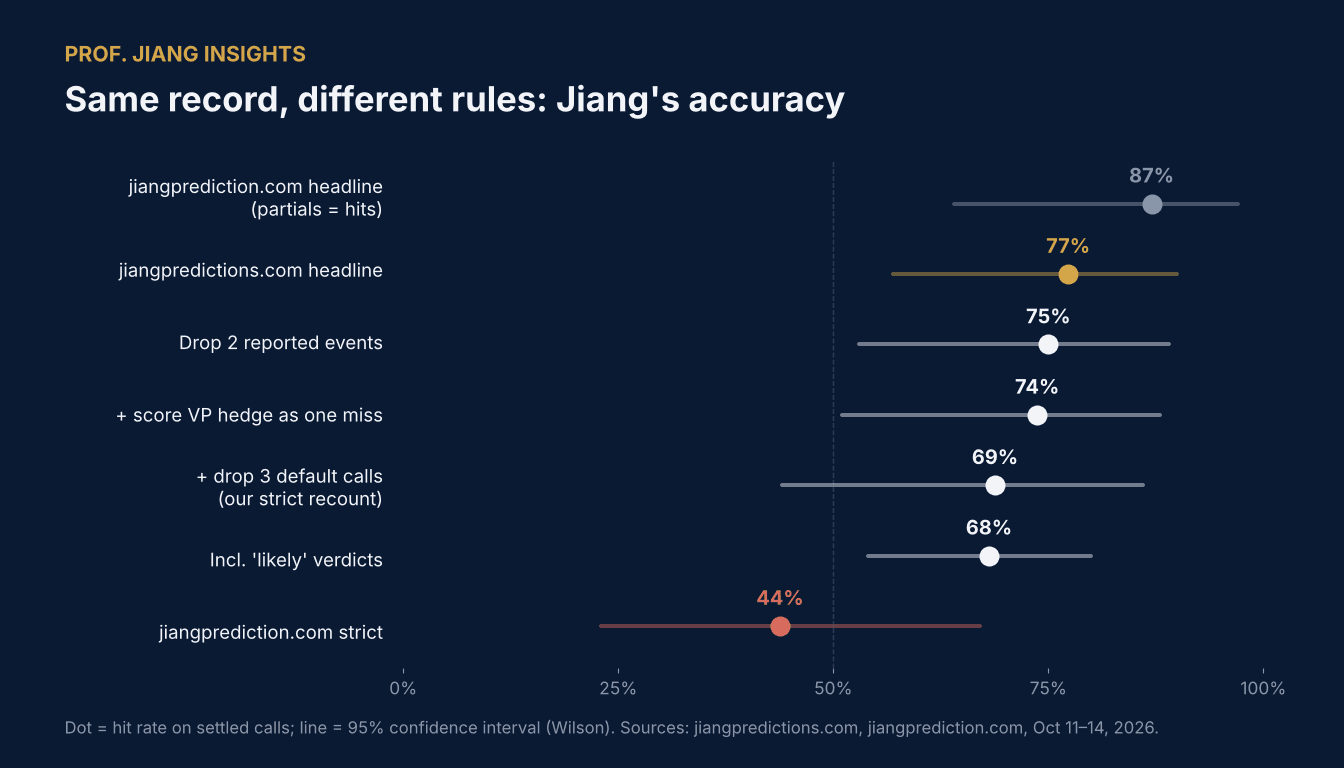
Here is the same data under progressively stricter rules. Ranges are 95% confidence intervals (Wilson method), which show how much a small sample can mislead.
- Tracker headline: 17 of 22, 77% (range 57–90%).
- Drop the two reported events: 15 of 20, 75% (53–89%).
- Score the VP pick as one miss: 14 of 19, 74% (51–88%).
- Also drop the three default or same-month calls: 11 of 16, 69% (44–86%). This step is our judgment call; reasonable people could keep them.
- Tracker data, counting the leaners as they lean: 32 of 47, 68% (54–80%).
- jiangprediction.com, strict: 7 of 16, 44% (23–67%); 66% with half credit for partials.
Our reading: on settled, genuinely forward-looking calls, Jiang sits somewhere around 65–75%, with an error bar of roughly 20 points either way. The 77% is defensible arithmetic on a generous list. The 87% does not survive strict scoring.
ANALYSIS
Our scorecard (October 14, 2026): Tracker headline 77% (17/22). Our strict recount 69% (11/16), range 44–86%. Strict count of the 87% tracker: 44% (7/16). Next data points: the November 3 midterms and the US–Iran ground-invasion window through year-end.
Is 77% accuracy good for a geopolitical forecaster?
A hit rate alone cannot answer that, because it depends on what you choose to predict. "Nuclear weapons will not be used" was close to certain. "Mojtaba Khamenei will succeed his father" was a long shot. Someone who only makes safe calls can hit 90% and know nothing. That is why forecasting research scores probabilities, usually with Brier scores, rather than counting hits. Philip Tetlock's long study of expert political judgment found that confident pundits did little better than simple baselines on long-range questions, and the superforecasters who later beat them did it with explicit probabilities on questions with fixed deadlines.
Jiang rarely gives probabilities, and much of his output has no deadline, so a Brier score is not possible. The next best test is to compare each call with what the market believed at the time. His flagship hit, Trump winning in 2024, was made in April 2024, when Polymarket had Trump at about 46% and Biden at 44%. He picked the right side of a coin flip. That is a correct call, but it is one coin flip, not proof of a method.
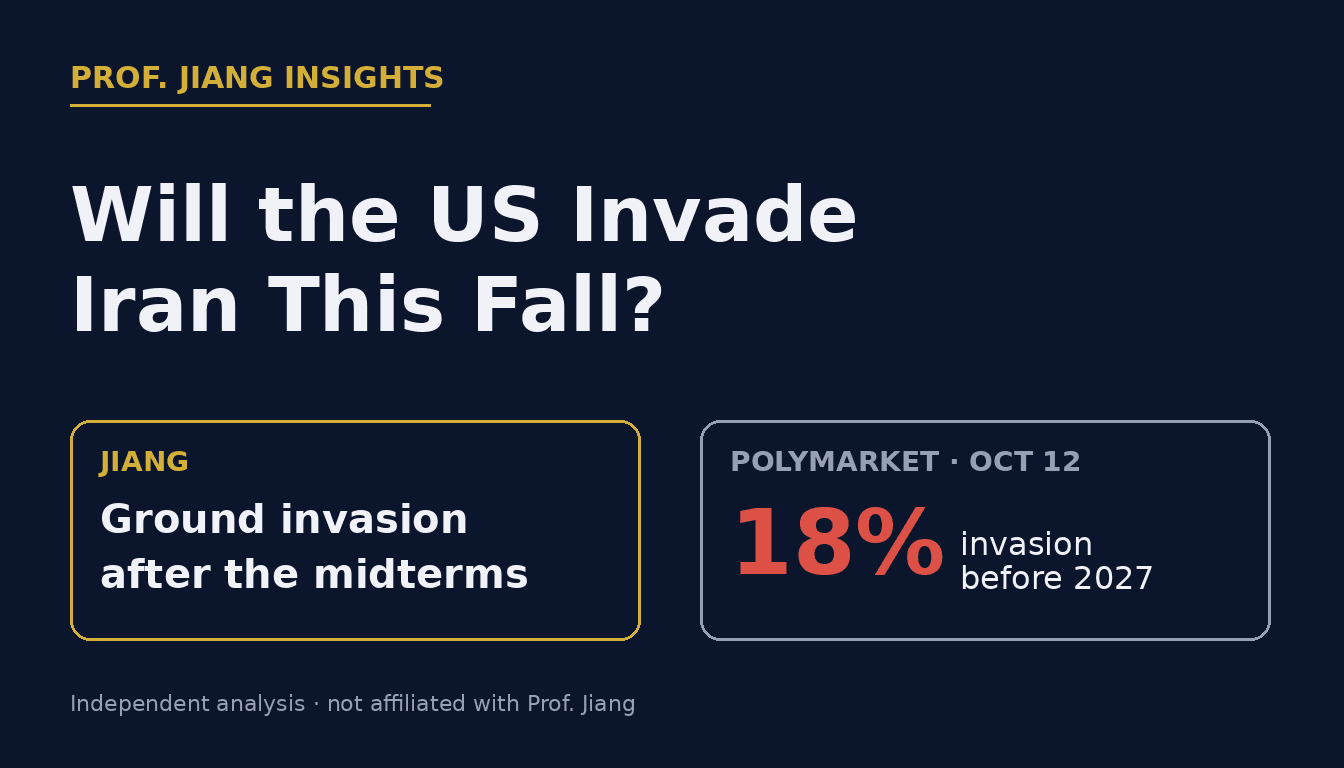
His two biggest live calls are both against the crowd. His midterm forecast, Democrats taking the House but not the Senate, traded near 30% on Polymarket in mid-October, against 62% for a Democratic sweep. His call for a US ground invasion of Iran after the midterms faces an 18% market price for an invasion before 2027. If he hits either, it will say more about his skill than a dozen consensus calls.
The case that the 77% undersells Jiang
His defenders have real arguments. A hit rate treats every item as equal, so calling the Iran war two years early counts the same as a VP guess. Jiang also says his method reads structure, not calendars, and several of his five misses are about timing: Le Pen's party governing France within three months, a China–Russia split "very quickly". The direction could still prove right. And automated extraction sometimes turns a lecture aside into a "prediction" he never framed as testable, which inflates the denominator of unverifiable claims and can produce misses he never really made.
Those points have limits. "Right direction, wrong timing" can excuse any miss forever, which makes a claim unfalsifiable. When Jiang puts a date on a call, as with a ground invasion "as early as October", his audience clips and shares the date, so the date should be scored. And weighting big calls more heavily cuts both ways: his largest open theses, from the dollar's collapse to a US military draft, have not resolved yet.
Which Professor Jiang prediction tracker should you trust?
For breadth, jiangpredictions.com is the better resource: it is large, links each claim to a lecture, publishes its misses and logs changes. Use it as a map of what Jiang said and where. Treat jiangprediction.com as a March 2026 snapshot and read its 87% as "including partial credit". For the accuracy number itself, neither headline should be quoted alone. A fair version reads: 17 hits out of 22 settled predictions, partials excluded, 428 not yet scored.
Automated verdicts need watching, too. On September 25, 2026 the pipeline moved Jiang's midterm split call (P391) from pending to "likely confirmed" on the strength of a headline saying Democrats were favored, then a re-check moved it back to pending the same day. The system corrected itself, which is to its credit. It also shows that a "likely" label can move on one news story about an election that has not happened.
That is why we score differently. For each big claim we record the exact quote and timestamp, the market price on the same question, and the resolution rule, all before the outcome. A hedge is scored as the main call he stated. We apply this to the midterms on November 4, to the Iran invasion window as it closes, and to the long-dated theses in our dollar collapse and draft analysis. We will update this recount after the midterms. If the two contrarian calls land, his number goes up for the right reasons.