Who Is Professor Jiang Xueqin? Age, Background, Books and the 'Professor' Title
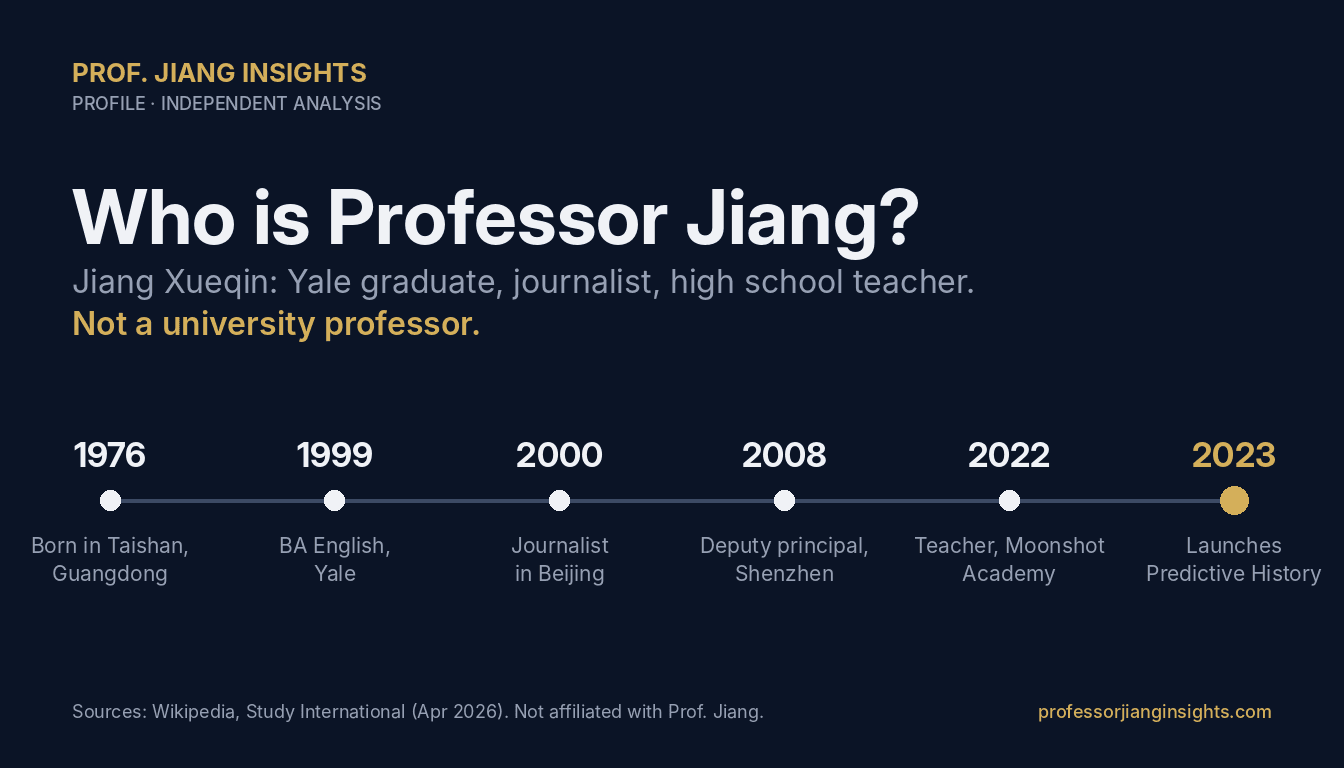
Jiang Insights' profile finds that Jiang Xueqin, known online as Professor Jiang, is a Chinese-Canadian educator born in 1976 who grew up in Toronto and graduated from Yale in 1999. He worked as a journalist and high school teacher in China, holds no university professorship, and launched Predictive History on YouTube in 2023.
ANALYSIS
This profile draws on public reporting and Professor Jiang's own recordings. Jiang Insights is independent and not affiliated with him. We do not cover his private family life. Facts are as reported up to October 14, 2026.
Professor Jiang is Jiang Xueqin, a Chinese-Canadian educator born in 1976 who runs the YouTube channel Predictive History. He grew up in Toronto, took a Yale degree in English literature in 1999, then spent two decades in China, first as a freelance journalist and later as a high school teacher and administrator. He is not a university professor and has no PhD; the title came from his audience. He became famous for a 2024 lecture that called Trump's re-election and a US war with Iran. Both happened.
How old is Professor Jiang, and where is he from?
He was born in 1976 in Taishan, a city in Guangdong province, according to the Chinese-language World Journal as cited on his Wikipedia page. That puts him at 49 or 50 in 2026; we found no reliable source for his exact birthday. His family left China when he was about six and settled in Toronto, where money was tight: his father, a teacher back home, took restaurant jobs. Jiang is a Canadian citizen.
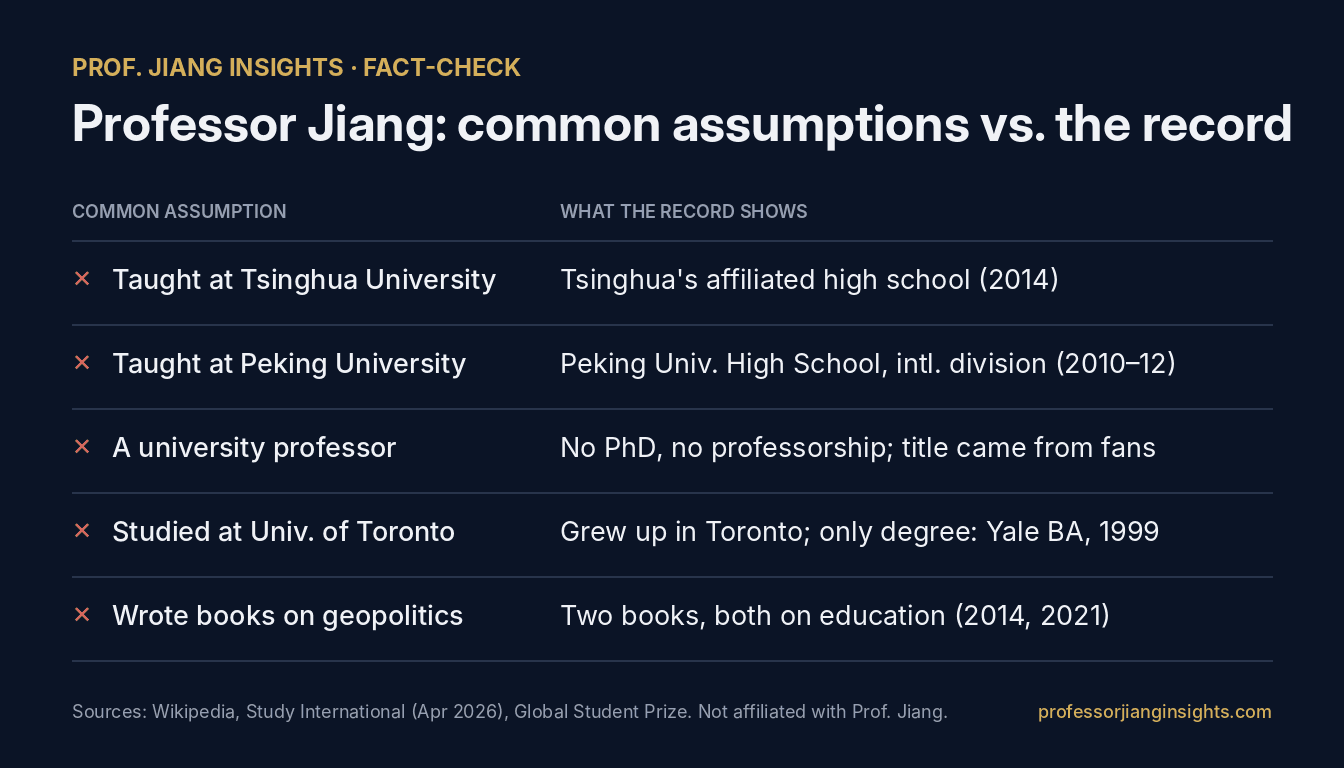
People often search for "Professor Jiang Toronto" as if he studied or taught there. None of the profiles we checked lists a University of Toronto degree or post. Toronto is where he grew up; Yale is his only degree on record.
Did Professor Jiang go to Yale?
Yes. A profile in Study International (April 2026) says he applied at 16 to Harvard, Princeton, MIT and Yale, and only Yale said yes, with a scholarship. He started in particle physics and switched to English literature, graduating in 1999. In 1998, still an undergraduate, he spent time teaching at the high school attached to Peking University in Beijing. That detail matters later.
Is Professor Jiang a real professor?
Not in the academic sense. He has no doctorate and has never held a professorship. Germany's Die Zeit called the title misleading, since in most countries "professor" means a university post. Jiang's answer, given to Zeteo, is that his fans started calling him that and the name stuck.
Our view: the label is less of a problem than what viewers read into it. "Professor" suggests archival research, peer review and a discipline checking his work. Predictive History is something else. Jiang describes his method as structural history plus game theory, inspired by the psychohistory of Isaac Asimov's Foundation novels. It is a synthesis of reading and analogy by a gifted explainer. The fair way to judge that is by results, which is why we score his calls one at a time.
Where does Professor Jiang teach?
His career runs in two halves. In 2000 he moved to Beijing as a freelance journalist, writing for outlets including the Christian Science Monitor and the Far Eastern Economic Review. In 2002, while filming a labor protest in Daqing for a PBS documentary, he was held for two days and expelled from China. He was let back in 2003 and switched to education.
From there the record reads like an education reformer's CV. He was deputy principal of Shenzhen Middle School from 2008 to 2010, pushing a creativity-focused curriculum, then ran the international division of Peking University's affiliated high school from 2010 to 2012. In 2014 he worked at Tsinghua University's affiliated high school. He was also listed as a researcher with the Global Education Innovation Initiative at Harvard's Graduate School of Education. From 2022 he taught history and philosophy at Moonshot Academy, a private school in Beijing, and the Predictive History lectures grew out of those classes. Whether Moonshot is still his day job is unclear: Wikipedia gives conflicting dates, and the school's public educator list no longer shows him on its first page.
Here is a mistake worth correcting. Several fan sites say Jiang taught at Tsinghua or Peking University. The record shows the high schools affiliated with those universities. It's an easy slip, because the university name is in the school's name, but it turns a high school teacher into a faculty member at China's two most famous universities. He was never either.
What books has Professor Jiang written?
Two, both published in China and both about schooling, not geopolitics: Creative China (2014) and Schools for the Soul (2021). There is no Predictive History book. His long-form writing now goes out through the Predictive History newsletter on Substack. Earlier he wrote op-eds for CNN, The Wall Street Journal, the Chronicle of Higher Education and the Chinese edition of The New York Times. He is a fellow of the Royal Society of Arts and in 2022 joined the judging academy of the Global Student Prize.
What is Professor Jiang's religion?
We could not find a reliable public statement about his own faith. Religion is a constant subject in his lectures, as a force that shapes empires and wars, but the profiles we checked name no affiliation for him personally. Treat confident claims online either way as unverified.
How did Predictive History become so popular?
He started the channel in 2023 to record classes for his students. The breakout was a 2024 Geo-Strategy episode, "The Iran Trap", which argued that Trump would win, that the US would be drawn into a war with Iran, and that it would lose. The first two came true by 2026. The third is still open. India Today noted that other analysts had made similar calls; Jiang's edge was making them early and memorably. The South China Morning Post reported that some media had started calling him the "Nostradamus of China".
Growth followed fast. Study International counted about 2.17 million subscribers and 68 million views in April 2026; Wikipedia later listed 2.6 million and 77 million. In 2026 he started live Global Meet-Ups with fans, including one in Los Angeles in August, and appeared on The Diary of a CEO on September 14. The SCMP points out that his audience is mostly outside China, where he says he avoids talking to reporters.
What do critics say about Professor Jiang?
The criticism falls into three groups. The Free Press and the SCMP accused him of spreading conspiracy theories about secret societies running the West, and a Peking University assistant professor, Yang Meng, argued in Canada's National Post that one of his claims about Israel echoed an antisemitic trope. Analysts quoted by Newsweek said his Iran lecture leaned on selective historical analogies and assumptions nobody could test. India Today made a quieter point: his geopolitical analysis rarely turns on China's own foreign policy or internal problems.
That last one deserves more attention than it gets. Jiang lives in Beijing and has said that anything he posts could be used against him. Readers can weigh that without assuming bad faith: a forecaster who rarely makes calls about the country he lives in has a blind spot by construction.
What his background tells you about his predictions
Read the CV as a forecaster's résumé and the pattern makes sense. A journalist learns to frame a story before the facts settle, which explains why he is often early. A teacher learns to make one big idea stick, which explains why his calls travel. What the CV lacks is training in quantitative forecasting. Jiang rarely puts a number or a firm date on a prediction, and that makes him hard to score.
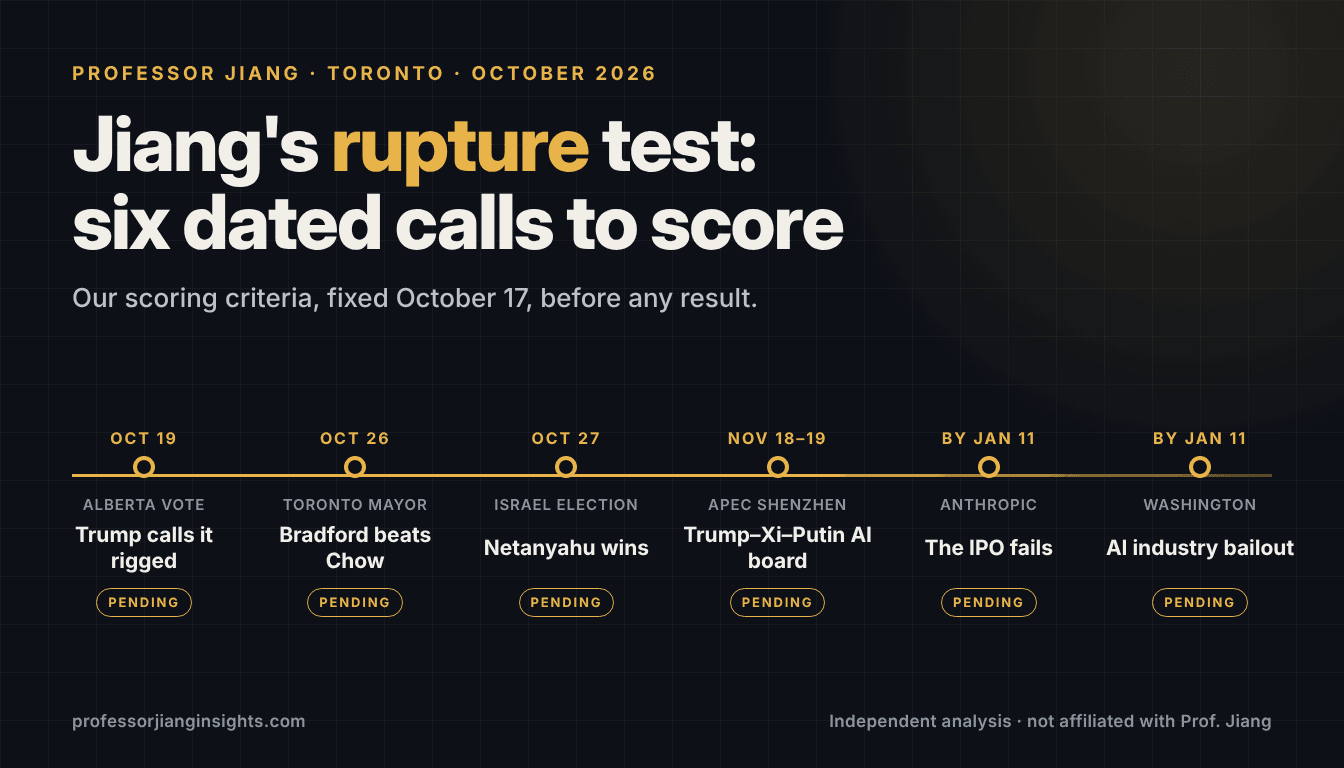
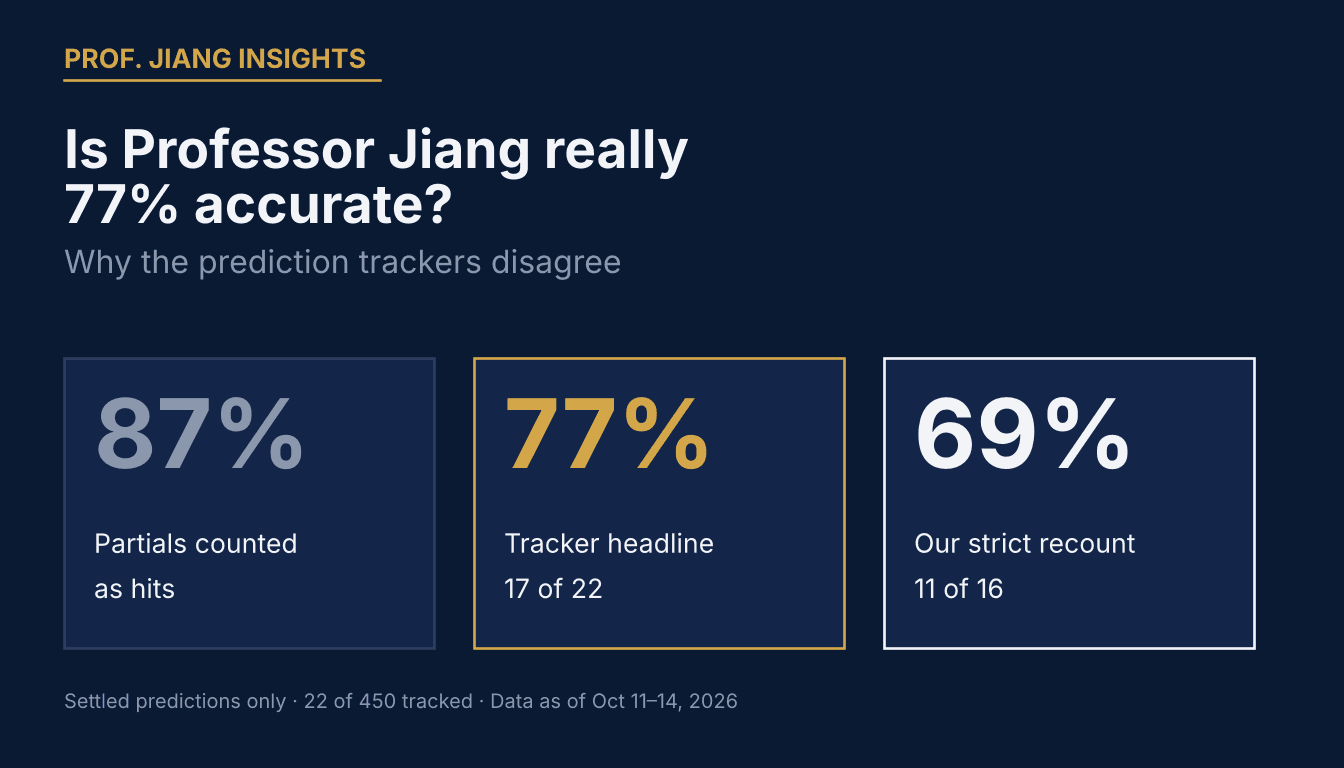
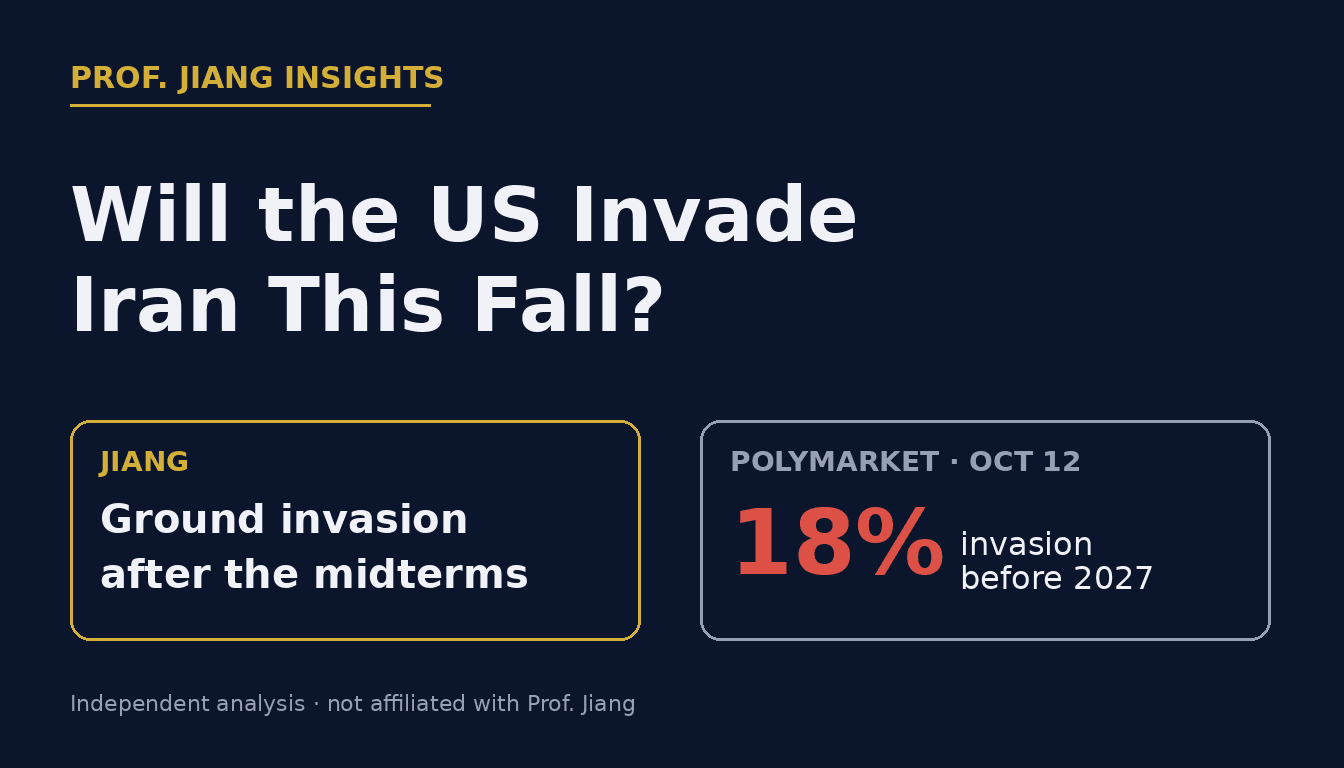
So we pin each call down: the exact quote and timestamp, the prediction-market price on the same question, and resolution criteria written before the outcome. On the settled record, the fan tracker's 77% rests on just 22 calls, and our strict recount of his accuracy puts him nearer 69–74%. The next tests are close. His midterm predictions get scored on November 4, and his forecast of a US ground invasion of Iran runs against an 18% Polymarket price.