ANALYSIS
This article summarizes Professor Jiang Xueqin's views as we understand them from his recorded lectures. It is independent analysis, not his official statement, and Jiang Insights is not affiliated with him. Errors in summarizing are ours.
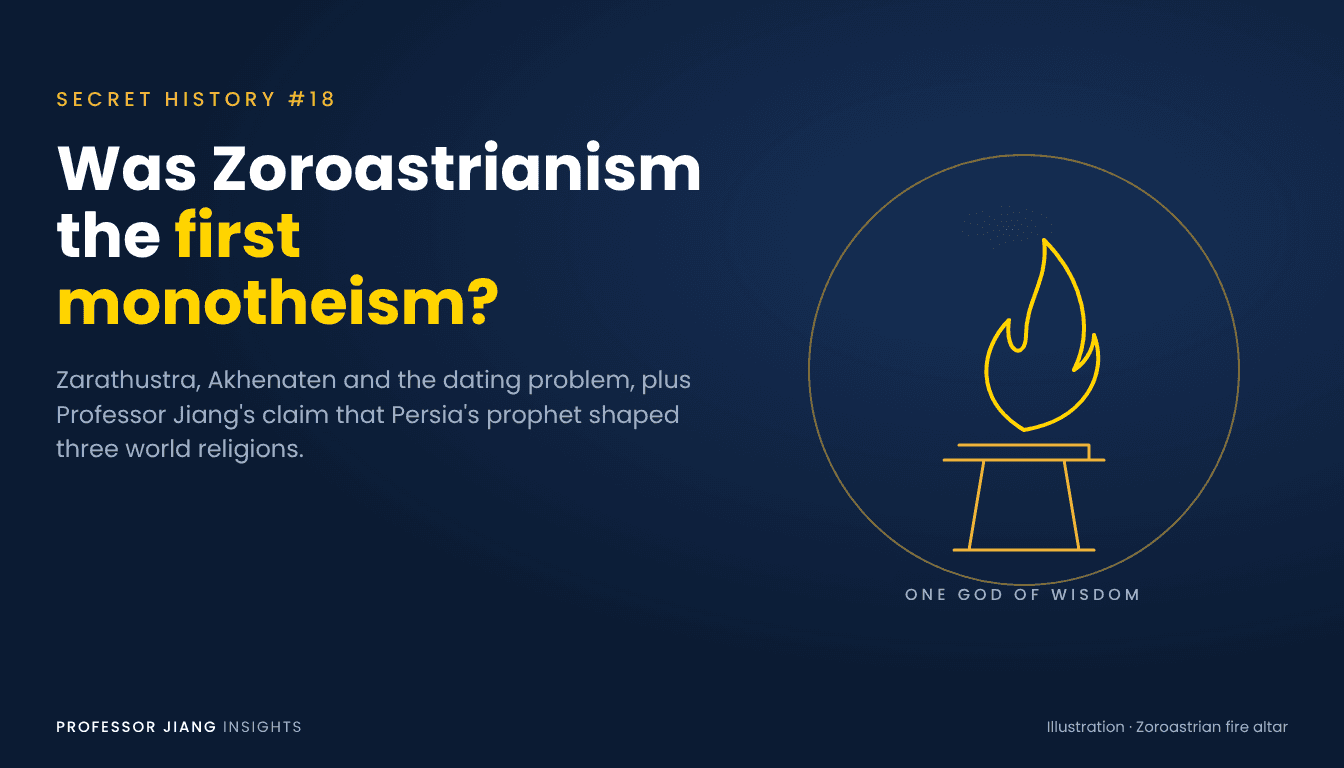
Zoroastrianism is the strongest candidate for the first monotheistic religion that lasted, but it is not a certain winner. Its prophet, Zarathustra (Zoroaster to the Greeks), proclaimed one supreme god, Ahura Mazda, the "Lord Wisdom". The problem is the calendar: scholars date him anywhere from about 1500 to 600 BC, and an Egyptian pharaoh had a one-god cult around 1350 BC.
Professor Jiang Xueqin, the Beijing-based teacher behind the Predictive History channel, has no doubts. In Secret History #18 he introduces Zarathustra as "the most influential person who has ever lived" (0:11) and credits him with the structure of Judaism, Christianity and Islam. Here is what the record supports.
What is monotheism, exactly?
Monotheism is the belief that only one god exists. It differs from henotheism (many gods exist but you worship one) and monolatry (one god is the only one allowed in worship). The line matters, because most "first monotheism" arguments are really arguments about which of these an ancient religion was.
Early Israel, for example, worshipped Yahweh alongside El, and an inscription from around 800 BC at Kuntillet Ajrud blesses people "by Yahweh and his Asherah". Strict biblical monotheism ("I am the LORD, and there is none else", Isaiah 45:5) appears in texts from the exile and after, around the sixth century BC.
What did Zarathustra teach?
Zarathustra was a priest who turned against the religion of his day, in which gods were patrons bought with sacrifices. He placed one god of wisdom at the top and moved the battle between good and evil inside each person: Asha, truth and right order, against Druj, the Lie. His hymns, the Gathas, describe two primal spirits, "the Better and the Bad, in thought and word and action" (Yasna 30.3, Moulton's 1912 translation), and say each person must choose between them. From this comes the Zoroastrian motto: good thoughts, good words, good deeds.
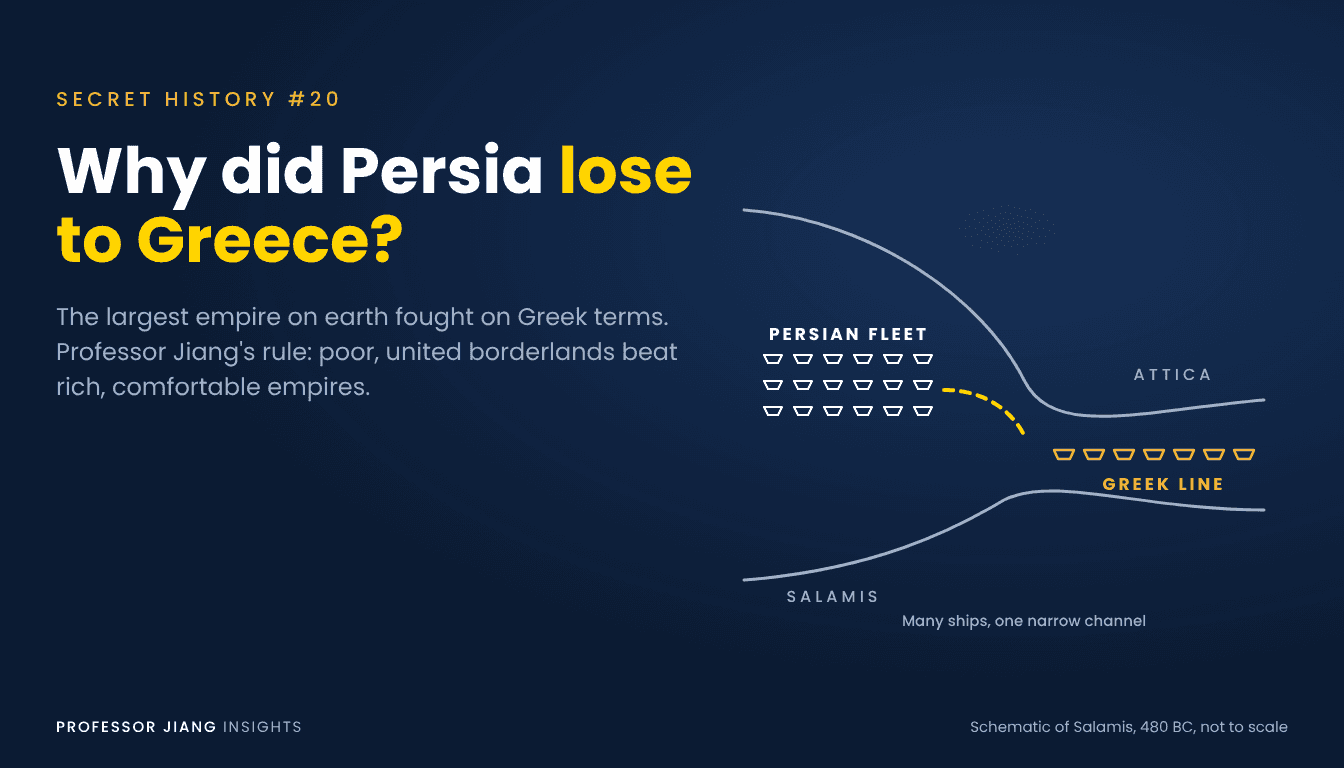
The Greeks knew the effect. Herodotus wrote that Persian boys were taught three things from five to twenty: "to ride, to draw the bow, and to speak the truth" (Histories 1.136). Those horsemen and archers built the largest empire of its day, yet in Greece's narrow terrain they counted for little; see why did Persia lose to Greece?
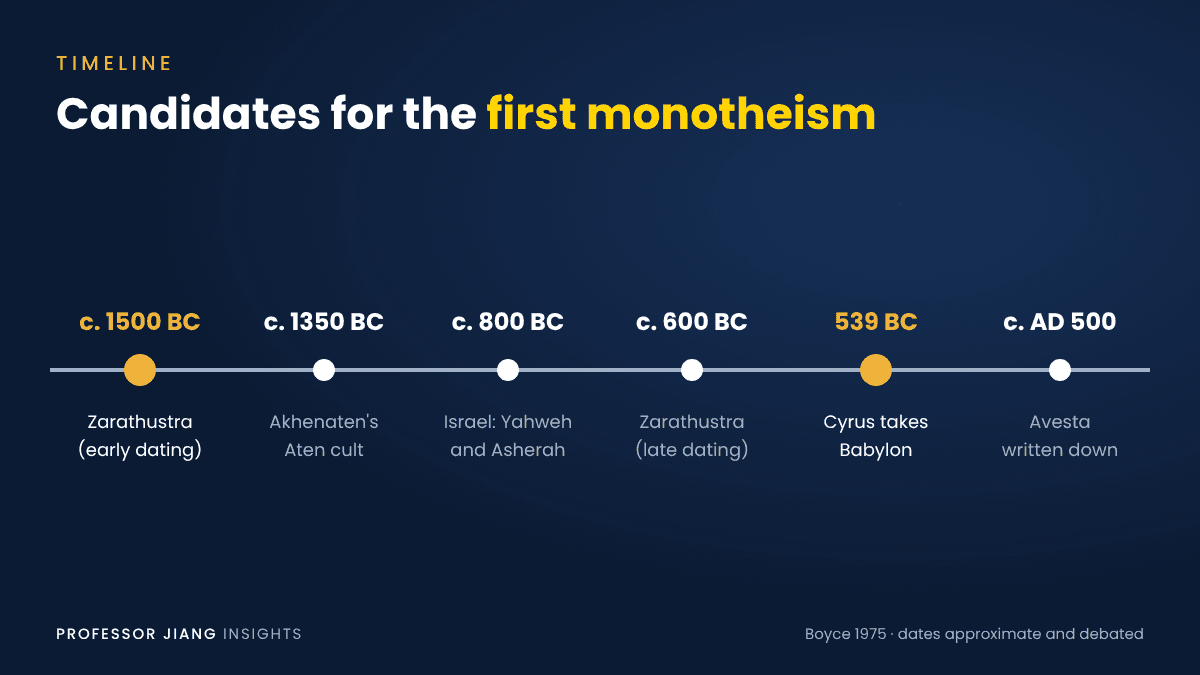
c. 1500–1000 BC
Zarathustra (early dating)
Mary Boyce's date, from the archaic language of the Gathas
c. 1350 BC
Akhenaten's Aten cult
Egypt's pharaoh promotes one sun-disk god; abandoned after his death
c. 800 BC
Kuntillet Ajrud inscription
"Yahweh and his Asherah": Israel still worships more than one deity
c. 600 BC
Zarathustra (late dating)
Later Greek and Persian tradition places him in the sixth century
539 BC
Cyrus takes Babylon
Judean exiles come under Persian rule
c. 520 BC
Behistun inscription
Darius blames every rebellion on "the Lie"
c. AD 500
Avesta written down
Zoroastrian scriptures fixed in writing under the Sasanians
Was Akhenaten first?
Pharaoh Akhenaten, who ruled Egypt around 1353 to 1336 BC, closed the temples of the old gods, chiselled out the name of Amun and promoted a single god, the Aten, the disk of the sun. If "first monotheism" means the first dated attempt, Akhenaten wins. But his revolution died with him: his successors restored the old gods and erased his name. Zoroastrianism, by contrast, became the religion of three Persian empires and survives today.
Is Zoroastrianism really monotheistic?
That is the second problem. Ahura Mazda is supreme, but the tradition also has Angra Mainyu, a destructive spirit who opposes him, so some scholars call Zoroastrianism dualist rather than monotheist. Defenders answer that the evil spirit is not a second god of equal rank and that he loses in the end: later Zoroastrian texts end the world with frashokereti, a renovation in which evil is defeated, all souls pass through molten metal and even the wicked are purified.
Did Zoroastrianism shape Judaism and Christianity?
Jiang's claim is that Zarathustra created three revolutionary ideas: the individual (you, not your tribe, face judgment), free choice, and truth as conscience. "What your family says, what your community says, what your nation says does not matter," he says (14:48). These, he argues, are the skeleton of every later monotheism.
Many historians see a real connection in the period after 539 BC, when Cyrus the Great conquered Babylon and the Judean exiles lived under Persian rule. Jewish texts after that point develop a final judgment, the resurrection of the dead, ranks of angels and a cosmic adversary, all central to Zoroastrianism. Christianity inherited them, and Matthew's Gospel even has Persian priests, the Magi, at the birth of Jesus. The caution is that Zoroastrian scriptures were written down very late, around AD 500, so who borrowed what is hard to prove. Similar ideas can also arise independently.
What Professor Jiang says about Zarathustra
In the lecture, Jiang retells Asha through later thinkers he believes said the same thing: Kant's categorical imperative (act as if everyone will copy you at once), Plato's cave (the freed prisoner must go back to tell the others), the poet Rumi, and Nietzsche's Thus Spoke Zarathustra. "The war of heaven and hell is within us" (9:01).
He is also candid that he changed his mind. In an earlier course he called Christianity the first monotheism; now he says Zoroastrianism (53:27). "This is a class not about answers. It's about questions" (52:48).
What the record shows
Jiang's description of the doctrine is accurate, and his correction about Christianity is right. Three details need care. His dating, 2000 to 1000 BC, is at the early end of a disputed range. Most scholars place Zarathustra's homeland in eastern Iran or Central Asia, not the north-west. And his figure of "two to three billion" followers of the Abrahamic religions understates them: Pew Research counts about 4.3 billion, which makes his point bigger. Nietzsche, finally, chose Zarathustra as a character to reverse him, not to channel him: in Ecce Homo he wrote that the prophet who first made good and evil the engine of the cosmos should be the first to see the error.
The fair verdict: Akhenaten was first to try, Zoroastrianism is the oldest one-god religion still practiced, and Judaism made monotheism strict. Jiang's larger claim, that Persia's prophet shaped the Abrahamic faiths, is a respectable minority-to-mainstream view, not a fringe one.
Read more
Jiang's history lectures connect to his forecasts about today. See how his calls are holding up on Professor Jiang's latest predictions, read our check of how accurate Professor Jiang really is, and learn more about who Professor Jiang Xueqin is.
Zarathustra and the Persian empire are covered in depth in Chapter 14 of our guide to Jiang's Secret History series. Read the first chapter free, and follow new breakdowns on Telegram.