ANALYSIS
This article summarizes Professor Jiang Xueqin's views as we understand them from his recorded lectures. It is independent analysis, not his official statement, and Jiang Insights is not affiliated with him. Errors in summarizing are ours.
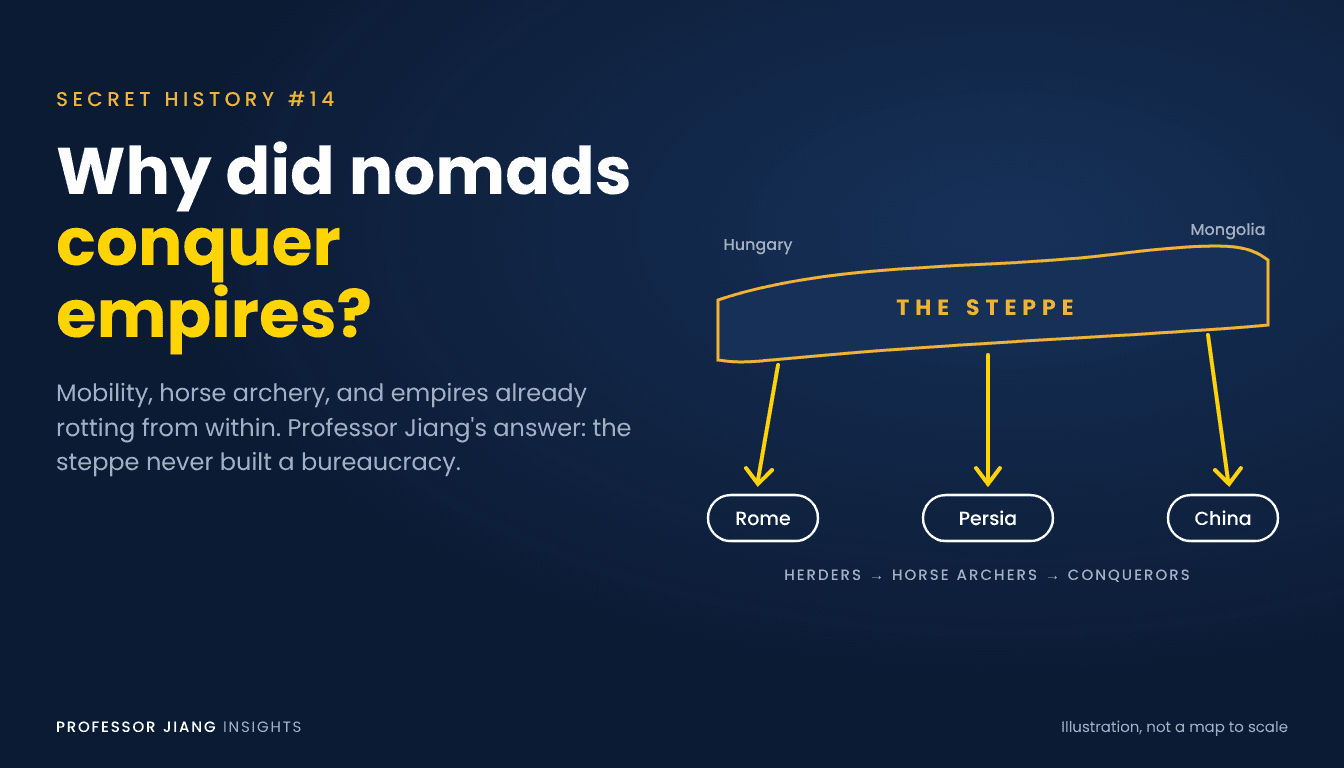
Steppe nomads conquered richer empires again and again because their way of life turned whole populations into mobile cavalry, and because they tended to strike when settled empires were already divided. From the migrations that carried Indo-European languages across Europe to Attila, Genghis Khan and Timur, the pattern held for roughly four thousand years, until gunpowder changed the math.
Professor Jiang Xueqin builds a whole lecture around this puzzle. If civilization makes people free, curious and rich, he asks, why did the "barbarians" keep winning? His answer flips what most of us learned in school.
Why did nomads conquer settled civilizations?
Historians usually give four reasons. First, mobility: on the grasslands that run from Hungary to Mongolia, herders lived on horseback and moved with their animals, so a nomad army carried its food with it. Second, the composite bow, which let a rider shoot accurately at a gallop. Third, constant practice: hunting and raiding kept every band battle-ready, while farmers had to be drafted and drilled. Fourth, timing. As the historian Thomas Barfield showed in The Perilous Frontier (1989), steppe confederations usually preferred to extort subsidies from China rather than conquer it, and moved in for the kill only when a dynasty was already collapsing.
That last point matters most. Nomads rarely toppled healthy states. They exploited sick ones.
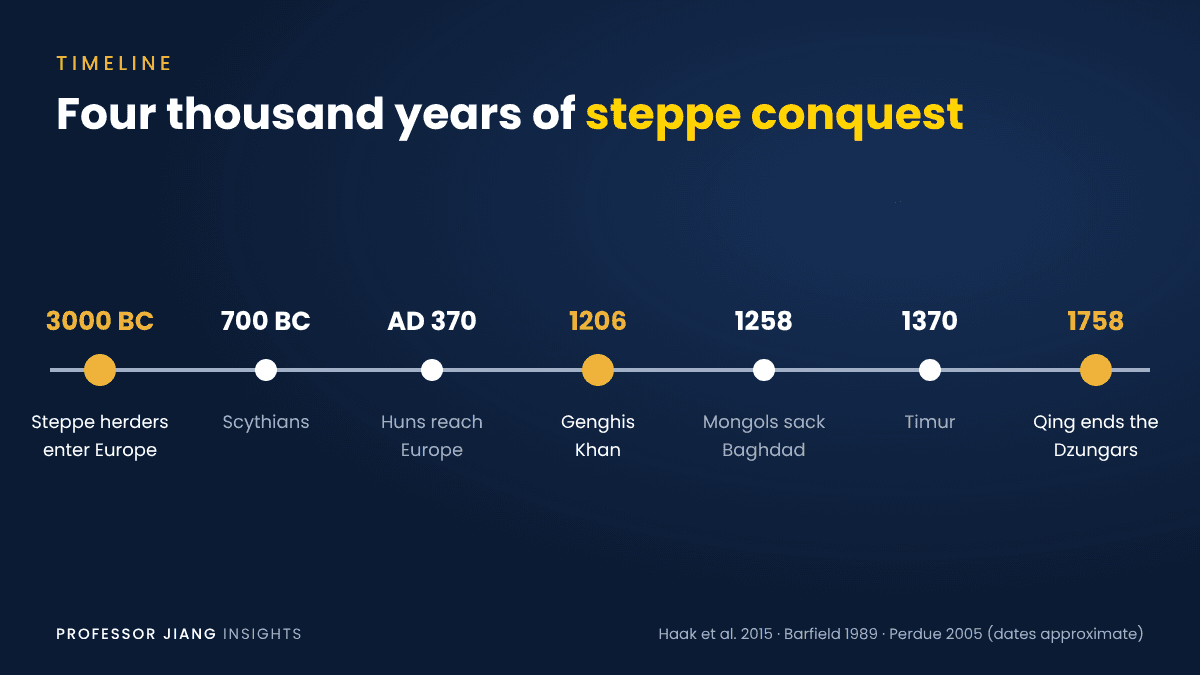
c. 3000–2500 BC
Steppe herders spread into Europe
Ancient DNA shows a massive migration of Yamnaya-related ancestry
c. 700 BC
Scythians dominate the western steppe
Raid as far as the Near East
133–89 BC
Han China wars on the Xiongnu
Begins centuries of steppe upheaval
c. AD 370–453
Huns reach Europe
Attila's empire peaks in the 440s
1206
Temüjin proclaimed Genghis Khan
Mongol conquests begin
1258
Mongols sack Baghdad
Led by Hülegü, Genghis's grandson
1370–1405
Timur's conquests
The last great steppe conqueror
1755–1758
Qing destroys the Dzungars
Gunpowder empires close the steppe
What Professor Jiang says about the steppe
In Secret History #14 (watch at 02:32), Jiang lists the school contrasts: civilization means intellectual freedom, curiosity and wealth; barbarians are emotional, static and poor. Then he argues the reverse. Empires, he says, start out innovative, but as they grow they become insular, secretive and monopolistic, which is what a bureaucracy is. His verdict: "Civilization leads ultimately to corruption" (09:16).
Ordinary people in a mature empire are trapped by war, debt and immobility, he says, while at the top too many heirs compete for too few positions. Elite factions hire the best fighters available, steppe horsemen, as mercenaries, and the mercenaries eventually take over (13:28). Rome's Germanic federates, the Turkic soldiers who came to dominate the Abbasid caliphs in the 860s, and the Uyghur cavalry that rescued and bled the Tang dynasty all fit his pattern.
His deeper point is that the steppe never built a bureaucracy. Without one, it kept what he calls open cooperative competition: rival clans learning from each other and fighting each other. He calls the grassland "a training ground for fighters" (28:05): the toughest stayed, and those pushed out went on to conquer empires.
How herding created property, war and patriarchy
Jiang's explanation starts with grass. You can't farm the steppe, but cattle and sheep can eat what humans can't, so people built an economy on animals (18:13). Animals are wealth you can count, steal and inherit, which brought raiding, which brought war and male rule. "Patriarchy, money and war," he says, "always go together" (19:19).
He illustrates the inheritance problem with a simple sum. A herder with 100 cows and ten sons who splits the herd fairly leaves each son ten; one bad winter and the family is finished. So the eldest inherits everything, and the younger sons band together to raid for cattle and wives. Loans of animals from rich to poor create bonds of loyalty, a big brother and little brother, and those chains of loyalty become tribes (25:16).
Parts of this are well supported. The Latin word for money, pecunia, comes from pecus, livestock. The archaeologist David Anthony, whose The Horse, the Wheel, and Language (2007) Jiang relies on, reconstructs an early Indo-European culture full of words for herds, wagons, oaths and gift exchange, and warrior brotherhoods of young men. Other parts need correcting. The Mongols did not practice primogeniture: Genghis picked his third son, Ögedei, as heir. And steppe peoples did take slaves, despite Jiang's claim that they had no concept of slavery.
Were the Yamnaya conquerors? What ancient DNA shows
The most dramatic part of the lecture concerns the Yamnaya, herders of the Pontic-Caspian steppe whose descendants spread across Europe around 3000 to 2500 BC. Jiang says they came mostly as young men who killed local men and married their wives: "from DNA research, we know that it was a genocide" (31:21).
The migration is real and enormous. Studies in Nature (2015) documented it; in Britain, a 2018 study found about 90% of the gene pool replaced within a few centuries after about 2450 BC; in Iberia, a 2019 study in Science found nearly all male lineages replaced by 2000 BC, while only about 40% of overall ancestry changed. That is strong evidence for a male-biased movement. But geneticists call it population turnover, not genocide. Violence is documented, yet plague bacteria also appear in genomes from about 2900 BC, and they may have emptied farming villages before the newcomers arrived.
Two other details in the lecture have been revised by recent research. Genetic studies of ancient horses (2021 and 2024) show that today's domestic horse spread only around 2200 BC, so the first migrants probably walked and drove ox-wagons rather than charging on horseback. And the ability to digest milk as an adult spread mostly after 1000 BC. The great age of the mounted archer came later, with the Scythians.
Jiang does add one caveat worth repeating: "This is not a race of people. This is a culture of people" (54:32).
Why did the nomads stop winning?
Gunpowder, Jiang says, was the turning point (56:59). Cannon could breach steppe strongholds, muskets could be handed to peasants, and only large taxed states could afford them. Russia pushed south and east; the Qing dynasty destroyed the Dzungar khanate in 1755 to 1758. Historian Peter Perdue tells that story in China Marches West (2005).
Is Jiang right?
His sequence, decay first and conquest second, is the strongest part, and it matches Barfield's research. The weaker part is the romance. The steppe was superb at one thing, mobile war, but depended on its settled neighbors for metal, grain and cloth, and its empires were often short-lived: the Mongols held China for under a century. Conquering a bureaucracy is one thing; running without one is another.
For readers, the takeaway is practical. Watch who a ruling class hires to fight for it. In Jiang's reading of history, that is often who ends up in charge. He makes the same argument about elites and their factions in his lecture on why societies rise and fall, and his ideas about elites hoarding opportunity echo the famous mouse experiment in our piece on Universe 25.
New to Jiang? Start with who Professor Jiang Xueqin is, and see how his forecasts score on Professor Jiang's latest predictions.
The steppe and the Bronze Age collapse are covered in depth in Chapter 12 of our guide to Jiang's Secret History series. Read the first chapter free, and follow new breakdowns on Telegram.