ANALYSIS
This article summarizes Professor Jiang Xueqin's views as we understand them from his recorded lectures. It is independent analysis, not his official statement, and Jiang Insights is not affiliated with him. Errors in summarizing are ours.
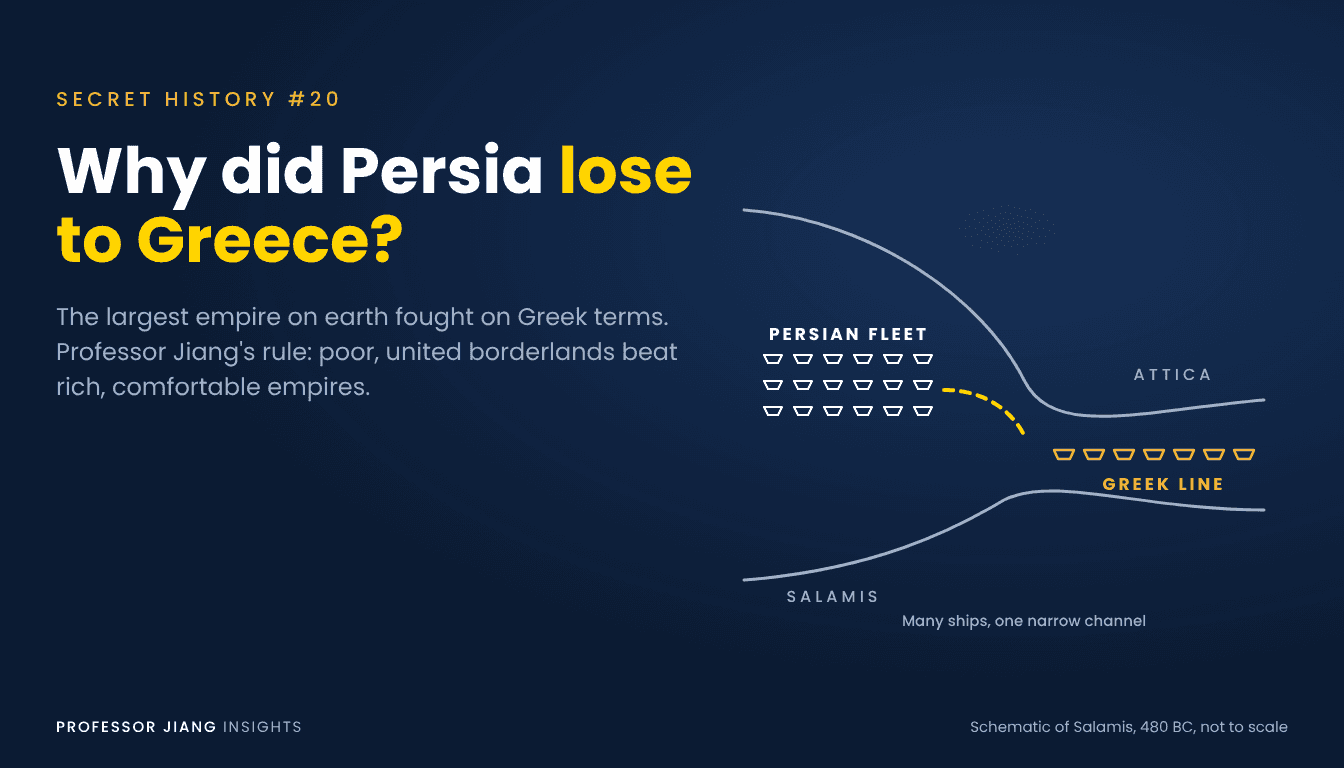
Persia lost to Greece because it fought on Greek terms. The largest empire in the world invaded a land of hills and narrow seas that cancelled its two great advantages, numbers and cavalry, and its king made choices that favored spectacle over strategy. The Greeks, fighting for their homes, also had less to lose by holding on.
Professor Jiang Xueqin turns this into a rule of history. In Secret History #20 he argues that empires have mass, organization and depth, while poor borderlands have energy, openness and cohesion, and that again and again the borderland wins (12:50).
499 BC
Ionian Revolt
Greek cities in Asia Minor rebel; Athens helps burn Sardis
490 BC
Battle of Marathon
Athenians defeat a Persian landing force
483 BC
Laurion silver strike
Athens funds a fleet of about 200 triremes
480 BC
Thermopylae; Athens burned
Leonidas and his Spartans killed; Athenians evacuate
480 BC
Battle of Salamis
Persian fleet destroyed in the straits
479 BC
Battle of Plataea
Spartans kill the Persian general Mardonius
454 BC
Delian treasury moved to Athens
The anti-Persian alliance becomes an Athenian empire
How big was the gap between Persia and Greece?
Persia under Darius and Xerxes stretched from Egypt to the Indus, perhaps 5.5 million square kilometres with tens of millions of subjects. Mainland Greece was a patchwork of more than a thousand small city-states, many with a few thousand citizens, most of them at war with each other. Even the Greeks who fought Persia in 480 BC were a minority of Greek states; others sided with Persia or stayed out.
Why did Persia lose at Marathon?
In 490 BC a Persian expedition landed at Marathon to punish Athens for helping the Ionian Revolt. The Athenian hoplites, heavily armored infantry fighting shoulder to shoulder, charged across the plain. Herodotus says the Greek center gave way but the wings won and turned inward, crushing the Persians between them. Lightly armored troops were no match for hoplites at close quarters, and Persia's horse archers, deadly on open plains, could not decide the battle.
What went wrong for Xerxes in 480 BC?
Xerxes came back with a vast army and fleet, bridged the Hellespont with boats, broke through at Thermopylae, displayed the head of the Spartan king Leonidas, and burned Athens. Jiang's point is that the war should then have been over (37:22). But the Athenians had left on their ships: "a polis is not a place. It's a people" (38:06).
All Persia had to do, he says, was land troops on the coast of Sparta, where enslaved helots far outnumbered their masters, and wait for revolt (38:27). Herodotus records exactly this advice: the exiled Spartan king Demaratus urged Xerxes to seize the island of Cythera off the Spartan coast (Histories 7.235). Xerxes refused, and instead sent his fleet into the narrows at Salamis, where the Greek triremes destroyed it. "It's just the dumbest thing I've ever seen," Jiang says (43:01). Without its fleet, the army could not be supplied; Xerxes went home, and his general Mardonius was killed at Plataea the next year.
What Professor Jiang says: the borderland rule
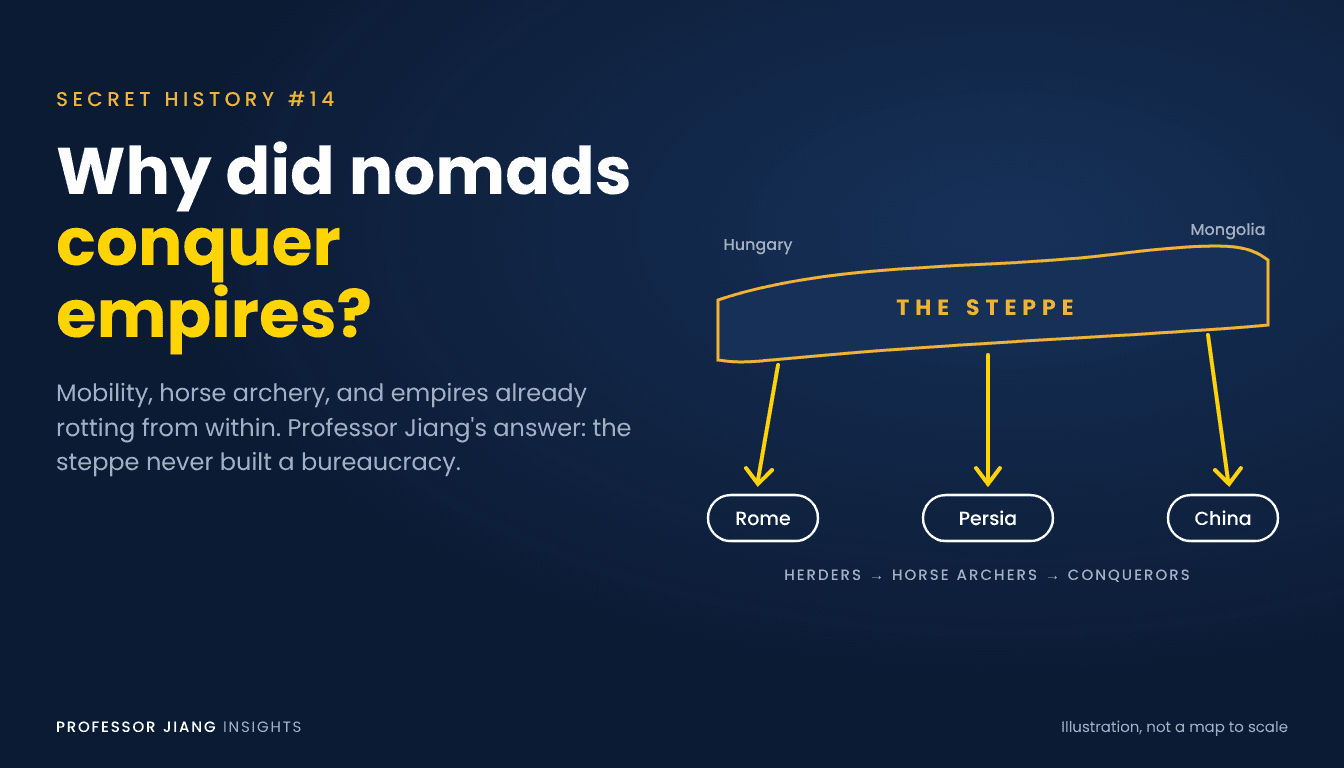
Jiang's lecture places Persia's defeat inside a larger cycle. Rich states settle into a comfortable balance and become, in his words, "lazy, stupid and arrogant" (8:01). Their talent and techniques leak to poor margins, often through mercenaries, and the margin conquers the center: Qin in China, Akkad in Mesopotamia, then Persia itself, Greece, Macedon and Rome. His most extreme borderland is the Eurasian steppe, whose horsemen beat Rome, Persia and China; see why did nomads conquer empires?
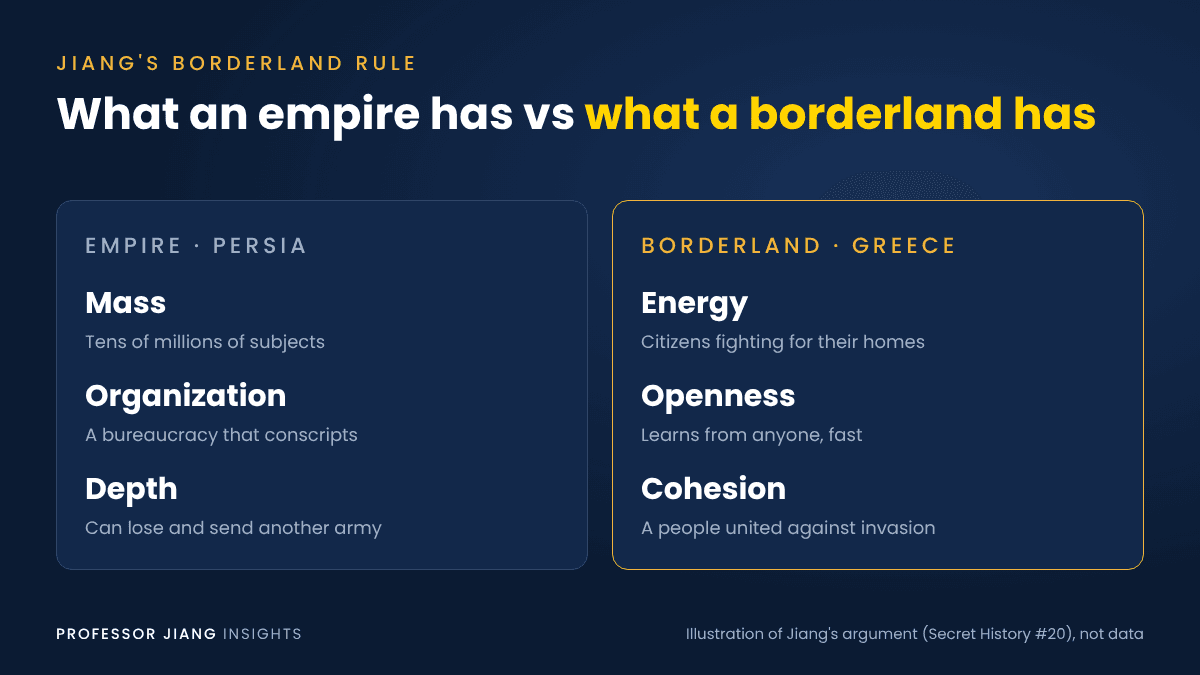
He sees it in Herodotus' own pages. When Persia offered Athens peace and money in 479 BC, the Athenians replied that as long as the sun kept its course they would never come to terms with Xerxes (45:19). And when an ally urged the Spartan commander Pausanias to impale Mardonius' head, as the Persians had done to Leonidas, he refused: that is what barbarians do. Liberty, faith and loyalty were the borderland's weapons. "But guess what? This all changes when they become an empire" (48:25).
Did Athens become the new Persia?
Jiang's sharpest argument follows. Athens led a defensive alliance against Persia, the Delian League, then moved its treasury to Athens in 454 BC and spent the members' tribute on the Parthenon. By 416 BC Athenian envoys told the neutral island of Melos that "the strong do what they can and the weak suffer what they must" (Thucydides 5.89), and killed its men when it refused to submit. The city that fought Persia for liberty now denied it to others, and Persia, the old enemy, ended up funding Sparta to defeat Athens. A century later the next borderland, Macedon, destroyed Persia under Alexander the Great.
What the record shows
The core of Jiang's account is Herodotus, and Herodotus supports him more than he lets on, especially on Cythera. A few corrections: the war began with the Ionian Revolt and the burning of Sardis rather than Greek piracy, Xerxes bridged the Hellespont rather than the Bosphorus, and Persia was not an empire of slaves (its own administrative tablets show paid workers, including women with maternity rations). The bigger caution concerns the rule itself. Some empires held off energetic borderlands for centuries, Byzantium for a thousand years, and many poor frontiers never conquered anything. Jiang's cycle is a powerful lens for reading the past; to become a prediction, it would need to say in advance which borderland rises next.
Read more
Jiang applies his empire-versus-borderland thinking to today's conflicts. Read his forecast on whether the US will invade Iran, check Professor Jiang's latest predictions, and see who Professor Jiang Xueqin is.
Persia, Athens, Macedon and Rome are covered in Chapters 14 and 15 of our guide to Jiang's Secret History series. Read the first chapter free, and follow new breakdowns on Telegram.