ANALYSIS
This article summarizes Professor Jiang Xueqin's views as we understand them from his recorded lectures. It is independent analysis, not his official statement, and Jiang Insights is not affiliated with him. Errors in summarizing are ours.
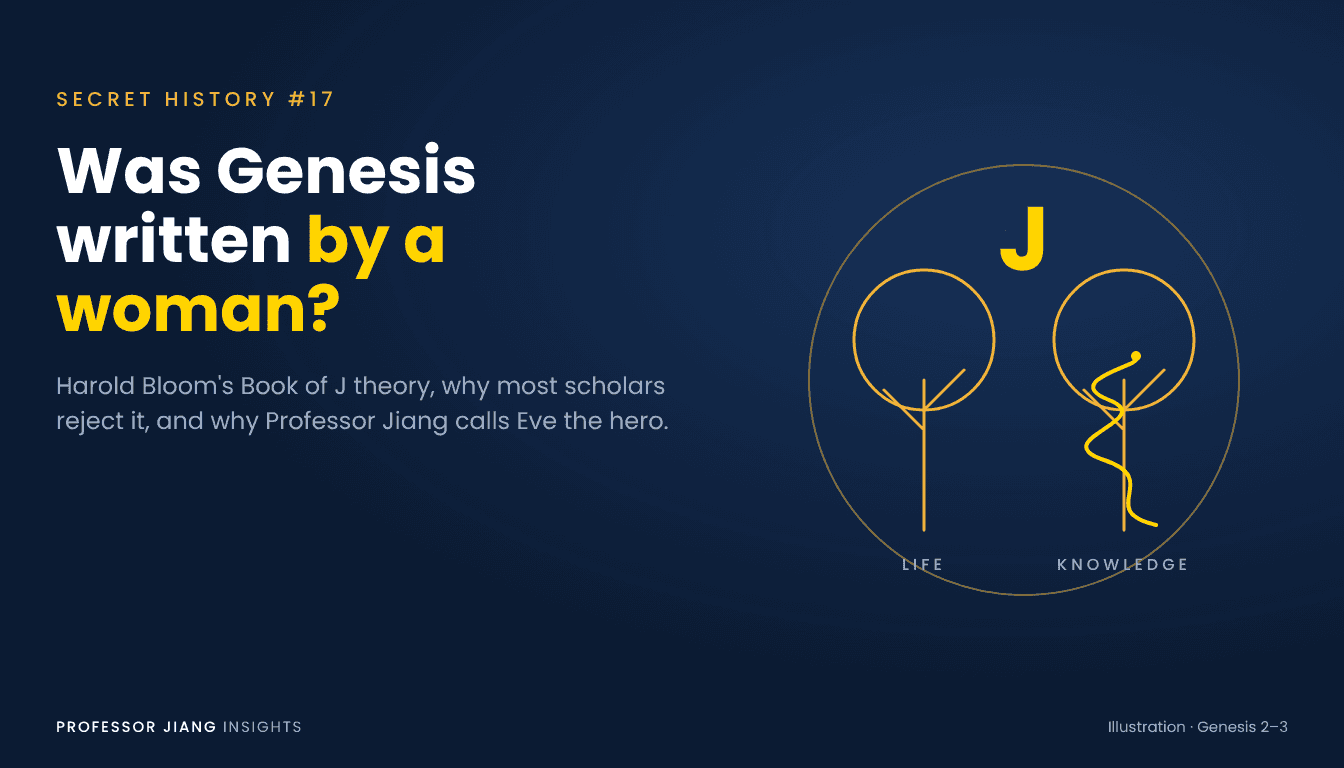
We don't know who wrote Genesis. Most scholars see it as several older sources stitched together, and the oldest storytelling layer, known as J, has no named author. In 1990 the literary critic Harold Bloom made a famous and controversial argument: J was a woman, a sophisticated writer at the royal court in Jerusalem. Most biblical scholars rejected his evidence, but the idea never went away, and Professor Jiang Xueqin has revived it in his lecture on the Bible.
Who wrote Genesis?
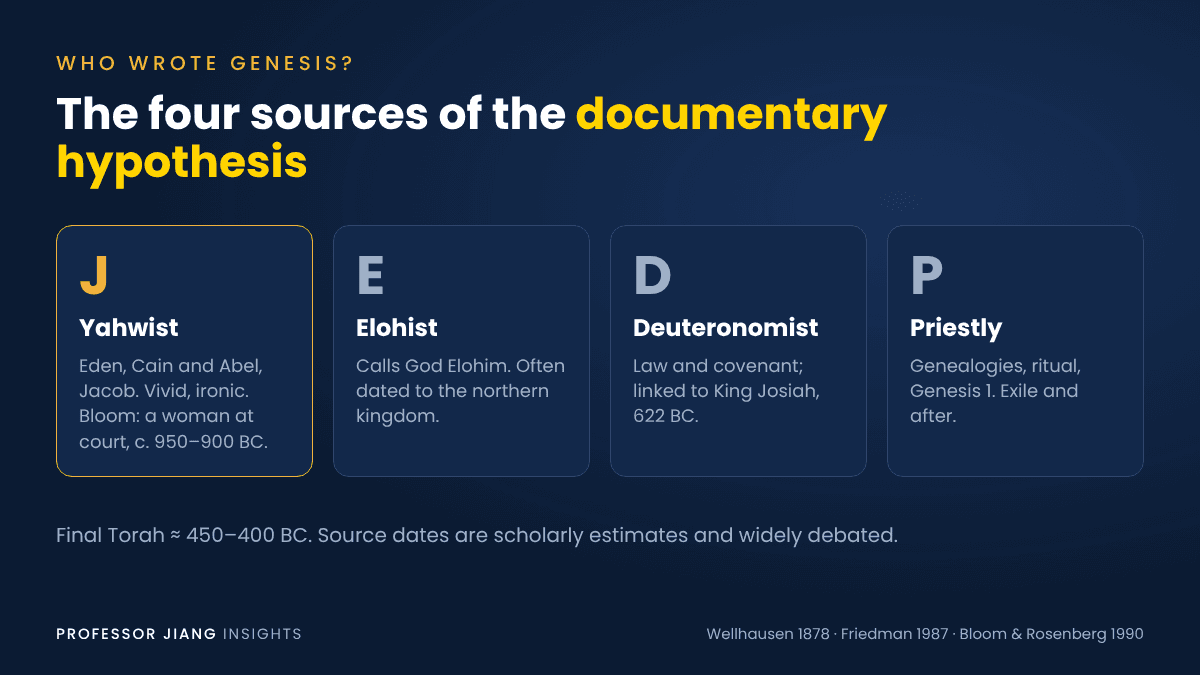
Jewish and Christian tradition attributed the first five books of the Bible to Moses. Since the 18th century, scholars noticed that Genesis tells some stories twice, uses different names for God, and shifts in style. The resulting documentary hypothesis, refined by Julius Wellhausen in the 1870s, proposed four main sources: J (which uses the name Yahweh, spelled Jahwe in German), E (Elohim), D (Deuteronomy) and P (the Priestly writer). The details are still argued over, and many scholars now prefer models of gradual growth, but nearly all agree that Genesis was compiled from earlier material and reached its final form around the 5th century BC, after the Babylonian exile.
The exile is also when many historians think Persian ideas of judgment, resurrection and angels entered Jewish thought; we weigh that in was Zoroastrianism the first monotheistic religion?
c. 1208 BC
"Israel" named on Egypt's Merneptah Stele
First outside mention of the people
c. 1000 BC
Traditional date of King David
Jiang dates the start of the Bible here
c. 950–900 BC
Bloom's date for J
At the court of Solomon and his successors
c. 840 BC
Tel Dan stele mentions the "House of David"
Earliest outside reference to David's dynasty
586 BC
Babylon destroys Jerusalem
Exile; much editing happens afterwards
c. 450–400 BC
Torah takes its final form
Persian period
1990
Bloom and Rosenberg publish The Book of J
Bestseller; scholars push back
The Book of J: Harold Bloom's theory
In The Book of J, the poet David Rosenberg translated the passages scholars assign to J, and Bloom, then America's best-known literary critic, wrote the commentary. Bloom argued that J was a writer on the level of Homer, Shakespeare and Tolstoy, an ironist rather than a theologian, and very likely a woman of the royal house living around the court of Solomon's successor Rehoboam.
His reasons were literary. J's women are memorable and active: Eve weighs the fruit and decides; Sarah laughs at God's promise; Rebecca engineers Jacob's blessing; Tamar outwits Judah. J's men are often foolish, and J's God is impish, impulsive, even comic. Bloom heard in this the voice of someone who knew power from the inside and did not take its men too seriously.
The case against
Bloom's critics were blunt. The biblical scholar Richard Elliott Friedman, himself a defender of the documentary hypothesis, wrote a sharp rebuttal. The objections: there is no external evidence for a female author; ancient scribes and court writers were overwhelmingly men; Bloom's selection of J passages was partly circular, since he chose texts that fit his portrait; and literary quality is not evidence of gender. Many scholars today doubt that a single continuous J document ever existed.
So the honest answer to the question in the title is no one can say, and the evidence for a woman is a reading, not a finding.
What Professor Jiang says about Genesis
In Secret History #17, Jiang argues that the Bible began as propaganda for King David, a usurper who needed to make a coalition of tribes into one family. But its first author, he says, turned propaganda into literature (1:04:56), and he believes that author was a woman.
His evidence comes from Eden. Adam is made from dust; Eve from Adam's flesh, a higher-quality material (15:51). The serpent speaks to the woman, not the man, and she judges the fruit for herself rather than asking her husband (17:18). Adam simply eats, then blames her. And instead of killing them as promised, God makes them clothes. "The real hero of the story is actually the woman," Jiang says (18:36).
He finds the same hand in the story of Jacob, Rachel and Leah, which he reads as a comedy of two sisters competing for one man, told with "economy and irony" (39:09). Only a woman, he says, would write stories like this.
What the record shows
Jiang's reading of Eve has serious scholarly company, even if his certainty about the author does not. Phyllis Trible's God and the Rhetoric of Sexuality (1978) pointed out that the first human, adam, is an undifferentiated "earth creature" until the woman is made, and that the text's punishments describe patriarchy rather than prescribe it. Carol Meyers's Discovering Eve (1988) read Eve against the hard realities of farming life in early Israel. Neither claims to know the author's sex.
Two of Jiang's details need care. The Hebrew word usually translated "rib" can mean "side", which changes the "higher material" argument. And Jiang's broader timeline, with David sponsoring the Bible, is a minority view: most of the text as we have it was written or edited centuries later.
What holds up best is his point about style. In 1946 the critic Erich Auerbach contrasted Homer, who lights every detail, with Genesis, whose gaps force the reader to interpret. Jiang argues that a culture raised on such stories learned to argue: when Abraham bargains with God over Sodom, from fifty righteous men down to ten, God listens (30:52). "The basis of Judaism is debate and argument and questions," Jiang says (33:14), and the Talmud, which records losing arguments alongside winning ones, bears him out.
Why it matters
Whether or not J was a woman, the question changes how people read Genesis. Ask it, and Eve stops being a cautionary tale and becomes a character who makes a choice with open eyes; God stops being a judge and becomes, as Jiang puts it, a friend who can be argued with (32:53). That is why the theory survives three decades after scholars rejected its evidence.
Jiang has long argued that schools teach answers instead of questions; see his case in who invented kindergarten. New to him? Start with who Professor Jiang Xueqin is, and see his forecasts scored on Professor Jiang's latest predictions.
Homer, Genesis and the problem of forgiveness are covered in depth in Chapter 13 of our guide to Jiang's Secret History series. Read the first chapter free, and follow new breakdowns on Telegram.