Professor Jiang's 2026 Midterm Predictions vs. Polymarket Odds
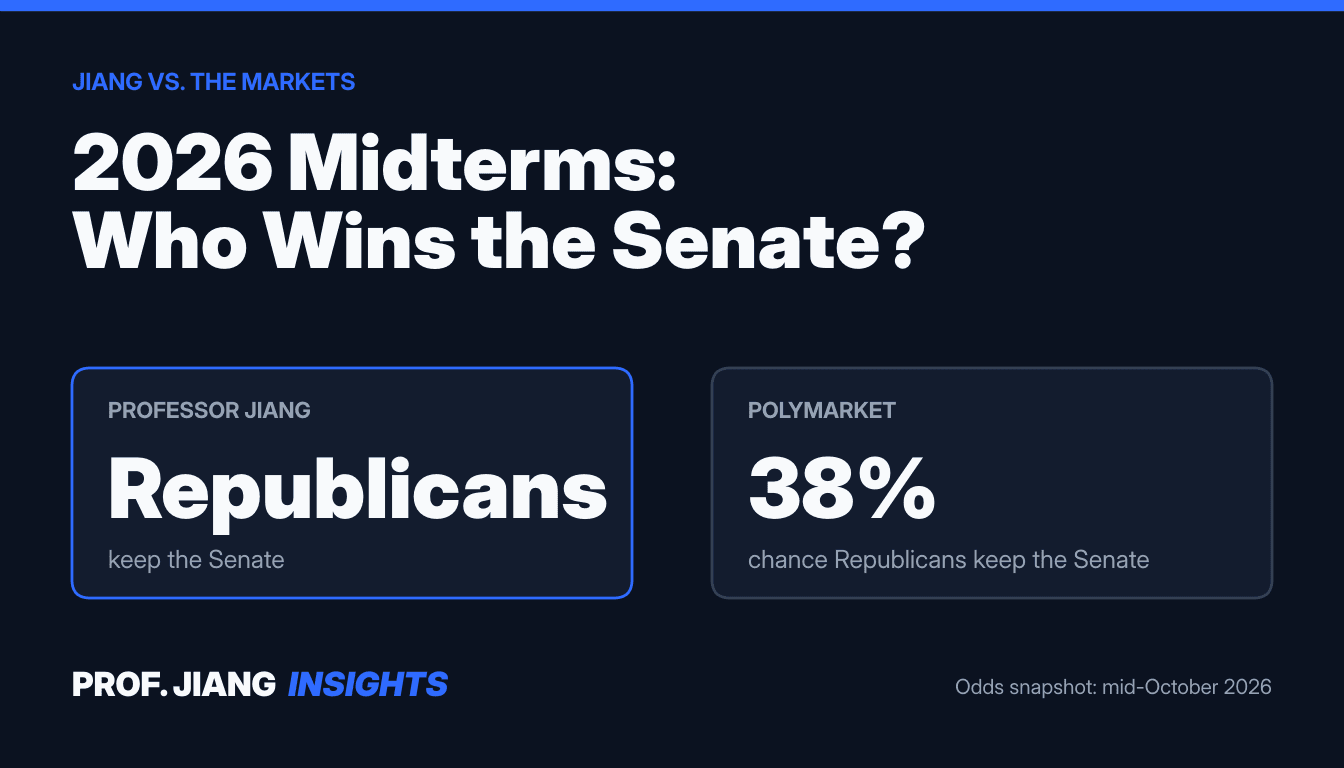
Professor Jiang Xueqin predicts Republicans will keep the US Senate in the November 3, 2026 midterms, while Democrats may win the House. As of mid-October 2026, Polymarket gave that split about 30% and a Republican Senate about 38%. Jiang also expects ICE deployments near polling places, which federal law (18 U.S.C. § 592) restricts.
· Updated
ANALYSIS
This article summarizes Professor Jiang Xueqin's views as we understand them from his own recordings. It is independent analysis, not his official statement, and Jiang Insights is not affiliated with him. Market odds are a snapshot, not betting advice. Errors in summarizing are ours.
Professor Jiang Xueqin's forecast for the November 3, 2026 midterms comes down to one firm call and a lot of hedging. The firm call: Democrats will not win the Senate. The hedges: they might take the House, ICE will be used to push turnout down, and many races could sit in court for months. On his firmest call, the betting markets currently disagree with him. Polymarket prices a Democratic Senate at roughly 62%. Below is exactly what he said, where he said it, and how we will score each claim on November 4.
What did Professor Jiang predict for the 2026 midterms?
His clearest statement came in the Q&A of his Global Meet-Up #2 in Los Angeles (August 2026, from about 1:22:00). Asked about the November vote, Jiang opened by saying he doesn't think the midterms matter much, then gave his call: "It's possible Democrats take the House, but they won't take the Senate." Impeachment hearings were possible too, he added, but he dismissed all of it as theater.
The rest comes from Live with Predictive History #2 (July 2026, from about 39:30), where a viewer asked whether Trump would cancel the midterms. His full set of claims across both recordings:
- Senate: Democrats won't win it (Los Angeles, August).
- House: Democrats might take it. Note the word "possible"; this is a hedge, not a forecast.
- ICE: agents will be deployed across the midterms to suppress turnout (July livestream).
- Cancellation: Trump can't legally cancel the midterms, because states run them, but he can disrupt them.
- Courts: many races will be litigated for months, possibly years, making it hard to seat the next Congress.
- Federal control: Trump's claims of Chinese election interference are a pretext to expand federal control over state elections.
- Iran: the US ground invasion will come after the midterms (Los Angeles, August).
Will Democrats win the Senate in 2026? Jiang vs. Polymarket
Polymarket runs a balance-of-power market that prices all four possible combinations of House and Senate control. In mid-October 2026 it looked roughly like this:
- Democrats win both chambers: about 62%
- Republican Senate, Democratic House (Jiang's scenario): about 30%
- Republicans keep both: about 9%
- Democratic Senate, Republican House: under 1%
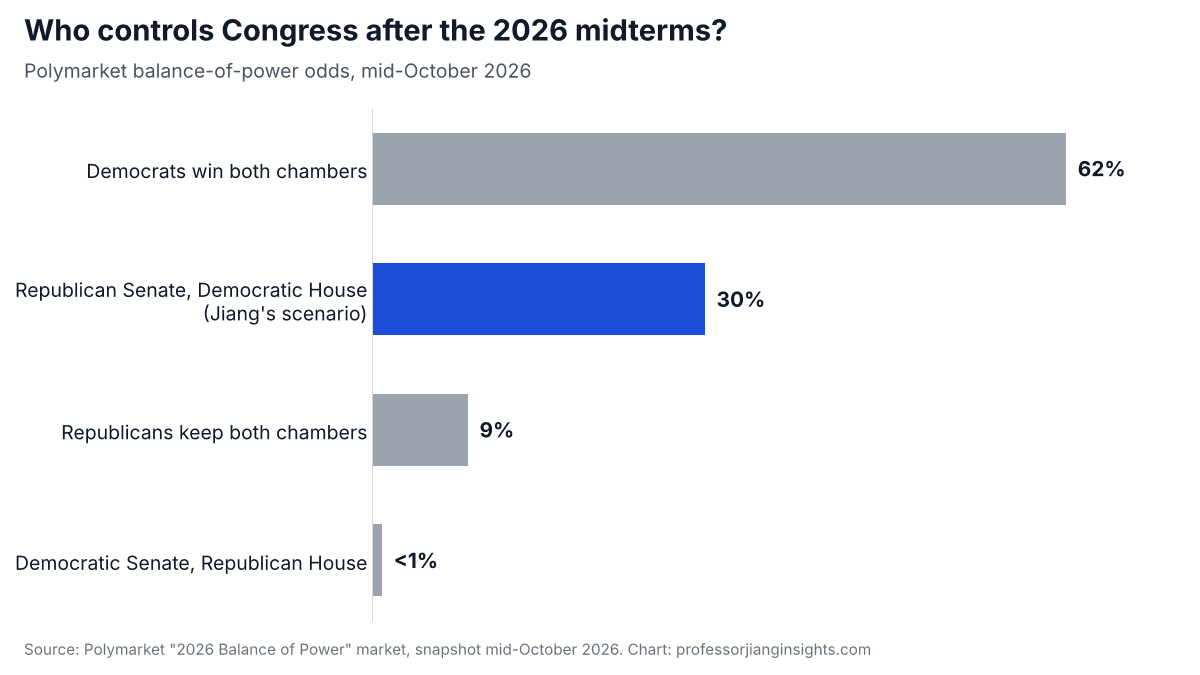
Two things follow. First, the House half of his call carries almost no information. Add up the rows and the market gives Democrats about a 91% chance of taking the House, so "it's possible Democrats take the House" is what nearly every forecaster already expects. Second, the Senate half is a real contrarian bet. Jiang's exact combination traded between 34% and 39% in early May, according to market trackers, and has drifted down to around 30% since. The money has been moving away from him all summer.
That isn't damning on its own. Contrarian calls are how Jiang built his audience: in 2024 he backed Trump's return and a US war with Iran when neither was the consensus. But it sets the stakes honestly. If Republicans hold the Senate, that is a genuine hit against roughly 2-to-1 odds. If Democrats take it, it is a clean miss, and "I said the midterms don't matter" shouldn't rescue it.
ANALYSIS
Jiang vs. the markets (mid-October 2026 snapshot): Senate stays Republican. Jiang: yes. Polymarket: about 38%. House flips to Democrats. Jiang: "possible." Polymarket: about 91%. We will refresh these numbers on November 2 and score the call on November 4.
Can ICE agents be at polling places?
Jiang's claim is that ICE will be sent across the country during the midterms to keep turnout down. This is the part of his forecast with the most real-world support, and also the part where the law is clearest.
Federal law already covers it. Under 18 U.S.C. § 592, a federal official who orders, brings or keeps troops or armed men at a polling place faces up to five years in prison and disqualification from federal office. The only exception is force needed to repel armed enemies of the United States. Justice Department election-crimes guidance goes further: deputy US marshals, who are armed on duty, are not to be stationed at open polls, and FBI agents do not conduct investigations inside polling places on Election Day.
Even so, senior officials have kept the idea alive. On September 1, Homeland Security Secretary Markwayne Mullin said ICE agents could enter polling places in November if there was a threat or a warrant to serve, while DHS said it was not planning operations aimed at polling locations (Democracy Docket). Acting Attorney General Todd Blanche has publicly asked why anyone objects to ICE officers at the polls, and Maine's Republican nominee for governor has said he will ask the administration to send them.
So Jiang is not inventing a scenario; administration figures have floated it themselves. The weakness is in how broad his wording is. "Deployed throughout the midterms" could mean anything from a nationwide operation to one arrest near a school gym. There is also a measurement problem: talk of armed agents near the polls can depress turnout in immigrant-heavy areas even if no agent shows up, and that effect is very hard to prove. To score this fairly we need something observable, and we set it out below.
Can Trump cancel the midterms?
Here Jiang gives the textbook answer: no. Article I, Section 4 of the Constitution leaves the time, place and manner of congressional elections to the states, subject to Congress, and federal law fixes the date as the Tuesday after the first Monday in November. No provision lets a president postpone them. Even during the Civil War and the Second World War, midterms were held on schedule.
The catch is that earlier in the same livestream, Jiang said it was possible some midterms "don't even happen." The two lines can be reconciled: no national cancellation, but local breakdowns in specific states or districts. That reading is the one we will hold him to.
The "federal takeover" claim and the noncitizen voter numbers
In the same July livestream (from about 28:00), Jiang argued that Trump's televised claim of Chinese interference in the 2020 election was cover for a push to put state elections under federal control. Notably, Jiang doesn't accept the China story himself: he says Beijing lacks the capacity to sway a US national election, that Russia has that capacity, and that Iran probably has more interest in trying than China does.
He then cites DHS's preliminary claim of more than 250,000 noncitizens on voter rolls in four states (California, New Jersey, Nevada and Pennsylvania), and notes that other sources put the number far lower. The skepticism is warranted. When Georgia audited its 8.2 million registered voters in 2024, it found 20 noncitizens on the rolls. Registration errors exist, but past audits have found them in the dozens and hundreds, not the hundreds of thousands.
One factual slip is worth correcting, because his argument leans on it. Jiang says Trump lost the 2020 election by "only about 10,000 votes," so flipping 10,000 votes in the right places would have reversed it. Biden won the national popular vote by about 7 million. The Electoral College was closer: Trump would have needed roughly 43,000 more votes spread across Arizona, Georgia and Wisconsin. The figure Jiang remembers is Georgia's margin alone, about 12,000. Changing a national result takes coordinated shifts in several states, which is a much harder thing to engineer than his framing suggests.
Why Jiang says the midterms don't matter, and the case that they do
Jiang's deeper claim is that the result is irrelevant to the Iran war. His reasoning: members of Congress remember how the 2002 Iraq vote haunted careers, so neither party wants a recorded vote on this war. Democrats, he argues, are better off in opposition, collecting donations and letting Trump own the conflict, and some might quietly prefer not to win at all. A Democratic House would bring impeachment hearings, he says, but no real attempt to stop the war.
History gives him more support than critics might admit. Democrats won both chambers in 2006 largely on anger over Iraq. In 2007 they passed a war-funding bill with a withdrawal timeline, President Bush vetoed it, and Congress then funded the war without the timeline. US troops stayed in Iraq until 2011.
The strongest counterargument is about leverage, not votes on the war itself. A House majority controls subpoenas, committee hearings and every appropriations bill, including supplemental war funding. It can force War Powers resolutions to the floor, which put members on the record whether leadership likes it or not. None of this guarantees an end to the war. But "doesn't matter" overstates it: a new majority changes what the administration has to defend in public, and how fast.
How we will score Jiang's midterm predictions
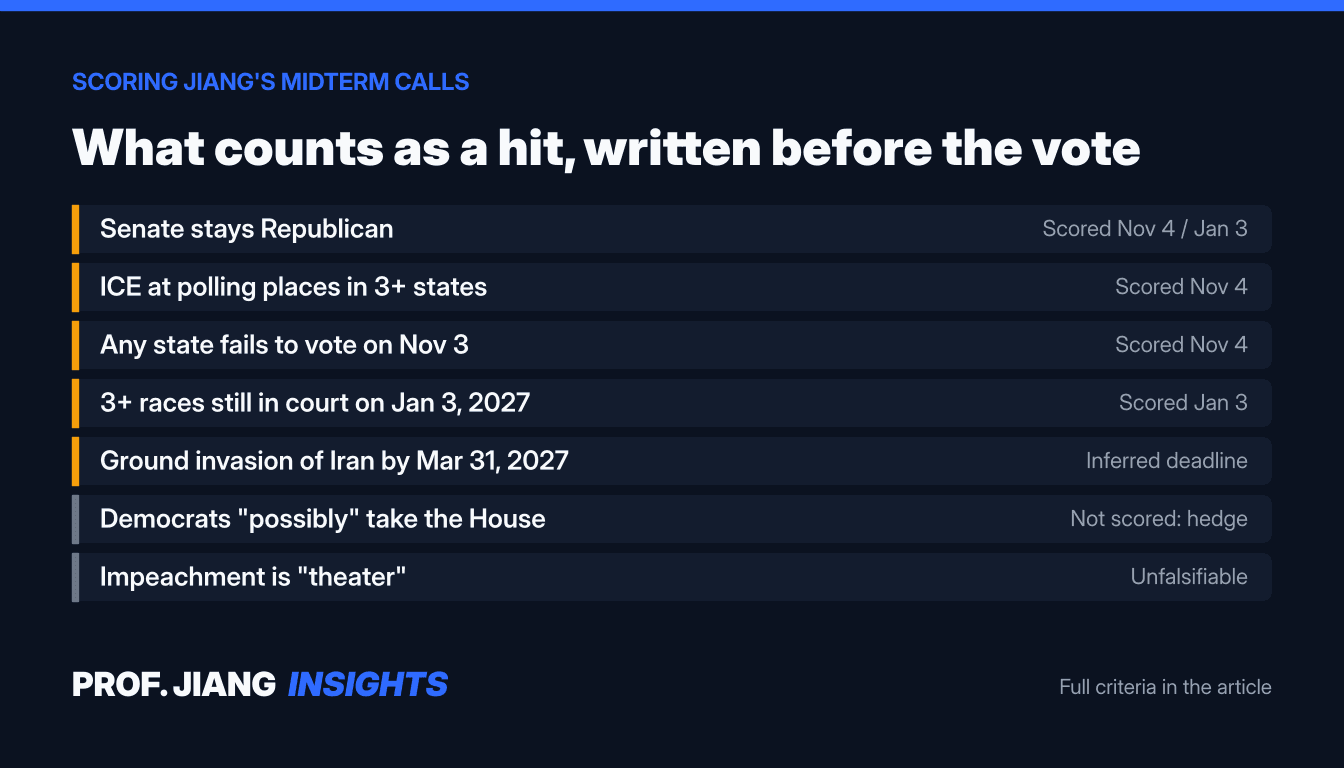
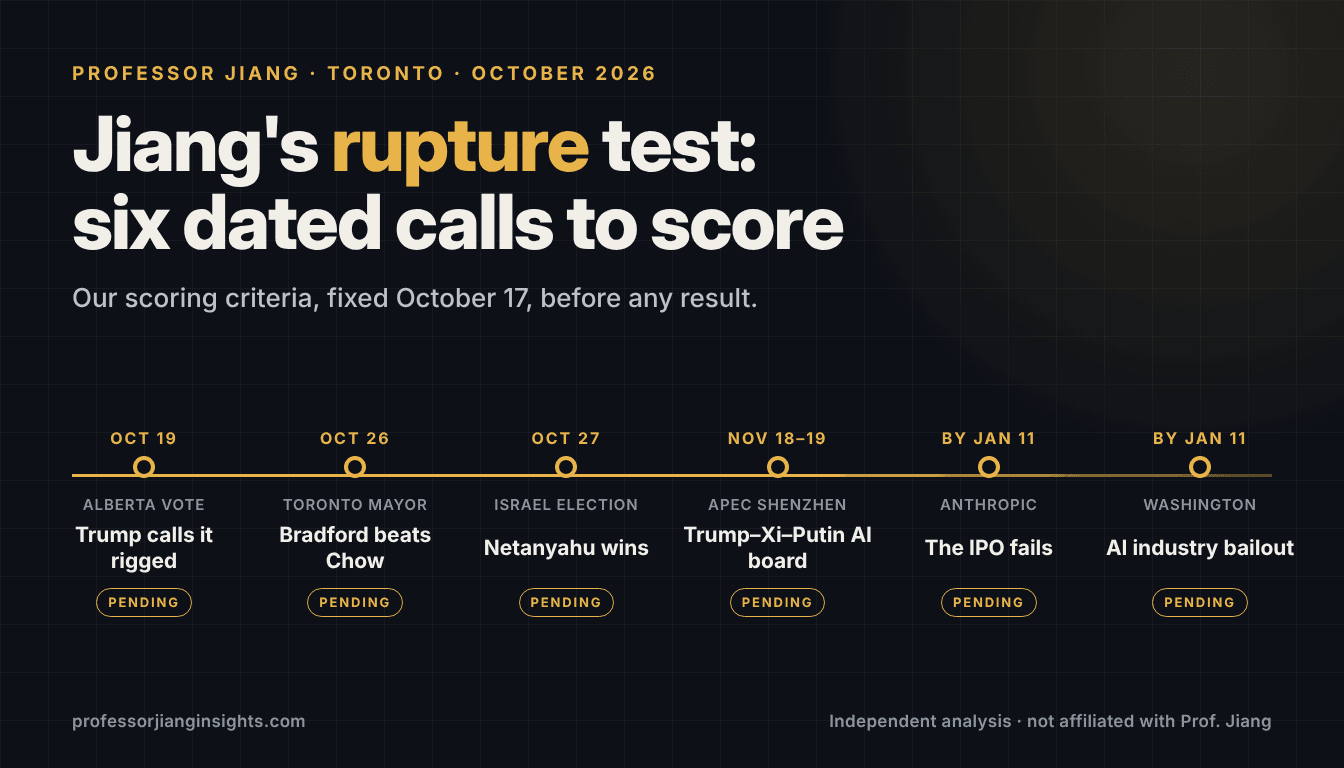
We are writing the criteria down now, before any results come in, so nobody (including us) can move the goalposts later.
- Senate. Correct if Republicans control the Senate when the new Congress convenes on January 3, 2027 (a 50–50 split counts, since the vice president breaks ties). Wrong if Democrats control it.
- House. Not scored. "It's possible" cannot be wrong.
- ICE. Correct if major outlets document ICE agents present at or immediately outside polling places in at least three states on Election Day, or if a court orders them away. A single warrant arrest does not count.
- Disrupted elections. Correct if any state fails to hold its federal general election on November 3, or postpones it in any district.
- Court fights. Correct if three or more House or Senate races are still unresolved because of litigation on January 3, 2027.
- Impeachment as "theater." Unfalsifiable. Whether hearings are theater is a judgment, not an event.
- Ground invasion after the midterms. Jiang gave no end date. Our inferred deadline: large-scale US ground forces operating inside Iran by March 31, 2027.
The ground-invasion call connects to two of his bigger theses we've covered before: the dollar collapse and a coming US military draft, and his Pax Judaica reading of the post-war Middle East. If the midterms produce a Republican Senate and a quiet November, Jiang's framework gets a boost going into 2027. If Democrats sweep and the polls run normally, his US-politics record takes a hit right when his Iran calls are about to be tested.
We will update this page with results on November 4 and with the January 3 checks once the new Congress is seated.