CAUTION
Independent analysis of Professor Jiang Xueqin's public lecture (Secret History #24). Not affiliated with Professor Jiang. Quotes are short and linked to the source; analysis is ours. We discuss history, not anyone's faith.
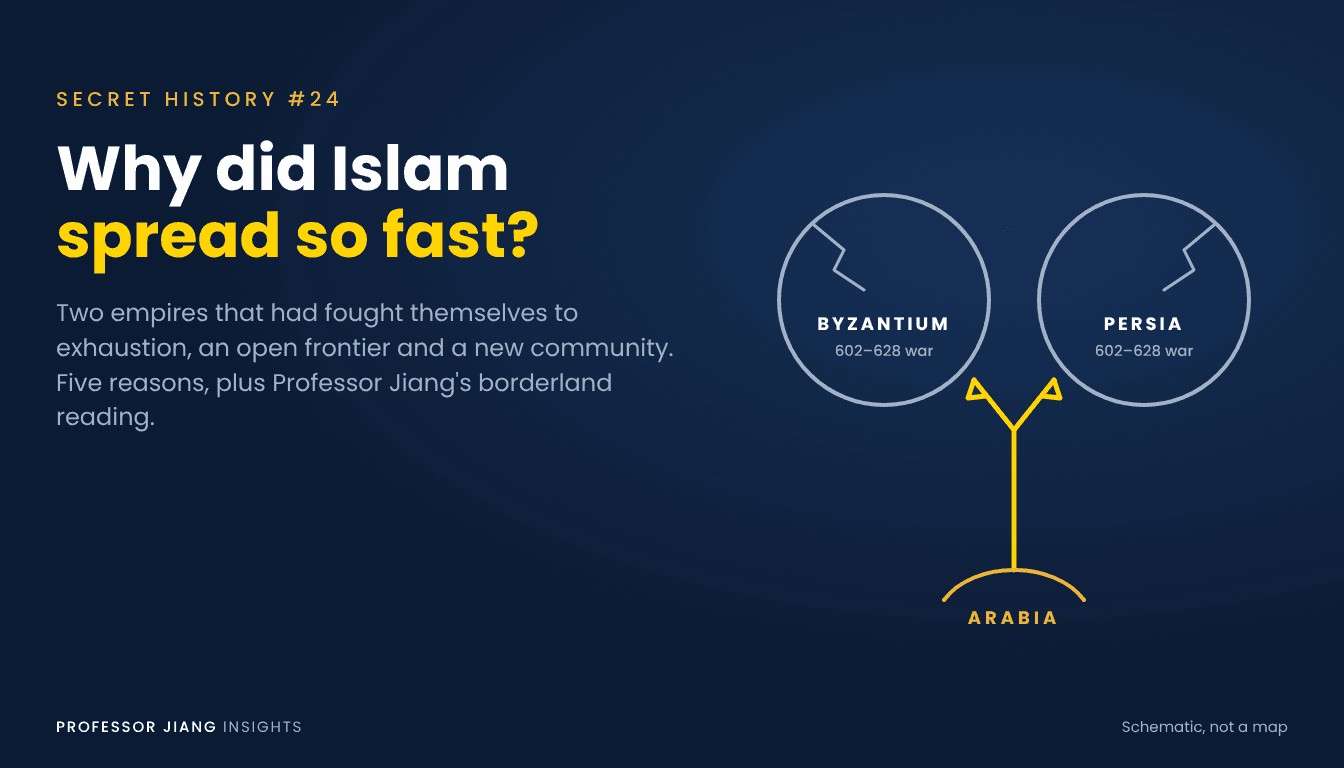
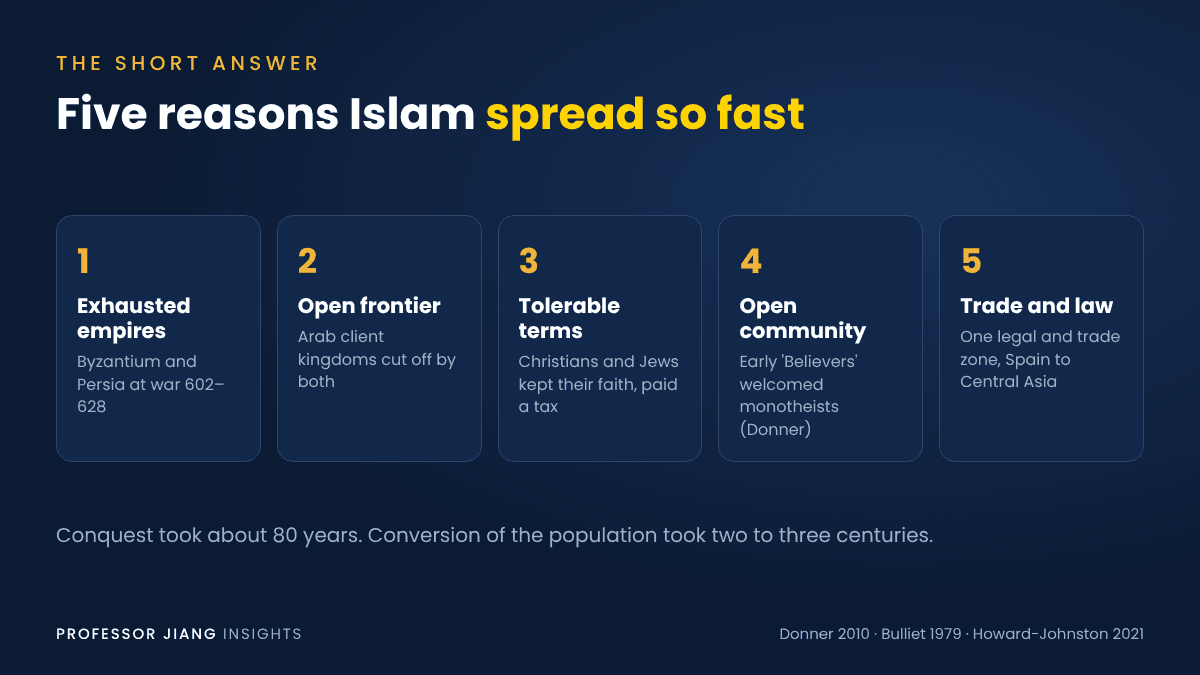
Islam spread fast for five main reasons: the two great empires of the region had just exhausted each other in war, the Arab tribes were newly united and battle-trained, the conquerors offered conquered Christians and Jews tolerable terms, trade and a shared law built trust across vast distances, and the early community drew in many people who already believed in one God. Within about 80 years of Muhammad's death in 632, Muslim rule ran from Spain to the Indus. Conversion of the population took much longer.
1. Two empires had exhausted each other
For centuries the Byzantine (Eastern Roman) and Persian empires fought over the Middle East. Their last war, from 602 to 628, was the longest and most destructive. Persia occupied Syria, Egypt and Jerusalem; Byzantium's emperor Heraclius struck back into Mesopotamia and won. Both sides ended bankrupt, their frontier provinces ruined. Persia fell into civil war, with about ten rulers in four years. When Arab armies arrived in the 630s, they met empires that had nothing left.
The Persian empire Islam replaced was Zoroastrian, the faith Professor Jiang calls the first monotheism; we weigh that claim in was Zoroastrianism the first monotheistic religion?
2. The desert frontier had been left open
Both empires had paid Arab client kingdoms to guard their desert borders: the Ghassanids for Byzantium, the Lakhmids for Persia. Persia ended the Lakhmid kingdom in 602, and Byzantium cut its Ghassanid subsidies. The men who knew both empires' armies best were left without a paymaster, just as a new movement in Arabia was offering a cause.
610
Muhammad's first revelation
Mecca, cave of Hira
614
Persians take Jerusalem
During the Byzantine–Persian war
622
Hijra to Medina
Start of the Islamic calendar
628
Byzantine–Persian war ends
Both empires exhausted
632
Death of Muhammad
Arabia united
636
Battle of Yarmouk
Byzantium loses Syria
637–638
Jerusalem surrenders
Persian capital Ctesiphon also falls
651
Last Persian king dies
Sasanian Empire ends
711
Crossing into Spain
Arab armies also reach the Indus
3. Many subjects had reasons not to fight
Byzantium had spent two centuries enforcing one creed on its churches. Christians who rejected the Council of Chalcedon (451), common in Egypt and Syria, were persecuted as heretics; Jews were expelled from Jerusalem after 630. Under Muslim rule, Christians and Jews became protected communities (dhimmi) who kept their churches and synagogues and paid a tax. That was second-class status, but for many it was better than what they had.
4. The community was open at first
The historian Fred Donner, in Muhammad and the Believers (2010), argues that the early movement called itself a community of "Believers" committed to one God and the Last Judgment, which pious Christians and Jews could join, and that a distinct Muslim identity hardened under the Umayyad caliphs around 690. The Constitution of Medina, Muhammad's compact with his city, lists Jewish clans as part of the community, each keeping its own religion. That openness had limits: by 627, relations with Medina's main Jewish tribes had broken down.
5. Trade and law built trust
Once established, the caliphate created a single zone of law, language and coinage from the Atlantic to Central Asia. Merchants could use partnership contracts, credit notes and a shared legal framework, which spread the faith along trade routes to East Africa, India and Southeast Asia without armies.
What Professor Jiang says about the rise of Islam
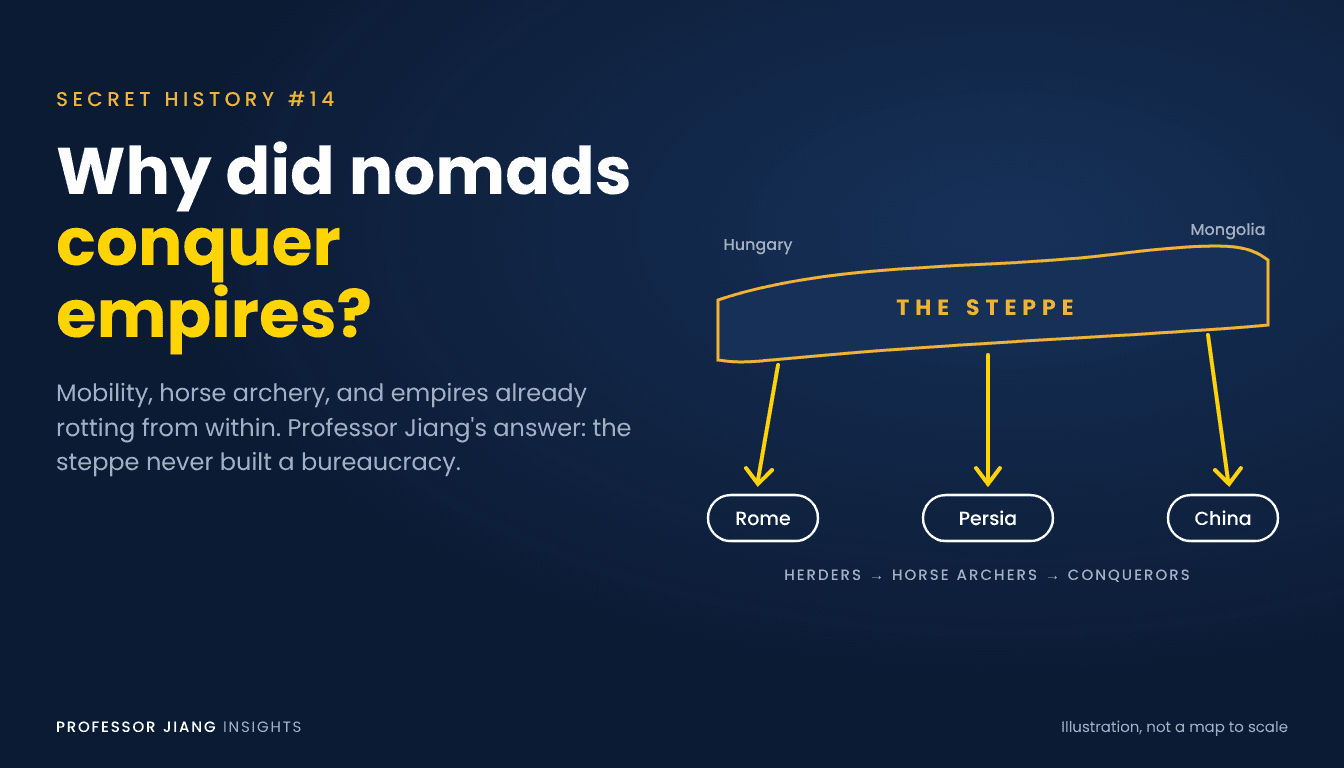
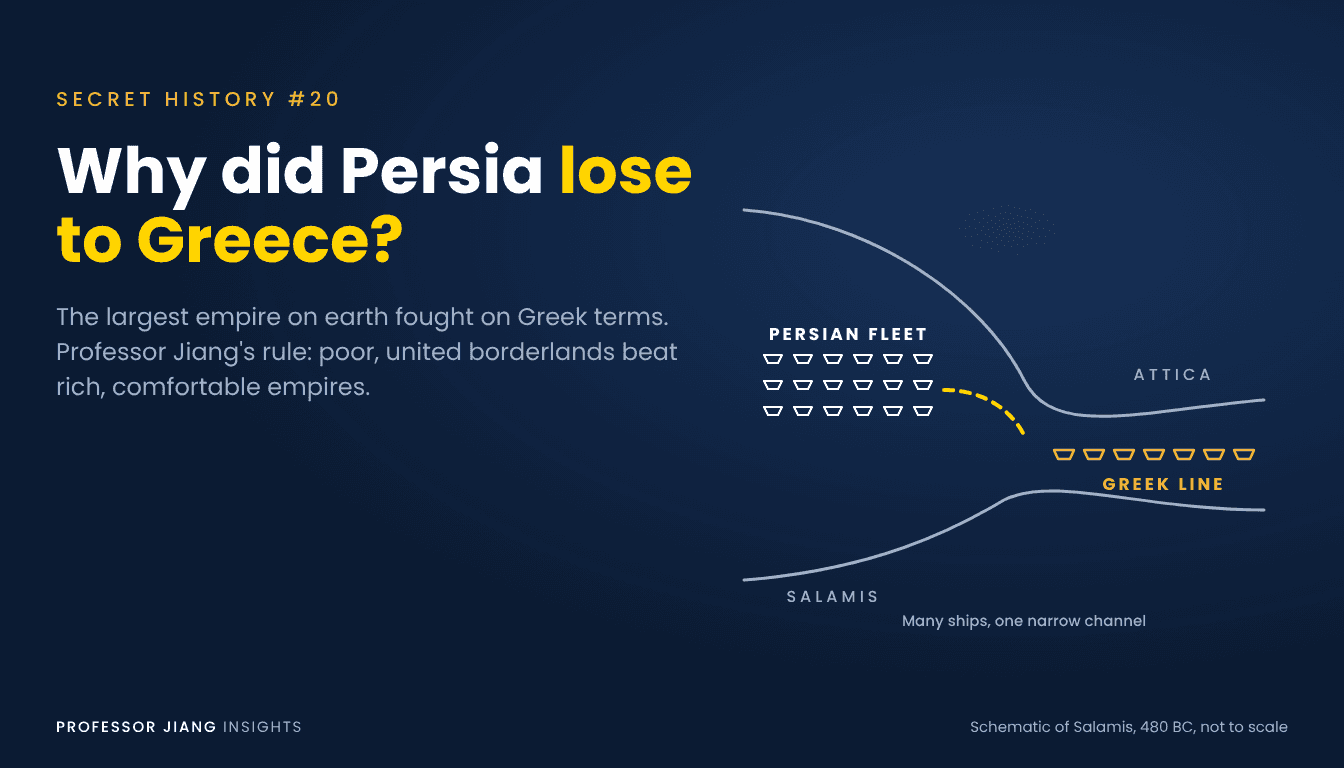
In Secret History #24, Jiang treats Arabia as a classic borderland: poor, but a crossroads of trade, with fighters trained in both empires' armies, at the moment those empires collapsed (28:15). Byzantium's forced orthodoxy, he argues, pushed dissident Christians and Jews into Persia and Arabia, and after Jerusalem changed hands in 614 and 630, messianic hopes ran high. Muhammad united Arabs, dissident Christians and Jews with a promise that each could worship as they chose (30:36). "Muhammad himself did not preach Islam," Jiang says; Islam as a separate religion took shape after his death (32:14). He calls it "a beautiful simple religion that builds trust and community" (57:43). It is the same rule Jiang first draws from an earlier Persian defeat: why did Persia lose to Greece? For the same pattern on the Eurasian steppe, from Attila to Genghis Khan, see why did nomads conquer empires?
What the record shows
Jiang's account is close to Donner's scholarship, and his reading of exhausted empires is standard. Two points need adjusting. Muhammad presented himself as a prophet, the last of the messengers (Quran 33:40), not as the Messiah; the Quran gives that title to Jesus. And the Quran already speaks of islām and of believers distinct from Jews and Christians, so the religion did not appear only after Muhammad. Finally, fast conquest was not fast conversion: Richard Bulliet's study of names suggests Iran became majority Muslim only in the ninth or tenth century.
More of Jiang's history lectures: Universe 25 and elite overproduction and will the US invade Iran?. For his forecasts, see Professor Jiang's latest predictions.
Our guide to his Secret History series, How Power Works, is out. Read the first chapter free. New analyses also go out on Telegram.