ANALYSIS
This article summarizes Professor Jiang Xueqin's views as we understand them from his recorded lectures. It is independent analysis, not his official statement, and Jiang Insights is not affiliated with him. Errors in summarizing are ours.
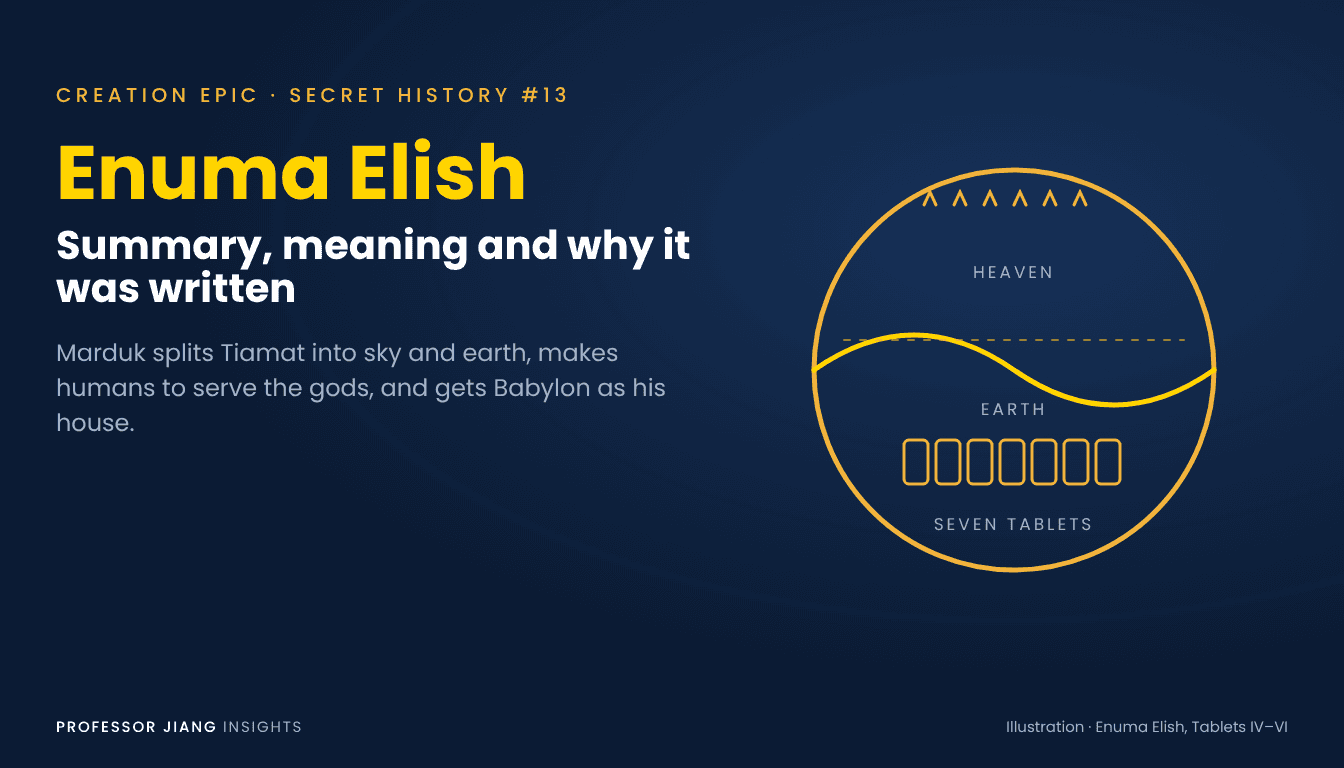
The Enuma Elish is the Babylonian epic of creation. In it the storm god Marduk defeats Tiamat, the goddess of the primeval sea, splits her body to make the sky and the earth, creates humans from a rebel god's blood so the gods can rest, and is rewarded with a temple city: Babylon. It survives on seven clay tablets and was recited at Babylon's New Year festival, which is why historians read it as much as politics as religion.
Enuma Elish summary
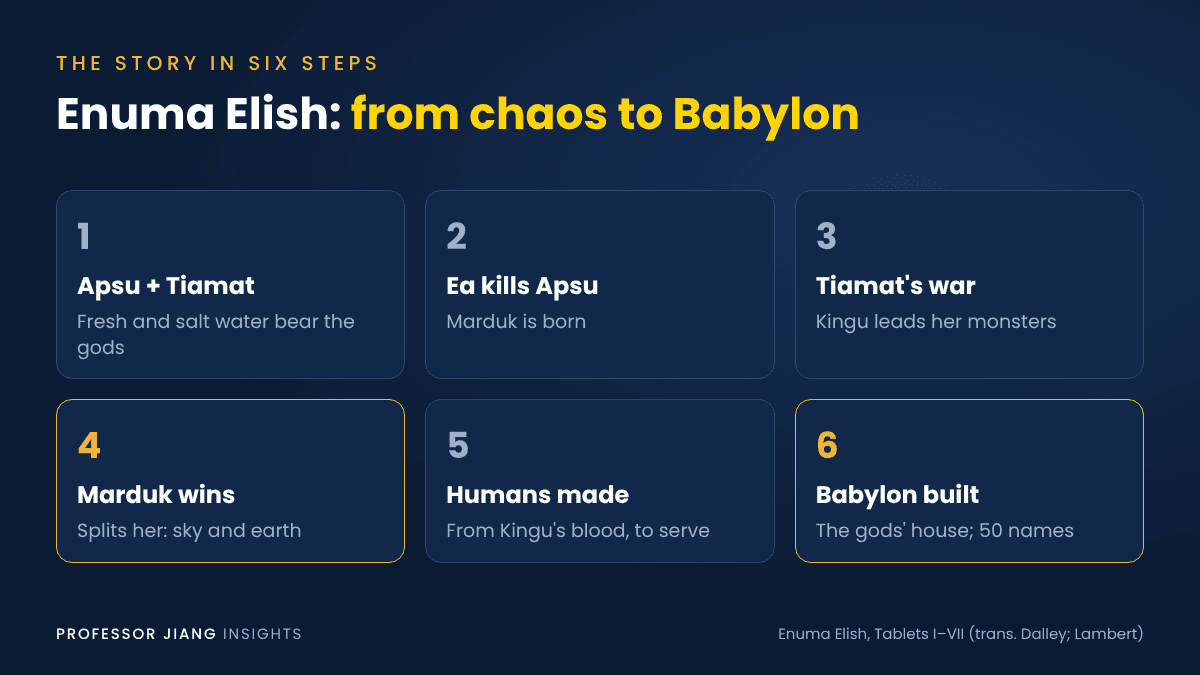
In the beginning, before heaven and earth had names, there were only two waters mingling: Apsu, the fresh water, and Tiamat, the salt sea. From them came generations of gods. The young gods were noisy, and Apsu, unable to rest, planned to destroy them. The wise god Ea discovered the plot, put Apsu to sleep with a spell and killed him, then built his home on Apsu's body. There Ea's son Marduk was born, larger and more brilliant than any god before.
Tiamat, provoked, created an army of monsters and put the god Kingu in command, giving him the Tablet of Destinies. The gods panicked. None dared face her until Marduk agreed, on one condition: if he won, he would be king of the gods. Armed with the winds and a net, he drove a storm into Tiamat's open mouth, shot an arrow into her heart and captured Kingu.
Then he built the world from her body. He split her in two, in Stephanie Dalley's translation "like a fish for drying", raised one half as the sky and laid down the other as the earth, making the Tigris and Euphrates flow from her eyes. He set the stars and constellations, fixed the year and its twelve months and gave the moon its phases. Next he proposed creating humans to do the gods' work. Kingu was found guilty of starting the war and executed, and from his blood Ea formed humankind. In gratitude the gods spent a year making bricks and built Babylon and Marduk's temple, Esagila. The poem ends with the gods proclaiming Marduk's fifty names.
What does Enuma Elish mean?
The title means "When on high", the first two words of the Akkadian text. The opening describes a time when the heavens above had not been named and the earth below had not been called by name, because in Mesopotamian thought to name something was to bring it into being. The poem is about 1,000 lines long, written on seven clay tablets of 115 to 170 lines each. The best-known copies come from the library of the Assyrian king Ashurbanipal at Nineveh, excavated between 1848 and 1876.
When and why was it written?
Its date is debated. Some scholars place it in the 18th century BC, when Babylon rose under Hammurabi; many now prefer the 12th century BC, under Nebuchadnezzar I, who brought Marduk's statue home to Babylon from Elam. Either way, its purpose is clear: it is a hymn that makes Marduk king of the gods and Babylon the centre of the world. Older Mesopotamian myths gave kingship to the god Enlil; the Enuma Elish transfers his role, and his name, to Marduk, whose fifty titles absorb the powers of many older deities.
It was performed, not just read. At the Akitu, Babylon's spring New Year festival, the poem was recited before Marduk's statue, and the king had his authority renewed in a ritual in which the high priest struck him and pulled his ears before returning his crown. A creation story ending with Babylon's founding, told at the moment the king was re-installed, was a statement about who rules and why.
Why Tiamat matters
Tiamat is the most discussed figure in the poem. She is the primordial mother of the gods, and Marduk builds the ordered world from her dismembered corpse. Joseph Campbell and many feminist historians, Gerda Lerner among them, read this as a mythic record of male sky gods displacing older female deities. Others caution that Tiamat is a figure of chaos, the sea that must be held back, and that the story celebrates order over flood in a land whose rivers were unpredictable. Both readings agree on one point: creation here is an act of violence and control.
Why humans were created to serve the gods
The poem's view of humanity is stark. Humans exist so that the gods don't have to work. The same idea appears in the older Atrahasis epic (c. 1700 BC), where the junior gods go on strike against digging canals and humans are made to take over their labor. In a society built on irrigation, temple estates and corvée labor, that was not an abstract idea. The poem told every listener what they were for.
How the Enuma Elish compares with Genesis
The similarities with Genesis 1 are striking: a formless watery deep before creation (the Hebrew tehom, related to the name Tiamat), a solid dome separating the waters above from those below, light and days before the sun and moon, and divine rest after humans are made. The differences are as important. In Genesis there is no battle and no divine corpse: God creates by speaking, and humans are made in God's image rather than as laborers. Many scholars read Genesis 1 as a deliberate answer to Babylonian myth, written during or after the Jewish exile in Babylon in the 6th century BC.
Genesis also has a second, older creation story, the Garden of Eden, which scholars assign to the J source; for the theory that its author was a woman, see was Genesis written by a woman?
After 539 BC the exiles lived under Persian rule instead, and the next great influence on Jewish religion may have been Zarathustra; see was Zoroastrianism the first monotheistic religion?
c. 1750 BC
Babylon rises under Hammurabi
Earliest proposed date for the poem
c. 1700 BC
Atrahasis epic
Humans made to relieve the gods' labor
c. 1125–1104 BC
Nebuchadnezzar I
Marduk's statue returned; a favored date for composition
c. 668–627 BC
Ashurbanipal's library at Nineveh
Best-preserved copies
6th c. BC
Jewish exile in Babylon
Genesis 1 often read as a reply
1848–1876
Tablets excavated at Nineveh
Published by George Smith in 1876
2025
Professor Jiang's reading
Secret History #13
What Professor Jiang says about the Enuma Elish
In his Secret History lecture "The Mandate of Heaven", Professor Jiang Xueqin reads the poem as evidence for a larger thesis: that civilization did not invent religion, art and writing but took over the religion people already had and rewrote it to make hierarchy look sacred. "Civilization is a device meant to gaslight or fool people into believing that a hierarchy is legitimate," he says (07:18).
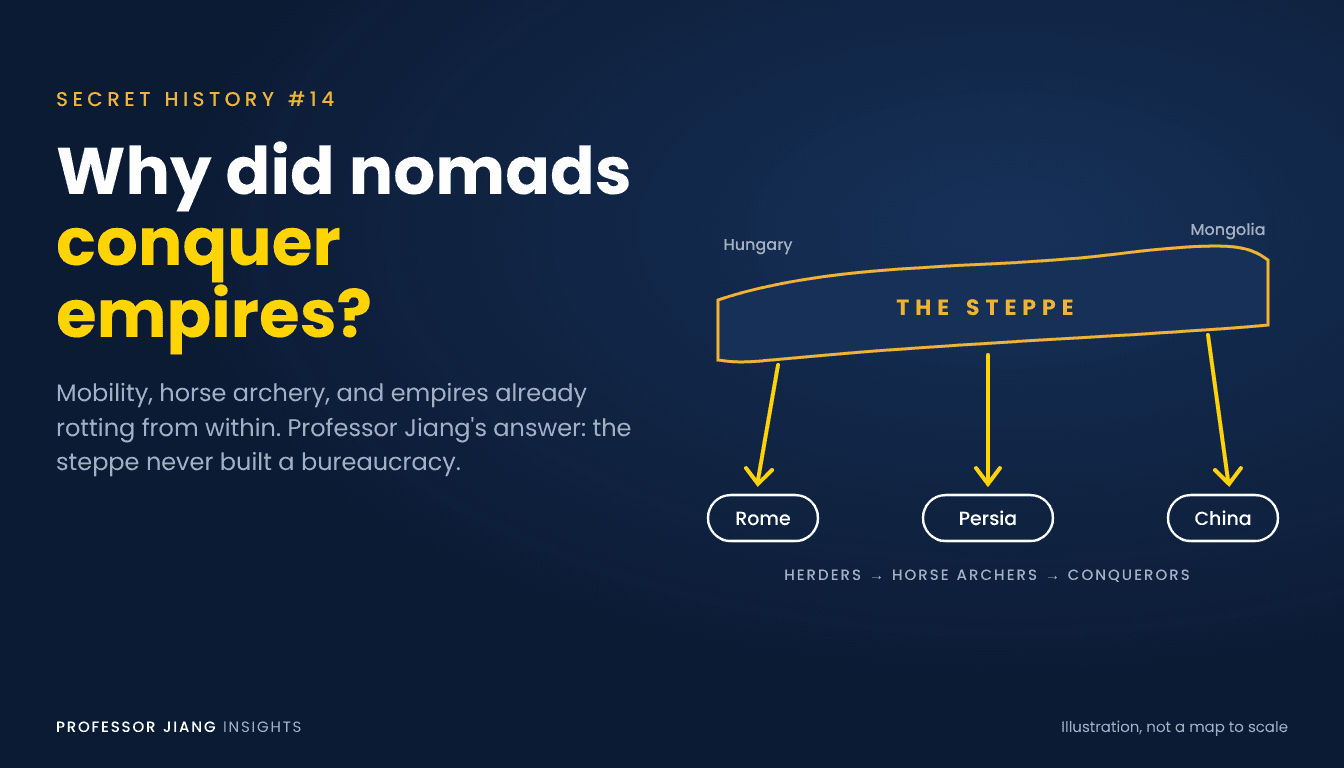
He walks his students through the story (25:39) and stops at Tiamat's death. The sky god killing the mother goddess, he argues, announces new values: struggle, toil and the mastery of nature, fitting a civilization that lived by controlling its rivers (28:02). Marduk's calendar and constellations are bureaucratic tools declared divine; in his words, the myth proclaims "that the bureaucratic world is divinely ordained" (29:04). Humans are made as servants, and Babylon becomes the gods' own city, so nobody should want to leave it (32:16). "This is the mandate of heaven," he concludes (33:02). The herders who lived outside that river bureaucracy, and kept conquering it, are the other half of his story: why did nomads conquer empires?
He also notices that Marduk keeps changing names in the poem, and explains it as different traditions merged into one composite story (31:01). And he dismisses the internet theory that the Anunnaki, the poem's gods, were aliens who created humans, calling it "a really stupid idea" (14:24).
What the record shows
Jiang's reading is closer to mainstream scholarship than most of his claims. Assyriologists widely agree that the poem is political, written to raise Marduk and Babylon above older gods and cities, that its fifty names merge earlier deities, and that its picture of humans as divine laborers reflects a society of temple estates and irrigation work. Two details need correcting: Apsu is killed by Ea, not by a general uprising of the young gods, and the title means "When on high". The ancient-aliens reading comes from Zecharia Sitchin's The 12th Planet (1976) and is rejected by every specialist who has examined it. Where Jiang goes further than the evidence is in reading the whole of civilization through this poem; the same scribes also wrote law codes, contracts and the Epic of Gilgamesh. But as a key to why ancient states told the stories they did, his question, who benefits from this myth, is the right one.
New to Jiang? Start with who Professor Jiang Xueqin is, then his account of how schools serve the state in who invented kindergarten. His forecasts are scored on Professor Jiang's latest predictions.
The Enuma Elish is at the heart of Chapter 11 of our guide to Jiang's Secret History series. Read the first chapter free, and follow new breakdowns on Telegram.