ANALYSIS
This article summarizes Professor Jiang Xueqin's views as we understand them from his recorded lectures. It is independent analysis, not his official statement, and Jiang Insights is not affiliated with him. Errors in summarizing are ours.
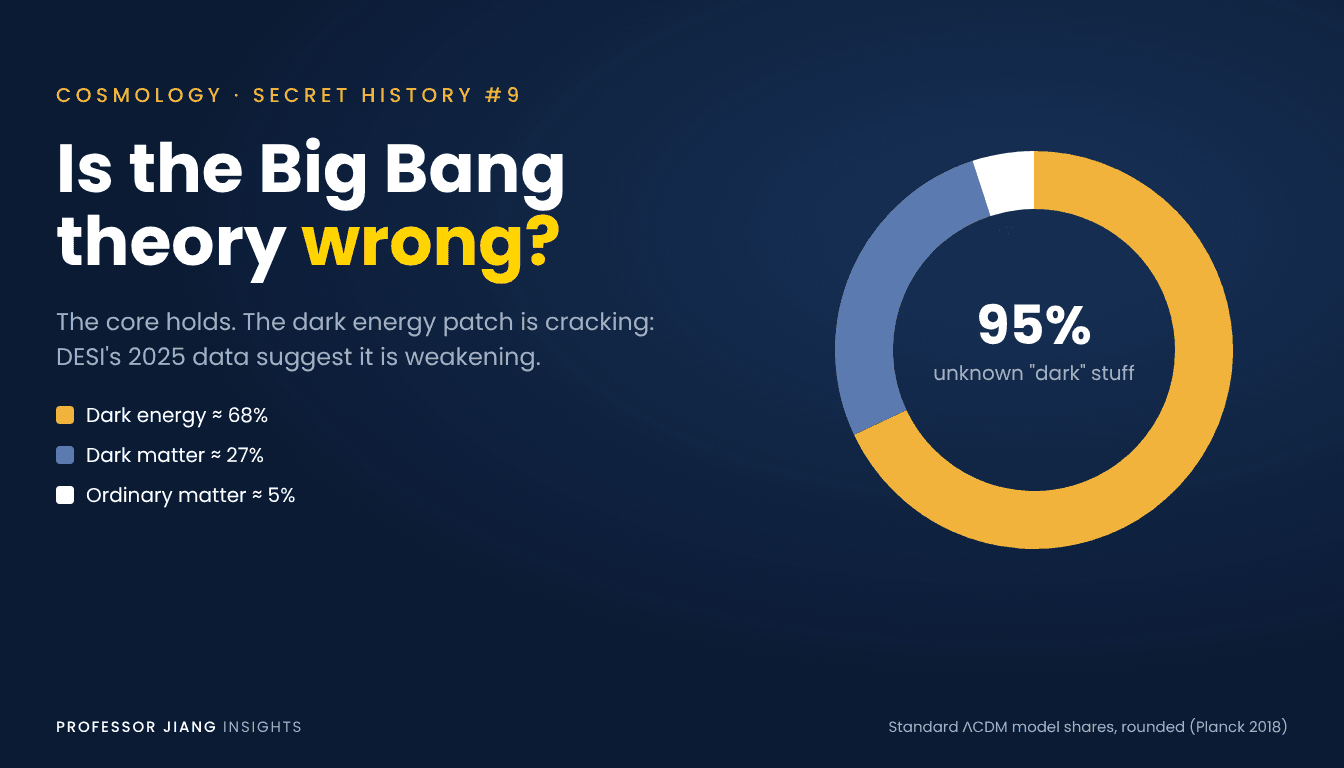
Is the Big Bang theory wrong? Not at its core: the evidence that the universe began hot and dense about 13.8 billion years ago and has been expanding ever since is strong. But the standard model built on it is under real strain. It depends on dark energy nobody understands, and in 2025 new data suggested that dark energy is changing. That is why critics such as Professor Jiang Xueqin argue the whole model is a patch.
What the Big Bang theory actually claims
The Big Bang theory says the universe was once extremely hot and dense and has been expanding and cooling since. It does not describe an explosion into empty space, and it says nothing certain about what came "before". Three findings support it independently. Distant galaxies recede faster the farther away they are (Hubble, 1929). The whole sky glows with leftover microwave radiation from about 380,000 years after the beginning (discovered 1965). And the amounts of hydrogen, helium and lithium in the oldest stars match what a hot early universe would forge.
The theory was first proposed in 1927 by Georges Lemaître, a Belgian physicist who was also a Catholic priest. Its modern version, called Lambda-CDM, adds two ingredients to fit the data: cold dark matter, which holds galaxies together, and dark energy, the "Lambda" that makes expansion accelerate.
Why dark energy is the weak point
In 1998 two teams measuring distant supernovae found that the expansion of the universe is speeding up, a discovery that won the 2011 Nobel Prize in Physics. Something was pushing space apart. Physicists called it dark energy and modeled it with the simplest option, a cosmological constant, the same term Einstein had added to his equations in 1917 and later regretted. In the standard model, ordinary matter is about 5% of the universe, dark matter about 25–27% and dark energy about 68–70%.
"Dark" is an honest word: it means unknown. Quantum theory predicts that empty space should carry energy, but the predicted amount is wrong by a factor of up to 10^120, often called the worst prediction in physics. Many cosmologists privately describe the cosmological constant as a placeholder.
What DESI found in 2025
The Dark Energy Spectroscopic Instrument, mounted on the Mayall Telescope at Kitt Peak in Arizona, is building the largest 3D map of the universe, measuring millions of galaxies and quasars back about 11 billion years. On March 19, 2025, its collaboration released results from its first three years of data. Combined with supernova and microwave-background measurements, the data prefer a dark energy that was stronger in the past and has been weakening, rather than a constant.
The statistical strength depends on which supernova catalogue is used, roughly 3 to 4 sigma, short of the 5-sigma threshold physicists use for a discovery. Some researchers suspect hidden errors in the supernova data. But the preference strengthened between DESI's first release in 2024 and the second, and if it holds, the "constant" in the standard model will have to go. In extreme versions, a weakening dark energy could even reverse expansion into a "Big Crunch" in the far future.
Other cracks: the Hubble tension and JWST
Two other problems sit alongside dark energy. The Hubble tension: nearby measurements of the expansion rate give about 73 kilometres per second per megaparsec, while the early universe, read from the microwave background, implies about 67. Better instruments have made the gap sharper, not smaller. And the James Webb Space Telescope, launched in December 2021, found galaxies that look too bright and massive for their age, within a few hundred million years of the start. Some of those claims shrank on closer analysis; the rest challenge theories of how galaxies form, not the Big Bang itself.
What Professor Jiang says about the Big Bang
In his Secret History lecture "The Theory of Everything", Professor Jiang Xueqin uses dark energy as his first exhibit against the modern scientific story (06:28). If the universe began with one explosion, he argues, it should expand evenly; instead different regions and galaxies move at different speeds. Astronomers patched the gap with dark energy, which he says makes up "at least 80%" of the universe. Then he gives his students a math test: 19,887 plus 25. A student answers 20, and when told it's wrong, adds "plus dark energy" (07:53). "Quite honestly, it's cheating," Jiang says (07:46).
His alternative is "different big bangs" (08:47), and his explanation for why scientists resist it is that the Big Bang has become a paradigm they refuse to abandon (09:26). For Jiang the stakes are larger than physics: he argues that the Big Bang, together with evolution and neuroscience, teaches people that the universe is random and material, and in his view that worldview serves power. That broader argument is covered in our explainer on Professor Jiang's theory of everything.
The Big Bang is the modern creation story; for one of the oldest, and why Jiang says it was written to serve a king, see the Enuma Elish explained.
Is Jiang right?
Partly, and on the most current point. His math-test joke is close to how many physicists talk about the cosmological constant among themselves, and DESI's 2025 data are exactly the kind of anomaly he describes: measurements that don't fit, explained by an ingredient defined only by what it does. He is also right that paradigms resist change; Thomas Kuhn made that the central idea of The Structure of Scientific Revolutions (1962).
Three corrections. His "80–90%" probably merges dark energy and dark matter (together about 95%). Uneven motion of galaxies is expected in the standard model, because gravity pulls galaxies into clusters and filaments; the anomaly is in the expansion history, not in local speeds. And "multiple big bangs" are a real but minority idea, the best-known version being Roger Penrose's conformal cyclic cosmology, with no observational confirmation. The scientists questioning the standard model are not abandoning the Big Bang; they are proposing a dark energy that changes, or new physics in the early universe.
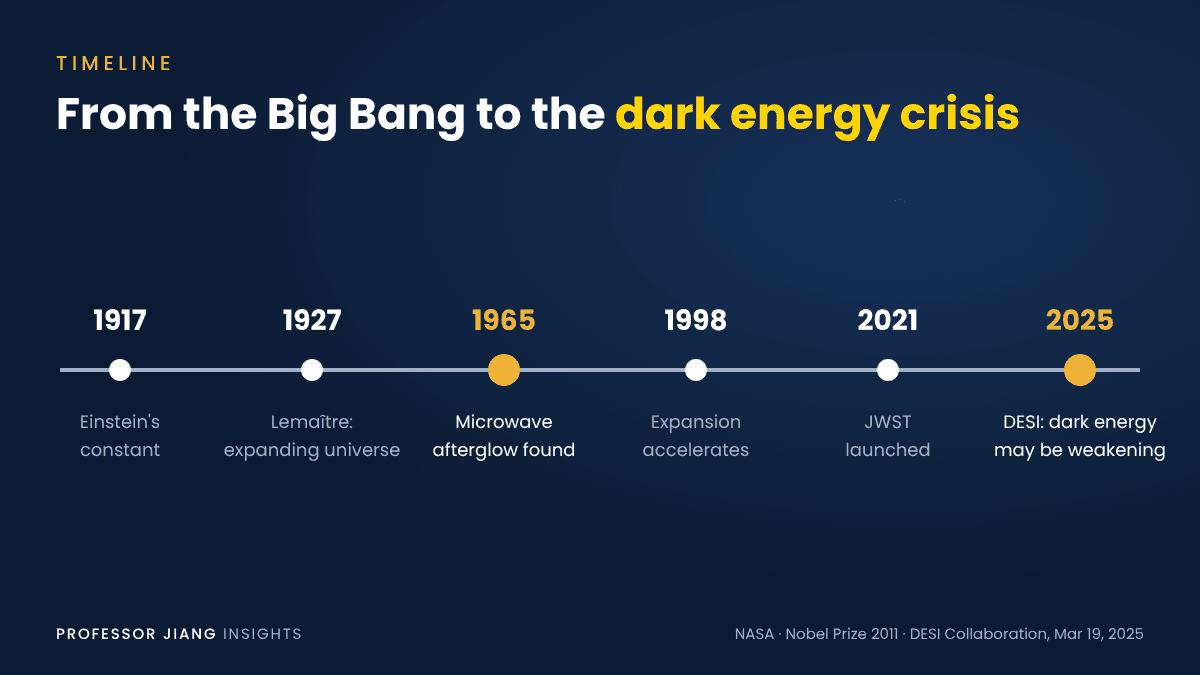
1917
Einstein adds the cosmological constant
Reportedly his "biggest blunder" (Gamow)
1927
Lemaître proposes an expanding universe
The first Big Bang model
1929
Hubble's law
Distant galaxies recede faster
1965
Cosmic microwave background found
The Big Bang's afterglow
1998
Accelerating expansion discovered
Dark energy enters the model
2011
Nobel Prize for accelerating expansion
Perlmutter, Schmidt, Riess
2021
JWST launched
Early galaxies challenge formation models
2025
DESI: dark energy may be weakening
Strongest crack in the standard model
2025
Jiang: dark energy is "cheating"
Secret History #9
What happens next
Answers should come within a few years. DESI is completing its five-year survey; the European Space Agency's Euclid telescope and the Vera C. Rubin Observatory in Chile are mapping billions of galaxies; and new supernova catalogues will test whether the weakening signal survives. If it does, textbooks will change, not by dropping the Big Bang but by admitting that the force driving the universe's expansion has a history of its own. Jiang would call that the paradigm budging. Cosmologists would call it the method working.
New to Jiang? Start with who Professor Jiang Xueqin is, and see how he applies the same skepticism to schooling in who invented kindergarten. His forecasts are scored on Professor Jiang's latest predictions.
Jiang's critique of modern science opens Part III of our guide to his Secret History series. Read the first chapter free, and follow new breakdowns on Telegram.