ANALYSIS
This article summarizes Professor Jiang Xueqin's views as we understand them from his recorded lectures. It is independent analysis, not his official statement, and Jiang Insights is not affiliated with him. Errors in summarizing are ours.
Professor Jiang Xueqin's theory of everything is his attempt to replace the modern scientific story of where we came from with an older one. In Secret History lecture #9 he argues that the Big Bang, evolution and the brain-made mind rest on three shaky assumptions, then proposes a universe made of vibration, minds that receive ideas, and heaven and hell as directions of love and hate. Here is the whole argument, with what holds up.
What is Professor Jiang's theory of everything?
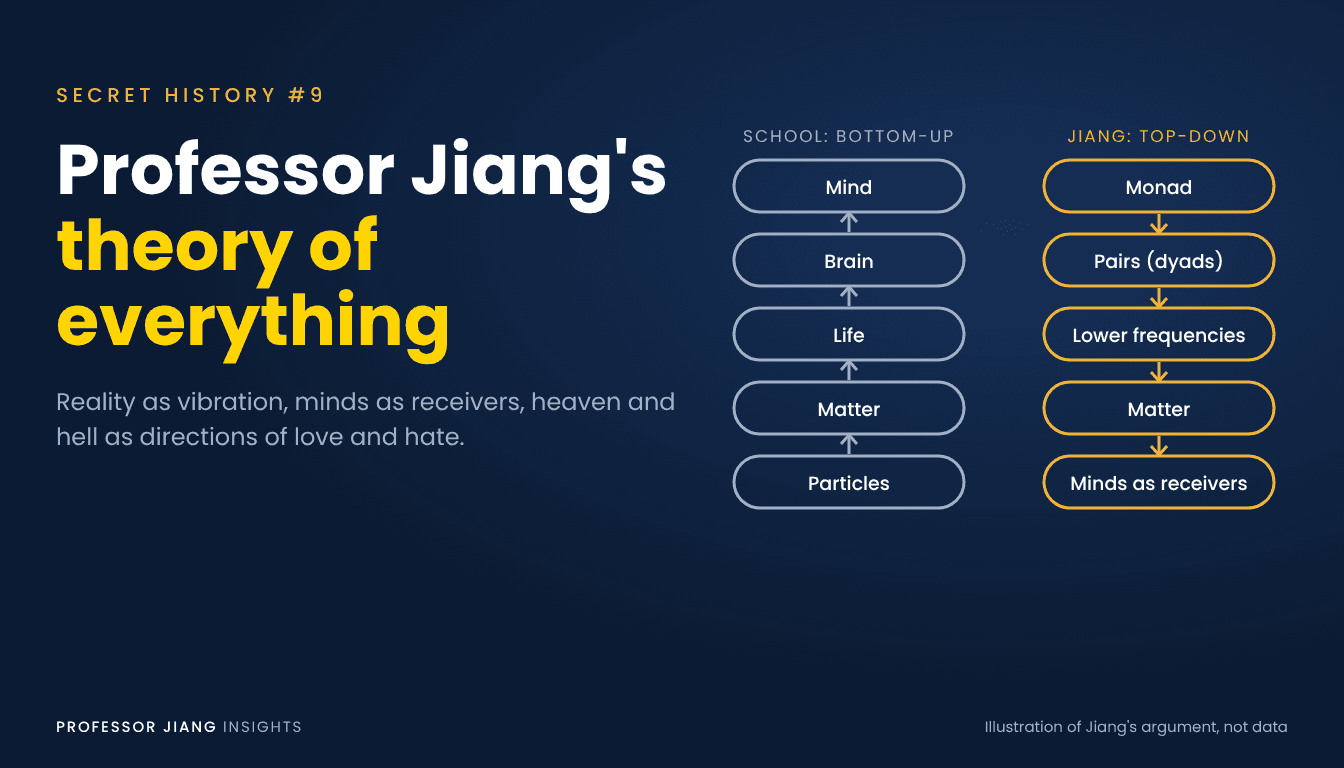
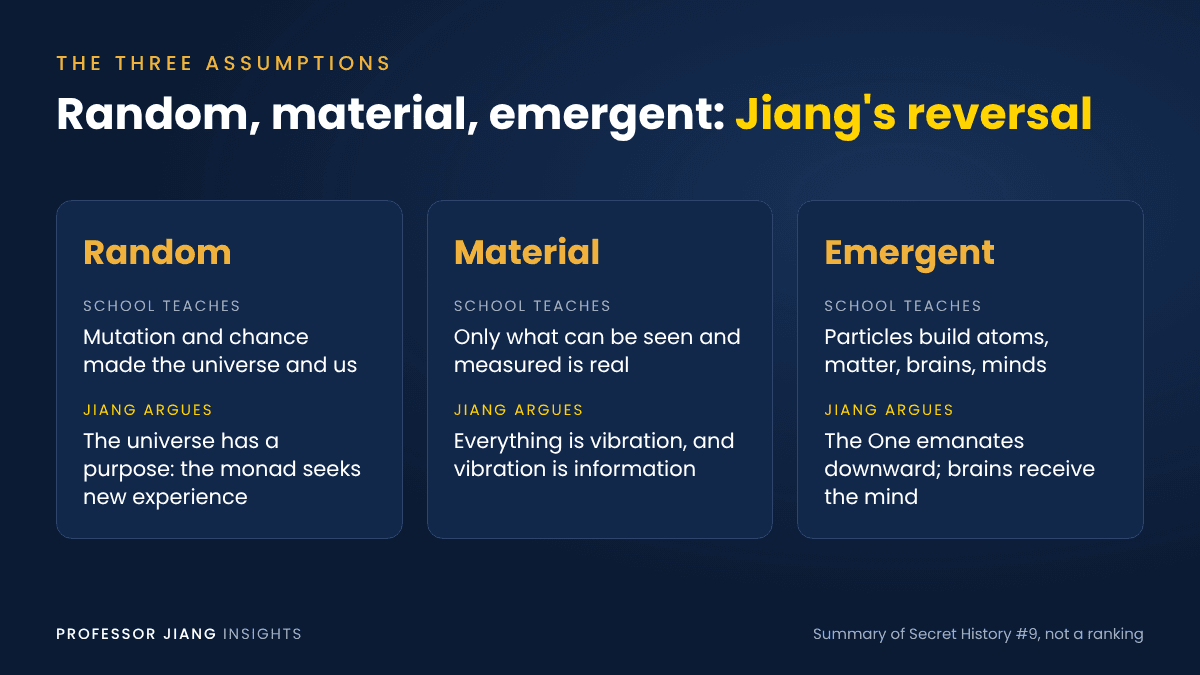
It is the framework the rest of his Secret History series stands on. Jiang opens by summarizing what school teaches (00:26): a ball of energy exploded and made the universe, life evolved by random mutation and the survival of the fittest, and the brain turns experiences into memories, memories into identity, and identities into a worldview. Then he names the three assumptions underneath (04:31). It is random, where people once saw design. It is material: what can't be seen or measured doesn't exist. And it is emergent: particles make atoms, atoms make matter, matter makes chairs and people.
His theory reverses all three. Reality is purposeful, made of vibration and information rather than dead matter, and built from the top down, from a single source outward. He is careful about its status: "I'm not trying to tell you what is true," he tells the class, only to present "new possibilities" (30:42).
Where Jiang says the scientific story breaks
He attacks each link in turn. On the Big Bang (06:28), the universe doesn't expand evenly, so astronomers added dark energy, which he says makes up "at least 80%" of the universe and which nobody can identify. He compares it to a student who gets a sum wrong and fixes it by adding "plus dark energy". "Quite honestly, it's cheating," he says (07:46).
On evolution (09:49), he asks why humans are so different from apes despite nearly identical DNA, where 150,000 years of human history went, and why only one human species exists. On the mind (12:03), he says neuroscience has no model of how we think and doesn't know where memory is stored, and that his three children were born with distinct personalities.
The record is mixed, and more interesting than either side admits. Dark energy really is a label for ignorance, and in March 2025 the DESI survey reported data suggesting it has weakened over time, a genuine crack in the standard model. But the usual split is about 68–70% dark energy and 25–27% dark matter, and the hot, dense early universe is still the best explanation for the cosmic microwave background. Humans and chimpanzees share about 98.8% of alignable DNA, not 99.9%; our species is about 300,000 years old; and several human species, Neanderthals and Denisovans among them, lived alongside ours until about 40,000 years ago. On memory he is half right: the hippocampus is needed to form new memories, but long-term storage is spread across the cortex, and there is still no accepted theory of consciousness.
We test the cosmology part in depth, including the DESI data and the Hubble tension, in is the Big Bang theory wrong?
Ideas are received, not made
The most personal part of the lecture is about creativity (15:55). School teaches that research leads to a hypothesis, then an experiment, then a conclusion. Jiang says real thinking runs backwards: the idea arrives whole, and you build the process afterwards. He has written three novels by lying in bed, walking in the park and writing down whatever comes. "It's not like I am generating these ideas," he says. "It's more like I'm receiving these ideas" (20:57). A student suggests the scientific method is how inspired ideas are presented to others, and he agrees (24:29).
Philosophers call this the difference between the context of discovery and the context of justification, a distinction named by Hans Reichenbach in 1938, and many scientists have described ideas arriving suddenly. One of Jiang's examples doesn't hold: there is no record of James Watson dreaming the double helix as a staircase; the famous scientific dream is August Kekulé's snake, which he said gave him the benzene ring.
The vibration model: monad, free will, love and death
Jiang's evidence for something beyond the brain is near-death experiences, psychedelic visions, meditation and great books such as Dante's (26:06). From Kant he takes the idea that we never see reality directly; from Hegel, a spirit behind everything; from quantum physics, the claim that matter is "just vibrations" in fields (34:42).
The model follows (38:02). Everything is vibration, vibration is information, and the brain is a receiver. We combine that information with experience into memories, which go back into the universe, the way a post becomes part of the internet. In Dante's language, the source of everything, the monad, breathes out layers of being at lower and lower frequencies until they condense into matter (41:03). Why? Because a perfect spirit world cannot suffer or make mistakes, so nothing new can happen there. Humans, with bodies, pain and free will, give the universe new experience (42:17).
Three principles keep it running: free will, love as a spark of the monad that pulls us back to it, and death as a release that lets us review our lives and return wiser (45:03). He illustrates the connection between people with Indra's net of reflecting pearls and Dante's candle mirrored in countless mirrors.
Heaven and hell as directions
What we create with love, Jiang says, returns to the monad. What we create with hate cannot enter a perfect world, so it sinks and forms lower dimensions (45:54). That is hell; the other direction is heaven. Later he adds a twist that drives the rest of the series: heaven is consciousness and spirit, while hell is "mechanical… machines" (50:35).
Jiang traces this inner war of good and evil to the Persian prophet Zarathustra, whom he calls the most influential person who ever lived; see was Zoroastrianism the first monotheistic religion?
The war of perception
How did we forget all this, if every early religion knew it? In Jiang's account, people who chose the lower path gained technology and power, and to rule others they needed them to forget God and fear death (51:39). Science, he argues, served that purpose by teaching that there is no purpose. Transhumanism, the dream of uploading minds, is the last step: to trap us here forever (53:14). He attributes this to secret societies working inside large bureaucracies, and says that "this war, it's not over resources. It's over perception" (01:02:23).
For a worked example of how Jiang thinks the first states rewrote older religion to make hierarchy look sacred, see the Enuma Elish, Babylon's creation epic.
This is the speculative core of the lecture, and Jiang offers no documents for it. Its strongest version is a real argument from the sociology of science: paradigms resist anomalies, and science has served power, from "race science" to the arms race. Against it, the Big Bang was proposed by a Catholic priest, Georges Lemaître, and genetics was founded by a friar, Gregor Mendel. Jiang's own last word matters: God and Satan, he says, are "projections of our imagination" that still help us understand the world (01:06:22).
1781
Kant's Critique of Pure Reason
We see reality only through space and time
1807
Hegel's Phenomenology of Spirit
Geist, the spirit behind history
1927
Lemaître proposes the Big Bang
A Catholic priest and physicist
1935
Schrödinger's cat
Meant as a reductio of quantum weirdness
1961
Wigner's friend
The observer puzzle Jiang cites
1998
Accelerating expansion discovered
Dark energy named; Nobel Prize 2011
2025
DESI hints dark energy is weakening
The standard model under strain
2025
Secret History #9
Jiang's theory of everything
What the record shows
Jiang's three words, random, material, emergent, are a fair summary of the naturalism most schools teach without naming, and his point that these are assumptions rather than findings is sound. His critique of cosmology is closer to the frontier than his numbers suggest, his memory and evolution claims need correcting, and his account of creativity matches what many scientists report. The vibration-monad model draws on real traditions (Neoplatonism, Gnosticism, Huayan Buddhism, Dante) but cannot be tested, and the claim that science is a tool to make people fear death has no evidence behind it. Read as a philosophy of meaning rather than physics, it is coherent, and it is the lens through which the rest of the series makes sense. We examine it chapter by chapter in our guide to the series.
New to Jiang? Start with who Professor Jiang Xueqin is, then his theory of how societies decay in Universe 25, the mouse utopia. His forecasts are scored on Professor Jiang's latest predictions.
The theory of everything is Chapter 9 of our guide to Jiang's Secret History series. Read the first chapter free, and follow new breakdowns on Telegram.