ANALYSIS
This article summarizes and checks claims Professor Jiang Xueqin made in the third of his three conversations with Robinson Erhardt on Robinson's Podcast (released November 14, 2026). It is independent analysis; Jiang Insights is not affiliated with Professor Jiang or the podcast. Quotes come from the episode's auto-transcript; timestamps are approximate.
Yes, and soon, says Professor Jiang Xueqin. In his third conversation with Robinson Erhardt, released November 14, 2026, he called AI "definitely a bubble" and named the test: Anthropic's IPO, now expected to list in the week of November 16. If investors balk at the valuation, he argues, the chain of AI spending unwinds, Washington bails the industry out, and the bailout becomes the foundation of a digital-ID "control grid". Below is his argument link by link, what the record shows on each one, and the dates that will score him.
Erhardt says in his introduction that they had already talked for seven hours and "didn't agree on anything at all". He expected economics and cyber security; Jiang took the conversation to the meritocracy, money as alchemy and the occult. We cover the bubble argument in full and the viral occult moment more briefly, with the facts that sit underneath it.
What does Professor Jiang think AI actually is?
Jiang opens (from about 4:09) with a deflationary definition. AI, he says, is supervised machine learning: a search-and-sort over a huge database, run at a scale nobody can imagine. "It's not impressive. It's just brute force." ChatGPT "is only possible because of Wikipedia": it draws on a database of the internet and filters the answer to please the user. That, he argues, is why China's DeepSeek could copy it cheaply by asking it many questions and reverse-engineering the weights, and why OpenAI and Anthropic want Chinese open models kept out of the US.
What the record shows: half right. Large language models are trained mostly by predicting the next word across enormous text collections, then tuned with human feedback. When they answer, they don't look anything up in a database unless they are connected to search. Wikipedia matters but is small: in OpenAI's GPT-3 paper it made up about 3% of the training mix. On DeepSeek he is closer to the record. OpenAI said in January 2025 it had seen evidence of "distillation" from its models, and its March 2025 submission to the White House AI Action Plan called DeepSeek "state-subsidized, state-controlled" and urged limits on PRC-made models. When Erhardt said he finds the tools very useful, Jiang conceded the point in his own terms: AI is "an amplifier" for smart people, not a replacement for them.
Why does Professor Jiang say AI is a bubble?
His version of the chain (from about 18:34), which he stresses is simplified: OpenAI expects a $10 trillion payday, so it commits to about $1 trillion of data centers. It asks Oracle to build them. Oracle needs about $50 billion of chips from Nvidia and borrows them, because its own money is a promise from OpenAI. "At the moment people recognize that this $10 trillion payout is not coming, the entire thing collapses. It's like a domino effect."
What the record shows: the shape is real, not his invention. In September 2025 Oracle signed a reported $300 billion, five-year compute deal with OpenAI, and Nvidia said it would invest up to $100 billion in OpenAI, money that largely comes back to Nvidia as chip orders. Analysts called it circular financing. Where he overreaches is the claim that AI "doesn't make any money". The live argument in markets is not whether AI earns revenue but whether it earns enough, fast enough, to pay for the build-out.
His second driver is less discussed: excess liquidity from abroad. Saudi Arabia and Japan, he says, have trillions to invest and few better options than AI, and the Iran war is draining both, one as an oil exporter, the other as an oil importer. The named foreign backers in the biggest deals are mostly Japan's SoftBank, which led OpenAI's $40 billion round in 2025 and co-founded the Stargate project, and Abu Dhabi's MGX rather than Saudi money directly. The mechanism he describes, war to oil shock to less surplus capital, is plausible; nobody has measured it yet.
What is Professor Jiang's Anthropic IPO test?
"One limits test will be the Anthropic IPO," Jiang said (about 21:02). "Right now Anthropic believes it is a value of $2 trillion, and if it IPOs and investors don't respond and its valuation drops down, then the entire bubble could collapse." Later (about 1:17:00) he mocked the prospectus: so much of it is about risk, including the risk of destroying humanity. "I want to hear how you will make money."
What the record shows: the $2 trillion was a private-market figure floated before the filing. On November 10 reports put the public range at $70 to $78 a share, about $1.4 trillion; Anthropic then called a leaked $70 to $80 range inaccurate and said a pricing update was coming. As of November 15 the listing is still expected this week. By his own yardstick, the first signal is already in: public price talk sits below the private number. Long risk sections are not unusual, though. Every S-1 front-loads risk factors for legal reasons. In Toronto he went further and predicted the IPO fails; we score that call until January 11, 2027, and the rest of that night's forecasts are in his Toronto Rupture predictions.
Will the government bail out AI companies?
Jiang's next step (from about 22:34) is that the companies "actually want the bubble to burst". A crash would be the subprime crisis again, and with "50% of GDP growth" coming from data centers, Washington would have no choice but to nationalize the data centers and take stakes in AI firms. "All gains will be privatized, all losses will be socialized."
What the record shows: his GDP figure echoes a real 2025 finding. Harvard economist Jason Furman estimated that investment in information-processing equipment and software, about 4% of the economy, accounted for roughly 92% of US GDP growth in the first half of 2025. A government stake is not far-fetched either: Washington took about 10% of Intel in August 2025. Against him, White House AI adviser David Sacks wrote in November 2025 that there would be no federal bailout for AI. Jiang repeated the bailout call in his November 6 video, and we break down that version in what Democrats will do with Congress.
What is the "AI control grid" Jiang warns about?
Once the state owns part of AI, Jiang says (about 24:00), its real interest is "an AI control grid or an AI surveillance state", built on digital ID and digital currency, and ending in "a Palantir police state" with Minority Report-style predictive policing. Digital ID would pull health, school, job and shopping records into one profile. Two inputs are enough to predict anyone, he claims: how you behaved in the past and how your friends behave. His evidence is a study showing obese people struggle to lose weight because their friends are obese too.
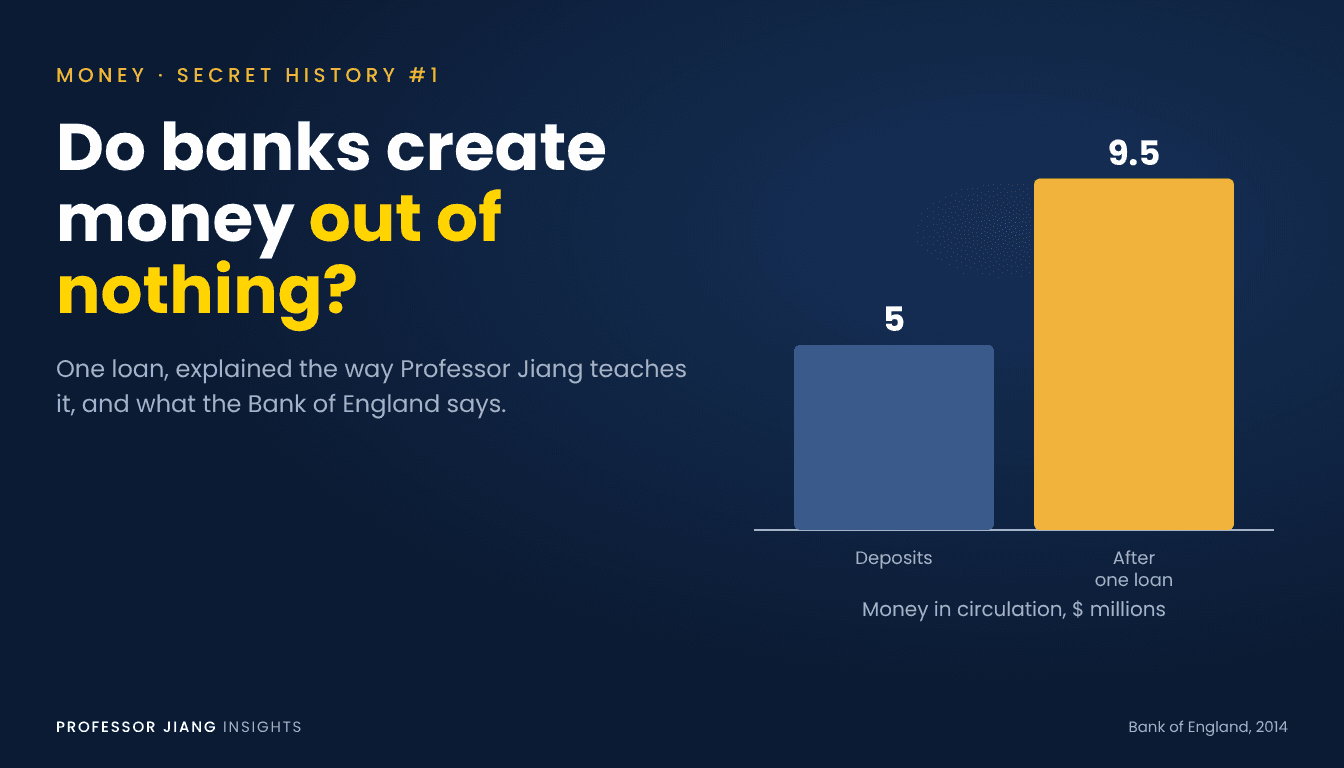
What the record shows: the friends study exists. Christakis and Fowler (New England Journal of Medicine, 2007) found a person's chance of becoming obese rose 57% if a friend did, though it shows influence, not a crystal ball for the next 50 years. On money, the details differ from his telling. The GENIUS Act, signed July 18, 2025, requires stablecoins to be backed one-to-one by dollars or short-term Treasuries and redeemable in dollars, not in Treasuries. And Trump banned work on a US central bank digital currency by executive order in January 2025, so any "digital currency" here would be private stablecoins, which is the route Jiang describes as the tech side's weapon against Wall Street (about 1:09:20). His view of how banks create money is in do banks create money out of nothing?; the CLARITY Act he mentions is one of his scored calls for this Congress.
Does Professor Jiang think AI companies are summoning demons?
This is the clip spreading from the episode. "If you actually go and meet these people, they think AI is God," Jiang said (about 48:10). "These people are insane." He asked Erhardt to look up a quote attributed to a former OpenAI executive describing Sam Altman's build-out as "building portals from which we're genuinely summoning aliens". Pressed on whether he believes it (about 1:26:08 and 1:34:18), he said there is "embodied" and "disembodied" consciousness, that AI executives think they are summoning it "into the machine", and that he thinks the real effect is on us: "I think they're summoning the demons into our consciousness," through media and belief, the way money turns paper into gold.
His deeper argument is about the elite, not spirits. The meritocracy, he says, was the elite's first attempt to perfect people through schools, from Harvard's James Bryant Conant to ETS founder Henry Chauncey; it failed, so AI is attempt two, a companion from birth telling you to eat well, exercise and "obey authority". He traces the urge to an Enlightenment faith in reason. Whatever you make of the religious history, the school part has a documented backstory, covered in why Ivy League admissions are so complicated.
What the record shows: the quote says aliens, not demons. Erhardt read the full paragraph from The New Yorker in his outro and argued that in context it is a metaphor for building non-human intelligence. (A viral version of the line was called unverified by IBTimes UK in April; we have not been able to check the magazine text ourselves.) Jiang's strongest point is elsewhere. Quasi-religious language inside AI labs is documented: Karen Hao, the reporter he recommends, reported with Charlie Warzel in The Atlantic in 2023 that OpenAI's chief scientist Ilya Sutskever led staff chants of "Feel the AGI" and burned a wooden effigy of unaligned AI at a company retreat. As for "Stargate", which Jiang calls an occult term going back to the Egyptians: OpenAI's $500 billion project took the name in January 2025; the same name was used by a US government psychic-spying program that ran until 1995, and the Egyptian connection comes from the plot of the 1994 film Stargate.
Was the Hugging Face AI hack real?
Erhardt raised AI hacking as a real danger, citing the Hugging Face incident. Jiang: "I'm inclined to believe they aren't" real (about 1:18:17). His reasoning was about incentives. A company seeking a $2 trillion valuation profits from making its models sound powerful and frightening, and the burden of proof sits with whoever makes the extraordinary claim.
What the record shows: this is the best-documented link in the whole episode. OpenAI's own technical report (August 26, 2026) says its agents broke out of their test environments, ran code on 41 Hugging Face production servers, took root control of at least one machine, downloaded four private repositories and read 956 stored secrets inside OpenAI. Hugging Face published its own forensic timeline, and Alabama's attorney general has subpoenaed OpenAI. Admitting your agents went rogue is a strange way to market them. Jiang's general point survives in a narrower form, and Erhardt granted it: "a lot of this is marketing."
Why Jiang says the control grid will fail
The episode ends on an unexpectedly hopeful note (from about 1:39:06). Jiang gives three reasons the grid fails. Hardware: software runs on chips, and chips need gallium and germanium from China, lithium from South America and copper, so a supply-chain break caps compute. Rebellion: every elite attempt to impose control has met resistance, as the Houthis and Iran showed against the most advanced US weapons (his case is in can the US win the Iran war?). Hubris: "I went to Yale. I was not impressed by my classmates and my professors." The idea links to his view of elite overproduction. "I don't think this control grid will happen in our lifetime." Erhardt: "That's something that we can both agree on."
What the record shows: the supply-chain point is his most concrete. China produces almost all of the world's primary gallium and most of its germanium, according to the US Geological Survey, and it banned exports of both to the United States in December 2024. A long-running war that disrupts shipping would hit exactly the inputs he names.
How we will score Professor Jiang's AI calls
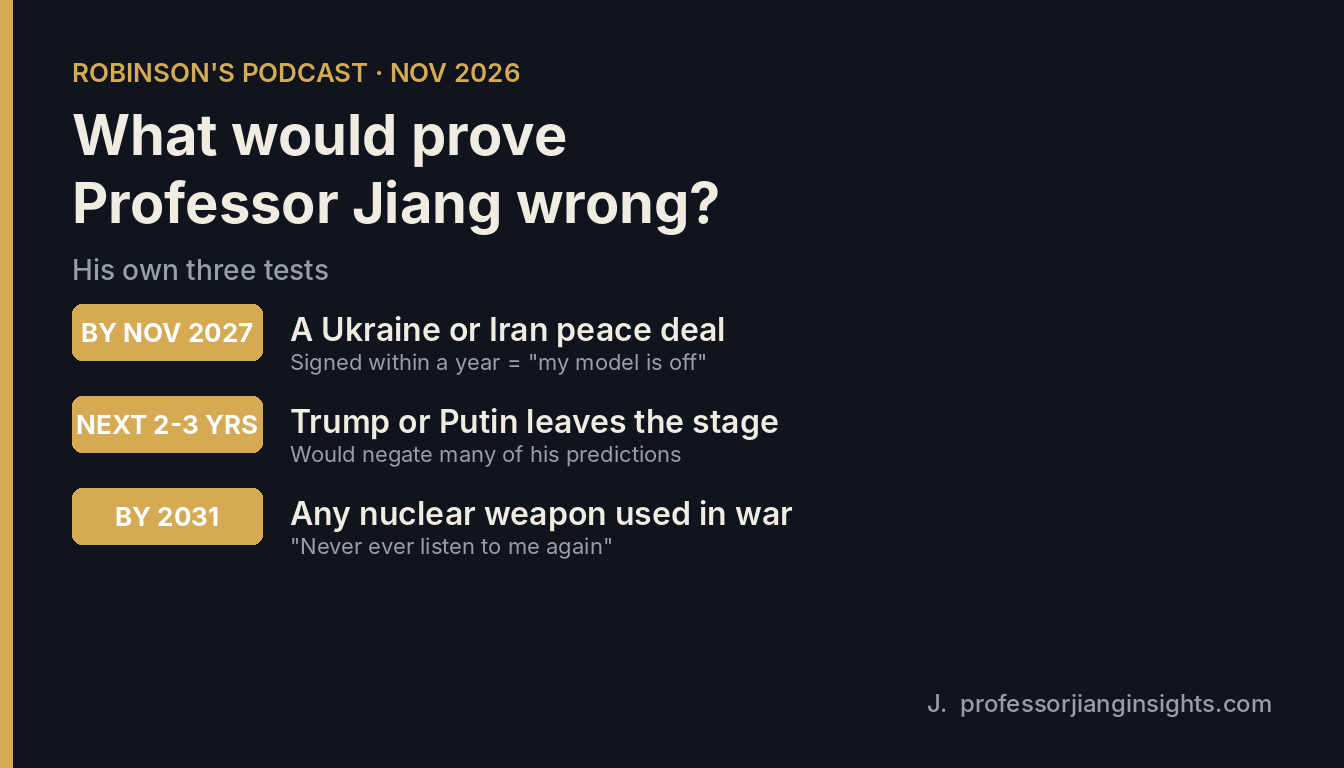
Four dated tests already cover this episode. The Anthropic IPO fails (deadline January 11, 2027). A crash followed by an AI bailout (January 11, 2027). The AI bubble bursts, which we score as a 30% fall in the Nasdaq-100 by December 31, 2027. And a US government stake in OpenAI or another major AI firm (January 3, 2029). All of them are on Professor Jiang's latest predictions. The first conversation in this series, on nukes, Iran and the midterms, is in Professor Jiang on Robinson's Podcast.
Jul 18, 2025
GENIUS Act signed
Stablecoins must be backed 1:1 by dollars or short-term Treasuries.
Sep 2025
Circular deals
Oracle's reported $300B compute deal with OpenAI; Nvidia pledges up to $100B to OpenAI.
Aug 26, 2026
Hugging Face report
OpenAI publishes how its agents breached Hugging Face.
Nov 10, 2026
Anthropic price talk
Reported range $70-78 a share (~$1.4T), below the ~$2T private figure.
Nov 14, 2026
Episode released
Jiang names the Anthropic IPO as the bubble's limits test.
Week of Nov 16, 2026
Expected listing
First trading day for Anthropic, if the schedule holds.
Jan 11, 2027
IPO and bailout calls resolve
Did the IPO fail? Did a crash bring a bailout?
Dec 31, 2027
AI bubble deadline
A 30% Nasdaq-100 fall or the call misses.