CAUTION
Independent analysis of Professor Jiang Xueqin's public lecture (Secret History #23). Not affiliated with Professor Jiang. Quotes are short and linked to the source; analysis is ours. We discuss history, not anyone's faith.
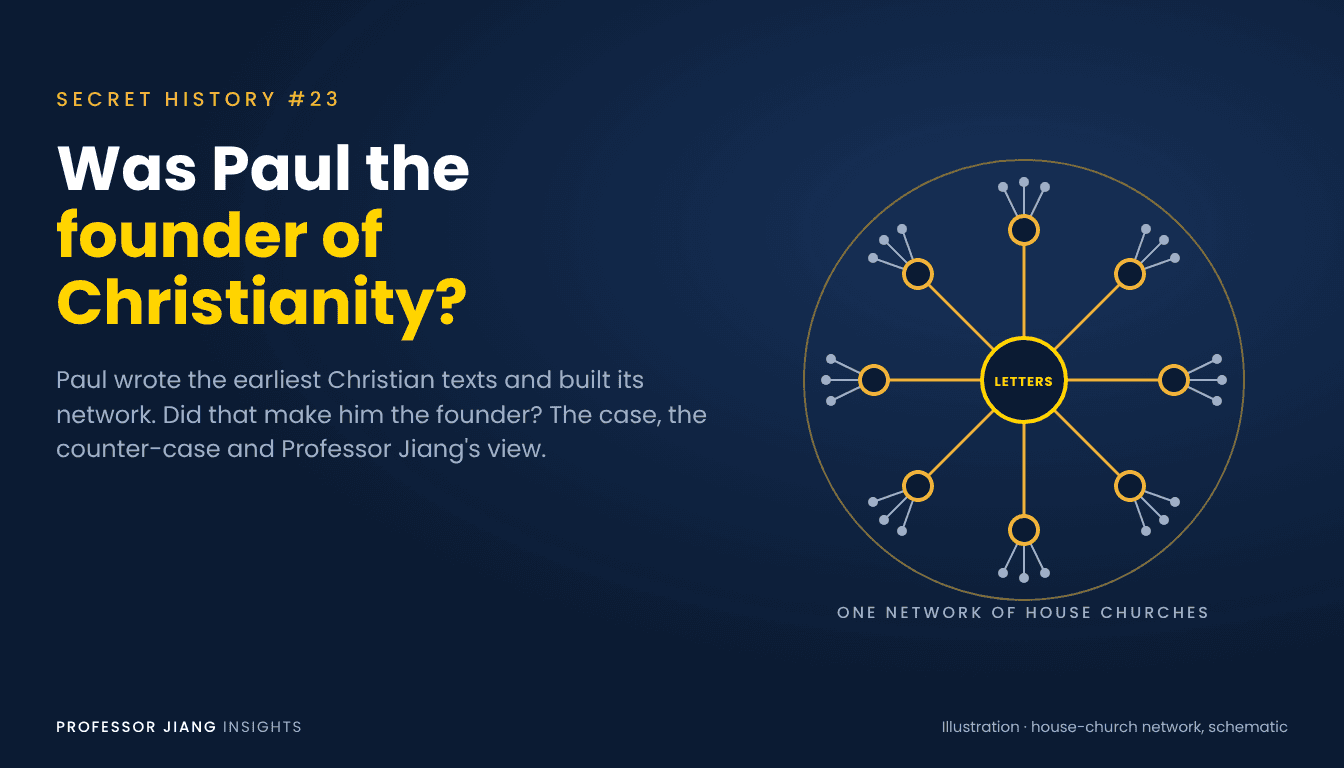
Was Paul the founder of Christianity? Not in the sense of inventing it: his own letters show that people were already worshipping the risen Jesus before Paul joined them. But Paul did more than anyone else to turn a Jewish movement into a religion for the whole Roman world. He wrote its earliest surviving texts, defined faith in Christ as the path to salvation, opened it to non-Jews and built a network of churches across the empire. Whether that makes him a "founder" depends on what you think Jesus started.
The case for Paul as founder
The argument is old. In the 1800s the German scholar Ferdinand Christian Baur and the Tübingen school saw early Christianity as a conflict between a Jewish party around Peter and James and a universal party around Paul, which won. In the twentieth century Hyam Maccoby (The Mythmaker, 1986) and Gerd Lüdemann (Paul: The Founder of Christianity, 2002) pushed it further.
Their evidence is strong on its face. Thirteen of the New Testament's 27 books carry Paul's name, seven of them accepted by nearly all scholars as his. His letters, from about 50 to 60 CE, are older than any gospel. Jesus, in the first three gospels, preaches the coming Kingdom of God to Jews; Paul preaches Jesus himself, crucified and risen, to everyone. And Paul rarely quotes Jesus's teaching.
The case against
The strongest objection comes from Paul. He admits he "persecuted the church of God" before joining it (Galatians 1:13), so the movement, and its devotion to Jesus, existed without him. He passes on a creed he "received" from earlier believers: Christ died for our sins, was buried, was raised, appeared to Peter and to James (1 Corinthians 15:3–7). Larry Hurtado (Lord Jesus Christ, 2003) showed how early that devotion was. Bart Ehrman and N. T. Wright, from very different positions, both reject the founder label.
Paul also quotes Jesus more than critics allow: the Last Supper words (1 Corinthians 11:23–25), the ban on divorce (7:10). And his signature phrase "circumcision of the heart" comes from Deuteronomy and Jeremiah, not from Greek philosophy.
Some of the ideas Paul built on, the resurrection of the dead and a final judgment, are older still: many historians trace them to Persian contact after 539 BC; see was Zoroastrianism the first monotheistic religion?
c. 30–33 CE
Crucifixion of Jesus
Followers report resurrection appearances
c. 33–36 CE
Paul's conversion
After persecuting the movement
c. 48–49 CE
Jerusalem meeting
Non-Jewish converts need not be circumcised
c. 50 CE
1 Thessalonians
Earliest surviving Christian text
c. 57 CE
Letter to the Romans
Faith in Christ, Jew and Gentile alike
c. 62–64 CE
James killed; Paul dies in Rome
Traditional dating of Paul's execution under Nero
c. 70–100 CE
Gospels written
After Paul's letters
What Paul actually changed
If Paul did not invent faith in Jesus, he did decide who could share it. The first followers were Jews who kept the Law. Paul insisted that non-Jews could join without circumcision or the food laws, and after a sharp clash with Peter and James (Galatians 2; Acts 15) his view prevailed. That one decision made Christianity a world religion instead of a Jewish sect. He also gave it a theology for that world: Jew and Greek, slave and free, saved by faith rather than by the Law (Romans 3; Galatians 3:28).
Christianity took about three centuries to reach roughly 6 million believers. Six centuries after Paul, Arab armies took Syria, Egypt and Persia in about 20 years, though conversion there was far slower; we compare the two in why did Islam spread so fast?
What Professor Jiang says about Paul
In Secret History #23, Jiang takes the founder thesis further than most scholars. "Christianity is a religion about Jesus, but not by Jesus. It's by Paul" (16:26). In his reading, Jesus taught that a divine spark lives in each person; Paul pulled "the greatest trick ever" by moving faith from Jesus's words to his person: believe in Jesus and you'll be saved (05:21).
His most original point is structural. Paul, he argues, modeled the church on the Roman household, the paterfamilias system of a patriarch, his sons, his slaves and his freed clients, which made it easy for masters to convert with their whole households. "Jesus was talking to slaves but Paul was talking to patriarchs" (13:51). He compares Paul to Ray Kroc, who built McDonald's by selling franchises rather than burgers: "Jesus is a prophet, but Paul is a business person" (19:13).
Jiang makes a similar argument about a far older religion: Babylon's creation epic, which he reads as making toil and hierarchy look divinely ordained. See the Enuma Elish explained.
What the record shows
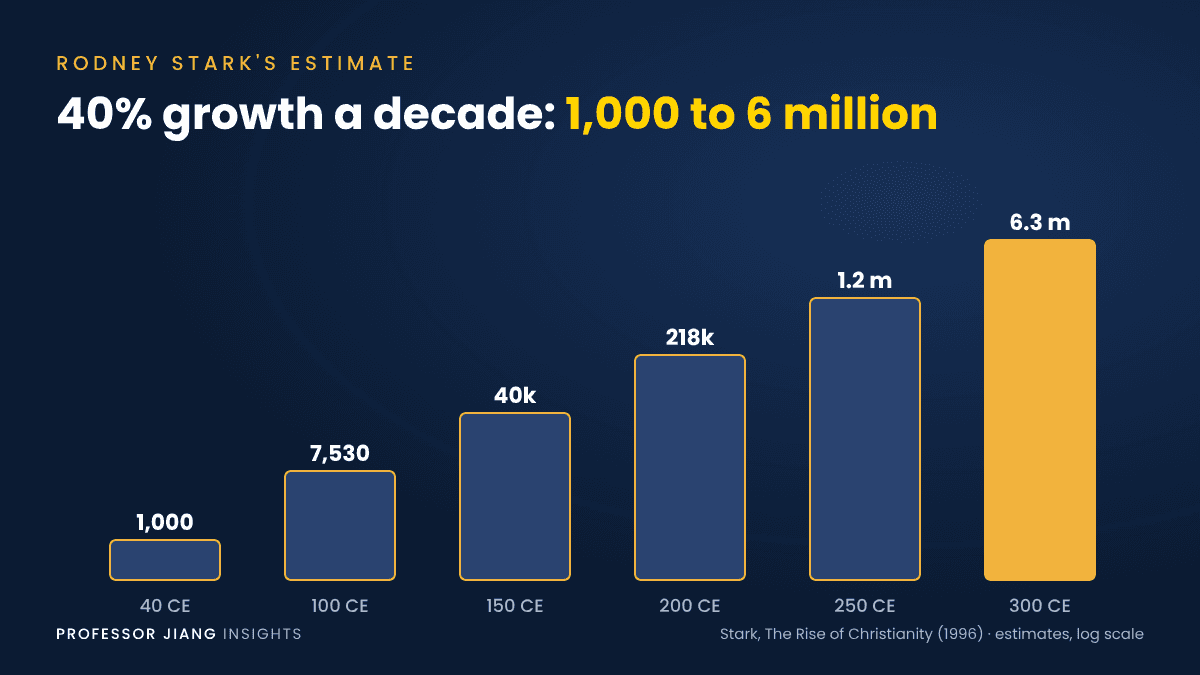
The household part of Jiang's argument has real support. Wayne Meeks's The First Urban Christians (1983) found that Paul's churches met in the homes of better-off patrons and mixed slaves with householders, and Acts describes whole households baptized together. Rodney Stark estimated steady growth of about 40% per decade, from roughly 1,000 believers in 40 CE to about 6 million by 300, the kind of growth that household conversion makes plausible.
Other parts need correcting. Paul was no wealthy executive: he worked as a tentmaker and thanked congregations for gifts. He named women as church leaders, including Phoebe and Junia (Romans 16). And the idea that Paul was a Roman agent appears in no ancient source. The fairest verdict is the one many historians reach: Jesus started a movement; Paul, more than anyone, decided what it would become.
Who wrote scripture, and why, is a question that goes back to the Bible's first pages; we weigh the theory that the oldest layer of Genesis was written by a woman in was Genesis written by a woman?
More on Jiang's history lectures: Universe 25 and elite overproduction and who invented kindergarten. For his forecasts, see Professor Jiang's latest predictions.
Our guide to his Secret History series, How Power Works, is out. Read the first chapter free. New analyses also go out on Telegram.