CAUTION
Independent analysis of Professor Jiang Xueqin's public lecture (Secret History #22). Not affiliated with Professor Jiang. Quotes are short and linked to the source; analysis is ours. We discuss history, not anyone's faith.
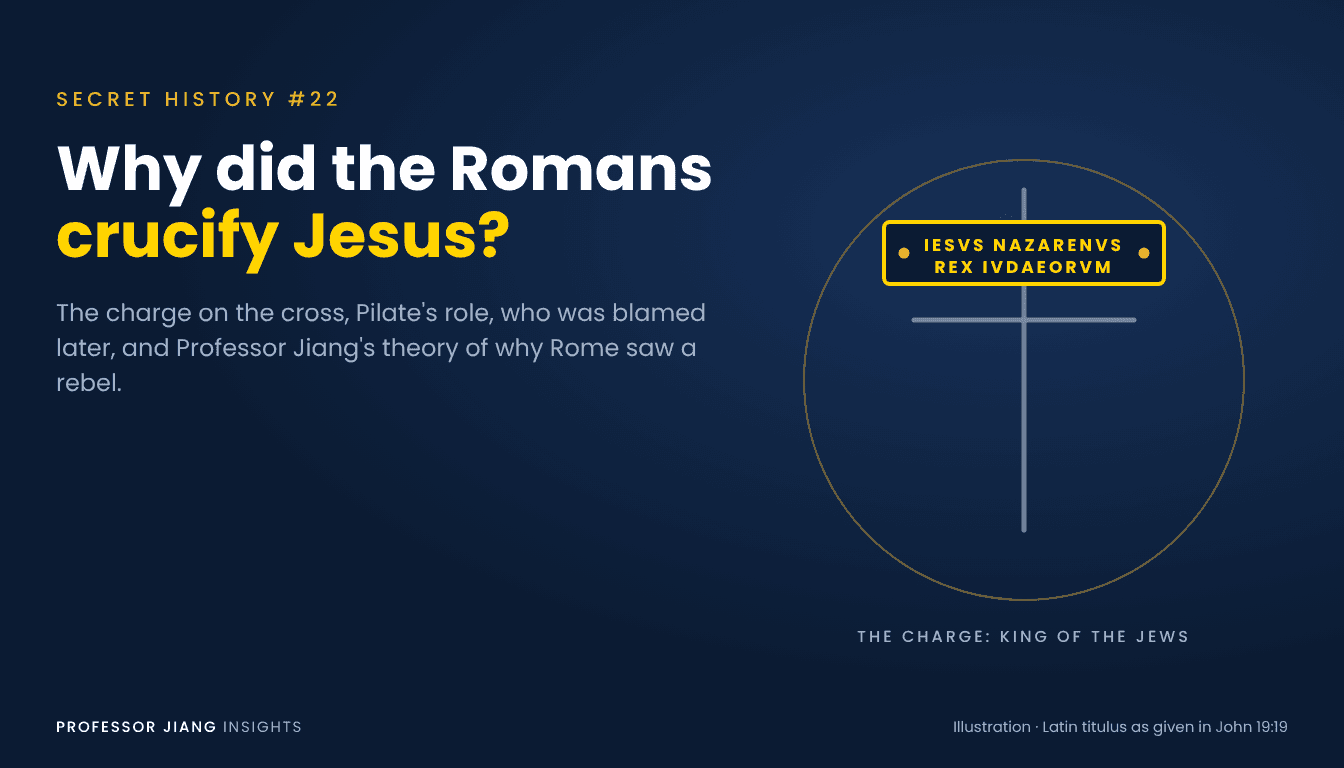
The Romans crucified Jesus because, to Rome, he was a rebel. Crucifixion was the empire's punishment for runaway slaves, bandits and anyone who challenged its rule, and the charge posted on his cross, "King of the Jews", was a charge of sedition. The decision belonged to the Roman governor, Pontius Pilate. What historians still debate is how the temple leadership in Jerusalem was involved, and why the gospels tell the story the way they do.
Who had the power to crucify?
Only Rome. Judea was a Roman province governed by a prefect, Pontius Pilate (26–36 CE), whose name survives on a stone found at Caesarea in 1961. The Roman historian Tacitus, no friend of Christians, wrote that Christ "suffered the extreme penalty" under Pilate. Jewish courts could punish religious offenses, but a cross meant Roman justice.
Rome used crucifixion as theater. It was slow, public and humiliating, reserved for people Rome wanted to make an example of. After the slave revolt of Spartacus, some 6,000 captives were crucified along the road from Capua to Rome. The two men crucified beside Jesus are called lēstai in Greek, a word that covers bandits and insurgents.
Why was Jesus seen as a rebel?
Three things made him dangerous in Roman eyes. He arrived in Jerusalem at Passover, when the city overflowed with pilgrims celebrating liberation from Egypt and the garrison was on alert. He caused a disturbance in the Temple, overturning the tables of the money-changers. And his followers spoke of a coming Kingdom of God. To a Roman official, a popular preacher from Galilee announcing a new kingdom was a would-be king, and the title on the cross says exactly that.
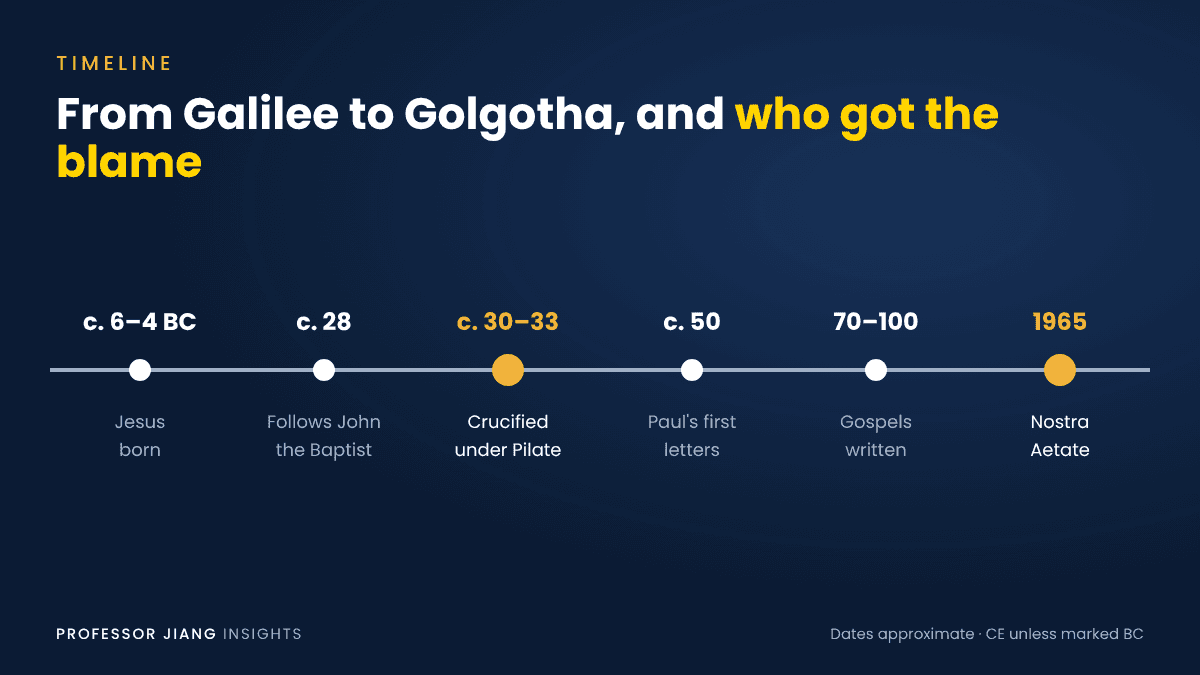
c. 6–4 BCE
Jesus born
Before Herod's death in 4 BCE
c. 28 CE
Joins John the Baptist
An apocalyptic preacher, later executed by Herod Antipas
c. 30–33 CE
Passover in Jerusalem
Temple disturbance; arrest; crucifixion under Pilate
c. 50 CE
Paul's first letters
The earliest Christian writings
c. 70–100 CE
The four gospels written
After Rome destroys the Temple in 70
1965
Nostra Aetate
Catholic Church rejects collective Jewish guilt
Did the temple priests hand him over?
The gospels say so, and the claim is not implausible. The high priest Caiaphas held office from 18 to 36 CE, an unusually long run, which suggests he worked smoothly with Rome. The Jewish historian Josephus records a close parallel about 30 years later: around 62 CE, Jerusalem's leaders seized a prophet who was predicting the Temple's fall, also named Jesus (son of Ananias), and delivered him to the Roman governor, who had him flogged.
Most historians, including E. P. Sanders and Paula Fredriksen, reconstruct it this way: the priestly leadership feared a Passover riot, and Pilate acted. Where they differ from the gospels is in Pilate's character. The gospels show him as reluctant, washing his hands while the crowd shouts for blood. Other sources describe a hard governor who was eventually recalled for brutality.
Why do the gospels blame the priests?
The gospels were written between about 70 and 100 CE, after Rome had crushed the Jewish revolt and destroyed the Temple. Christians were a small, suspect sect inside the empire. Many scholars, from S. G. F. Brandon to John Dominic Crossan in Who Killed Jesus? (1995), argue that the writers had reasons to present Rome's governor as fair and the Jerusalem leadership as guilty.
Scholars ask the same question of the Hebrew Bible's oldest stories, which Jiang reads as political in origin but literary in execution; see was Genesis written by a woman?
The cost of that tilt was enormous. One line in Matthew (27:25) was used for centuries to accuse Jews of deicide, and it fed persecution across Europe. The Second Vatican Council formally rejected the charge of collective guilt in 1965.
What Professor Jiang says about the crucifixion
In Secret History #22, Jiang lays out what he calls the few facts scholars agree on: born around 4 BCE, a student of John the Baptist, crucified by Rome, succeeded by his brother James (04:39). Crucifixion was for thieves and rebels, so "Jesus… was probably a rebel or the Romans considered him a rebel" (07:46).
His explanation goes further. Jiang reads Jesus through the Gospel of Thomas as a poet-prophet who taught that a divine spark lives in every person and that the world of money and power is a "corpse". In an empire built on slavery, that message was explosive: it told slaves they were worth more than their masters. Rome killed him, Jiang argues, because he inverted the order, "slaves at the top, Romans at the bottom" (28:43).
Jiang's argument that empires bend religion to their needs starts with Babylon, whose creation epic made humans servants of the gods; see the Enuma Elish explained.
He also doubts the gospel account of the priests' role, arguing that Jewish factions argued constantly without handing each other to Rome, and that the story served to excuse the empire (14:13).
What happened after the cross is the other half of his argument: Jiang says the church that grew up in Jesus's name was built by Paul, and we weigh that claim in was Paul the founder of Christianity?
Jiang carries the same theme of dissident Christians and Jews into the seventh century, arguing that Muhammad won them over with a promise of religious tolerance; we weigh that in why did Islam spread so fast?
What the record shows
Jiang's core conclusion matches the mainstream: Rome crucified Jesus as a political threat, and the gospels softened Rome's role. Two of his supporting arguments need adjusting. Jerusalem's leaders did, at least once, hand a Jewish prophet to Rome (the Josephus case above). And James the Just, who lived on in Jerusalem, was eventually killed in 62 CE on the orders of a high priest, though other citizens protested and the high priest was removed. The picture is of a divided leadership, not a united front either way.
For more Jiang analysis, see our article on Universe 25 and elite overproduction and who Professor Jiang Xueqin is. For his forecasts, see Professor Jiang's latest predictions.
Our guide to his Secret History series, How Power Works, is out. Read the first chapter free. New analyses also go out on Telegram.